
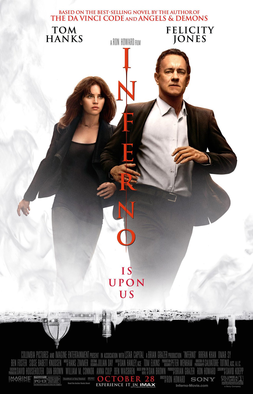
Behind the film
- Year
- 2016
- Director
- Ron Howard
- Writers
- David Koepp
- Genres
- Thriller, Drama, Crime, Mystery
- Production
- Sony Pictures
- Country
- United States
- Cast
- Tom Hanks, Felicity Jones, Sidse Babett Knudsen, Irrfan Khan, Omar Sy, Ben Foster, Ana Ularu
About the film
Contains story spoilers.
Robert Langdon wakes in a Florence hospital with amnesia and escapes with Dr. Sienna Brooks after an assassin attacks. They follow a trail built from Dante imagery and discover that Bertrand Zobrist created a biological weapon intended to address population growth. Langdon and Brooks flee pursuing agents, interpreting clues across Florence and Venice while Langdon gradually uncovers his own involvement. After he identifies Istanbul as the destination, Brooks reveals that she was Zobrist’s lover and intends to release the weapon. Langdon is recaptured, then rescued by Harry Sims, who reveals that Langdon’s amnesia and hospital scenario were staged through drugs. The group identifies the weapon in Istanbul’s Basilica Cistern. Brooks triggers an underwater blast, but the weapon has been secured inside containment. The threat is stopped; Langdon later returns the Dante death mask to Florence. The film’s pathogen premise is fictional, not public-health science.
Ron Howard structures Inferno around disorientation. Langdon begins without reliable access to his own recent past, so the audience is asked to interpret clues alongside a protagonist who cannot be sure which memories or allies deserve confidence. Tom Hanks gives the character a familiar intellectual composure, but the amnesia premise disrupts it. He can recognise art, symbols and historical patterns while remaining uncertain about his own role in the immediate crisis. That mismatch creates a useful thriller engine: expertise is still valuable, but it no longer guarantees security. The film keeps asking whether knowledge can guide someone when the self doing the interpreting is incomplete.
Felicity Jones’s Sienna Brooks first appears as a practical partner whose medical knowledge and quick decisions help Langdon navigate danger. Their dynamic matters because the film’s puzzle-solving is shared work, not simply a lecturer explaining art to a passive companion. Jones gives Sienna intelligence and alertness, making her presence credible within the chase. The eventual redefinition of her motives changes how earlier scenes read, but it also complicates the film’s trust theme. A person can provide real help while pursuing a different goal, and intimacy can make that possibility more difficult to recognise rather than less.
The European locations are not decorative stops on a travel itinerary. Florence, Venice and Istanbul supply a chain of physical spaces whose histories and artworks become part of the film’s clue system. Langdon’s knowledge gives these places narrative function, while the camera and editing turn them into a fast-moving map. This approach makes cultural memory feel active: images from the past can shape the choices people make in the present. It also gives the thriller a visual vocabulary distinct from an ordinary pursuit film. A building, sculpture or underground chamber can operate as an archive that the characters must read while moving through it.
The film’s relationship with Dante is playful in the sense that it treats literary art as a maze, but the plot also insists that interpretation has consequences. Langdon’s ability to connect images and references makes him useful, yet a solved clue does not automatically produce a morally sound decision. The villain’s plan is framed in intellectual language and grand design, which creates a contrast between abstract arguments about humanity and the lives of particular people who would be affected. That contrast is where the story’s ethical tension sits. Symbols can organise a pursuit, but they cannot make an extreme policy humane just because it has been dressed as a philosophical necessity.
The pathogen is a fictional thriller device. Its scale and imagined effects belong to the movie’s dramatic construction, not to medical evidence or population science. That boundary matters because the story uses the language of biological threat to create urgency, while its most grounded questions concern who gets to make decisions for everyone else. Zobrist’s reasoning claims that catastrophe can be justified by an abstract calculation. The film’s action pushes back by centring the people who must prevent that calculation from becoming reality. It is a familiar suspense conflict, but it also reveals how easily supposed rationality can conceal coercion.
Howard’s style favours momentum: transitions, close pursuit and rapidly decoded images keep the story moving from one place to the next. That pace mirrors Langdon’s limited time and incomplete understanding, though it can make the architecture of the mystery feel deliberately crowded. The audience is not invited to settle into prolonged contemplation of any single object; it has to notice details quickly and hold several explanations in mind at once. This is an appropriate formal choice for a thriller about memory and unreliable guidance. The movie’s visual richness is constantly under pressure from the clock, creating a productive tension between looking carefully and moving fast.
Inferno belongs to a series in which Robert Langdon’s specialist knowledge repeatedly becomes a tool for navigating danger. Here, the tool is less secure because his own memory has been manipulated. The film uses that premise to question how a person distinguishes expertise from trust: Langdon can decode a clue, but he cannot rely on every account of why he is there. That separation gives the story a human dimension beyond puzzles. It is about identity as something partly dependent on what others tell us, and about the work required to test those stories when stakes are high. The final containment of the threat resolves the chase, while the larger unease about manipulation lingers.