
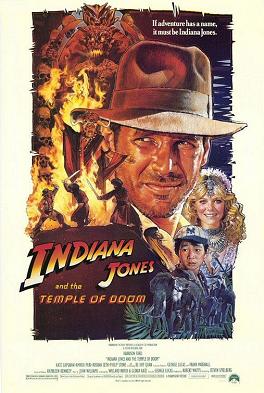
Behind the film
- Year
- 1984
- Director
- Steven Spielberg
- Writers
- Willard Huyck, Gloria Katz, George Lucas
- Runtime
- 1h 58m
- Genres
- Action, Adventure, Treasure hunt
- Production
- Lucasfilm, Paramount Pictures
- Country
- United States
- Cast
- Harrison Ford, Kate Capshaw, Ke Huy Quan, Amrish Puri, Roshan Seth, Philip Stone, Roy Chiao
About the film
Contains story spoilers.
Indiana Jones and the Temple of Doom sends its archaeologist into danger before Raiders of the Lost Ark takes place, opening in Shanghai in 1935. A nightclub performance becomes the cover for a negotiation with gangster Lao Che, who poisons Indy during an exchange of artifacts and payment. The scramble for the antidote draws singer Willie Scott into an escape she never intended to make. Short Round, a boy who already works alongside Indy, drives them away from the club, and the three board an aircraft whose ownership gives Lao Che another chance to kill them. When its crew abandons it, an inflatable raft becomes their improbable way down from the sky. The film announces its adventure rules immediately: elegant surroundings can turn hostile, equipment rarely serves just one purpose, and getting out of one trap can deposit the travelers in another.
Their arrival in an Indian village changes the kind of problem Indy is facing. The villagers have lost a sacred stone and their children, and they believe the disappearances are connected with Pankot Palace. The stone’s absence is associated with the land’s decline, linking a stolen object to a community’s ability to survive. Indy recognizes a possible Sankara stone, but the request is not simply an invitation to acquire something valuable. Returning it and finding the children would repair losses that the people asking for help cannot overcome themselves. Willie is uncomfortable with the journey’s food, animals and lack of luxury, while Short Round treats Indy as someone whose judgment he can trust. Those different responses keep the group argumentative even as the village gives its travels a shared purpose.
Pankot initially appears to contradict the villagers’ fears. The travelers are welcomed into a palace governed by a young maharaja, and official conversation dismisses Indy’s questions about what might be happening nearby. The banquet turns hospitality into a grotesque spectacle, establishing a world of extravagant performances and unpleasant surprises. An attack in Indy’s bedroom gives him a more direct reason to investigate. The route behind the palace walls leads through insects and a chamber with a crushing ceiling, where Willie has to reach through the doorway and find the mechanism that can save Indy and Short Round. Beneath the cultivated rooms above, they discover a temple organized around human sacrifice and an extensive mine staffed by kidnapped children. The architecture has concealed both religious terror and exploited labor.
Mola Ram controls the temple through supernatural power and coercion. His cult possesses three Sankara stones and forces the children to search for the others, making its ambition depend on their continued captivity. Indy’s attempt to take the stones ends with the travelers captured. A potion puts him into a trance, turning the person who should rescue Willie into somebody preparing her for sacrifice. Short Round is sent to work with the other children but escapes and brings Indy back to himself through the shock of a burning torch. The reversal gives the boy a decisive responsibility: he has to recognize that his friend can be reached beneath the spell and risk approaching him. Once Indy recovers, rescue becomes more urgent than whatever reward the stones might have represented.
Freeing the children produces a sustained chase through the mine. Indy fights on the machinery, the travelers escape in a cart, and a released torrent of water follows them toward the surface. The cart sequence turns a work system into a runaway route, with tracks and switches deciding where the characters can go while guards pursue from behind. Safety remains elusive even outside the tunnels. Mola Ram’s men corner them on a rope bridge over a gorge, leaving Indy to cut the bridge and cling to its broken remains. The stones burn through his bag during the final struggle, and Mola Ram falls after trying to hold one. Indy recovers the remaining stone as soldiers arrive. The return to the village reunites the children with their families and places the object back where it belongs.
The film’s movement from acquisition to restitution helps explain the difference between its opening and ending. In Shanghai, Indy is negotiating for a valuable artifact; at the village, he hands one back without turning the rescue into a sale. Short Round’s presence also changes the adventure’s scale. He can be comic, suspicious of cheating and eager to help, but the mine places him among children whose situation is far more dangerous than an ordinary sidekick’s task. Willie supplies a contrasting perspective because she has no training for any of this. Her complaints and fear keep returning attention to how strange the journey would be for somebody who had expected to finish a nightclub performance. The three do not become interchangeable adventurers, even when they learn to rely on each other.
Spielberg’s staging makes nearly every environment capable of changing function. A dance floor becomes an escape route, a bedroom hides an entrance, and a mine vehicle becomes a chase machine. The action combines full-scale sets, stunt work, miniatures and optical effects, allowing the cart’s speed and the bridge’s height to become larger than ordinary geography would comfortably permit. The darker temple scenes belong to a deliberately heightened serial adventure, including invented supernatural rites and grotesque palace imagery. That is a fantasy construction of India rather than a reliable account of its religious life or history. Understanding that distinction makes the story’s pleasures and limitations clearer: its central rescue concerns real human needs within an imaginary system of threats, while its visual world is assembled for danger, suspense and spectacle.