
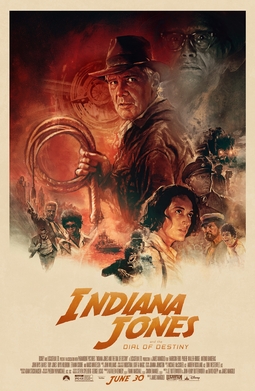
Behind the film
- Year
- 2023
- Director
- James Mangold
- Writers
- Jez Butterworth, John-Henry Butterworth, David Koepp, James Mangold
- Genres
- Adventure, Action
- Production
- Lucasfilm, Paramount Pictures
- Country
- United States
- Cast
- Harrison Ford, John Rhys-Davies, Phoebe Waller-Bridge, Mads Mikkelsen, Antonio Banderas, Boyd Holbrook, Toby Jones, Karen Allen
About the film
Contains story spoilers.
In 1944, Indiana Jones and Basil Shaw recover half of Archimedes' Dial from Nazis. By 1969, Indy is retiring, grieving his son's death and separated from Marion. Basil's daughter Helena steals the artefact for sale, drawing him into pursuit of Nazi scientist Jürgen Voller. After chases and a fatal attack on diver Renaldo's crew, Indy and Helena find the other half in Sicily. Voller abducts Indy and uses the completed Dial to attempt a return to 1939, hoping to change Germany's defeat. Instead, its fissure leads to ancient Syracuse during a siege; Voller dies in a crash. Indy wants to remain, but Helena brings him back to 1969. He awakens among friends and reconciles with Marion, choosing connection over disappearance into history.
Time has always been part of Indiana Jones's world, though usually as something waiting to be excavated. This adventure makes it a pressure on the archaeologist himself. Harrison Ford's older Indy carries the awkwardness of a person whose familiar strengths no longer guarantee a place in the present. The contrast matters more than a simple demonstration that he can still survive a chase. Adventure once promised discovery; now it also asks whether discovery can offer anything to someone who feels that his most meaningful years have gone. The film uses the familiar hat and the less familiar weariness together. Recognising the hero becomes part of recognising what has changed, rather than an invitation to pretend that change has never happened.
Helena gives that problem a particularly abrasive companion. Phoebe Waller-Bridge's character is quick, resourceful and difficult to take at face value, qualities that make her more than a younger admirer following an established legend. Her presence tests Indy's assumptions about who gets to value the past and what that value means. Knowledge can be a commitment, a bargaining tool or both at once. Their relationship therefore has a tension that a purely affectionate partnership would lack: shared history does not automatically produce shared ethics. She also prevents his exhaustion from becoming the only emotional perspective available. The exchanges between them keep the adventure argumentative, with each person capable of exposing the other's limitations while resisting an easy account of their own motives.
Voller turns the desire to recover the past into something much uglier. Mads Mikkelsen's villain treats history as an outcome he should be able to correct in his own favour. That conviction makes his intelligence dangerous without making his worldview persuasive. The point is not simply that another antagonist wants another valuable object. He wants a second chance for an ideology that should remain defeated, and regards the intervening world as an error. Placing that desire opposite Indy's grief separates very different forms of longing. Missing a person is not the same as resenting the existence of everyone who came afterwards. The film's time-travel fantasy gives those attitudes a common mechanism while keeping their moral differences visible throughout the pursuit.
The Dial is useful because it promises the kind of certainty people often seek from objects they do not fully understand. A mechanism appears to offer precision: assemble the pieces, interpret the signs and obtain a definite result. Human desire then rushes ahead of the available knowledge. That tension belongs comfortably within an archaeological adventure, where expertise matters but rarely grants complete control. The artefact becomes a meeting point between scholarly curiosity, financial appetite and a wish to rewrite life. None of those interests can be reduced to a generic hunger for treasure. What somebody hopes to do with the object tells you more about them than possession alone. The mystery therefore concerns the limits of interpretation as much as the excitement of discovering a hidden function.
The contrast between the opening wartime adventure and the later world gives the film an unusually direct way of examining its own heroic image. Youthful motion and older fatigue belong to the same man, yet they do not produce the same relationship with danger. An action scene can display familiar resilience while also making the cost of that resilience more apparent. That is why the quieter emotional premise matters alongside the spectacular travel. The film cannot simply solve loneliness by proving that Indy remains physically capable. Competence and purpose are related, but they are not interchangeable. Someone can know exactly how to respond to an immediate threat and still struggle to understand why returning to ordinary life would be worth the effort.
Friendship provides another answer to that uncertainty. The established relationships around Indy give his world a history that extends beyond artefacts and enemies. They suggest a life made of favours, recognition and people who know more about him than the heroic outline. That social memory is important because a legend can become a lonely role to inhabit. An audience may recognise the silhouette instantly, while the person wearing the hat needs something less ceremonial: a reason to be present for someone else. John Williams's returning musical voice similarly connects this adventure with an older emotional vocabulary. Familiarity offers continuity, though continuity does not require the character to arrive unchanged. The film's attachments make room for weariness without treating weariness as his whole identity.
The fantasy remains an adventure fantasy rather than an explanation of the real Antikythera mechanism or a claim about ancient technology. That distinction leaves the film free to make an emotional argument through impossible events. The lure of another era is compelling partly because the present can feel disappointingly ordinary beside the stories people tell about the past. Indy's profession makes that lure especially personal. He has spent a lifetime seeking traces of vanished worlds; the question is whether those worlds should also become an escape from the people still here. The story places historical wonder beside that temptation and asks the hero to reckon with both. Looking backwards can deepen a life, but it cannot by itself replace the difficult work of continuing it.