
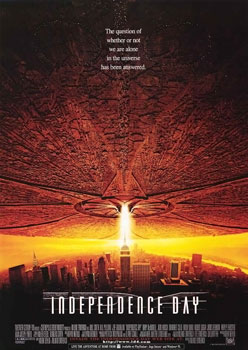
Behind the film
- Year
- 1996
- Director
- Roland Emmerich
- Writers
- Dean Devlin, Roland Emmerich
- Runtime
- 2h 24m
- Genres
- Adventure science fiction, Thriller, Alien invasion, Disaster
- Production
- Centropolis Entertainment, 20th Century Studios
- Country
- United States
- Cast
- Will Smith, Bill Pullman, Jeff Goldblum, Mary McDonnell, Judd Hirsch, Robert Loggia, Randy Quaid, Margaret Colin
About the film
Contains story spoilers.
Independence Day unfolds over July 2, 3 and 4, following several people as a vast alien invasion moves from unexplained signals to the destruction of major cities. David Levinson, a satellite technician in New York, notices a pattern in transmissions and recognizes that it is a countdown. His ex-wife Constance Spano works at the White House, giving him a way to alert President Thomas Whitmore. At the same time, Marine pilot Steven Hiller is called back from leave, and Jasmine Dubrow tries to get out of Los Angeles with her son Dylan. Retired crop-duster Russell Casse sees the ships as confirmation of his long-ridiculed claim that he was abducted. The film gives each character a different entry into the same global crisis.
David and his father Julius travel to Washington, where David explains the countdown to Whitmore. The government orders evacuations, but the attack comes before the cities can empty. The saucers fire, destroying New York, Los Angeles and Washington in a single coordinated strike. Whitmore escapes aboard Air Force One with Constance and the Levinsons, while Jasmine and Dylan survive by sheltering in a tunnel alcove with other people. The scale of the attack separates the characters physically, but the film keeps cutting between them so the disaster registers as a personal emergency as well as a national one. Their survival depends less on being prepared than on finding a moment of cover before the cities are engulfed.
On July 3, military counterattacks fail because the alien fighters are protected by force fields. Steven lures one craft into the Grand Canyon, ejects and blinds it with his parachute; the fighter crashes, allowing him to capture its pilot. He joins a convoy that brings the alien to Area 51, where Whitmore’s plane has landed. The base houses a recovered craft from Roswell and several alien bodies, facts long concealed by the government. The captured pilot telepathically attacks Dr. Okun and reaches Whitmore’s mind. The president experiences the invaders’ intent: they plan to destroy human life and strip Earth of its resources. A secret held for decades becomes immediately relevant to a war the country is already losing.
The government tries a nuclear strike against a saucer above Houston, but the alien shield survives the explosion leaving the military without a workable strategy. With conventional weapons and nuclear force both failing, David begins searching for a weakness in the shield system. Jasmine and Dylan make their way through the ruins in a maintenance truck, rescue several survivors, and reunite with Steven at Area 51. First Lady Marilyn Whitmore is among those they save, though she later dies from her injuries after seeing her family. The survivors’ arrival draws together the film’s separate plotlines, but it also makes the costs of the attack concrete. The strategy must now come from people who have lost homes, colleagues and family while the invasion continues.
David develops a computer virus to disrupt the aliens’ communications, using the Roswell spacecraft as a way to reach the mothership. He and Steven volunteer for the mission; the military uses Morse code to organize an international counterattack. President Whitmore recruits civilian and retired pilots to fill the remaining cockpits, including Russell, whose experience with crop dusters becomes unexpectedly useful. Steven marries Jasmine before he leaves, and David and Constance reconcile. The plan requires them to dock with the mothership and upload the virus, then launch a nuclear missile from inside before it can recover. The film ties this dangerous mission to both David’s technical insight and Steven’s flight skill rather than making one hero capable of everything.
The virus disables the shields, giving Whitmore’s squadron a chance to attack the saucer threatening Area 51. When they run out of ammunition and the craft prepares to fire, Russell deliberately crashes into its primary weapon, destroying it and saving the base. His death gives the other pilots a practical example of the ships’ vulnerability, and the information spreads to resistance forces around the world. Inside the mothership, David and Steven launch the missile and escape before the vessel explodes. They return to Earth alive, and the film reunites them with their families as people celebrate the defeat of the invaders. The victory is collective: the technical solution, coordinated forces and last-second sacrifices all matter to the outcome.
The film’s story is built around multiple points of view rather than a single military chain of command. A technician notices the pattern, a pilot makes an improvised capture, a president helps organize resistance, and a parent leads survivors through a ruined city. The three-day countdown gives the action a clear shape, while the shifts between Washington, Area 51 and the scattered survivors keep the stakes changing scale. Its aliens and invasion are science-fiction inventions, but the plot’s central devices remain grounded in observable tasks: decode the signal, learn why the weapons fail, get close enough to upload the virus, and coordinate a strike after the shield drops.