
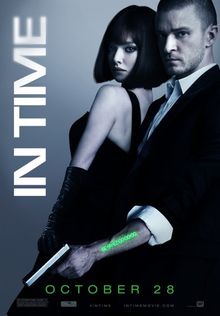
Behind the film
- Year
- 2011
- Director
- Andrew Niccol
- Writers
- Andrew Niccol
- Runtime
- 1h 49m
- Genres
- Action, Science fiction, Thriller, Dystopian
- Production
- Regency Enterprises, Strike Entertainment, 20th Century Studios
- Country
- United States
- Cast
- Justin Timberlake, Amanda Seyfried, Cillian Murphy, Vincent Kartheiser, Olivia Wilde, Matt Bomer, Alex Pettyfer, Johnny Galecki
About the film
Contains story spoilers.
In Time takes the familiar idea of spending your life at work and makes the spending literal. Andrew Niccol writes and directs a science-fiction world where a clock on the body measures the life still available to exchange. Justin Timberlake’s Will Salas lives with the pressure of obtaining enough time for the next day, while Amanda Seyfried’s Sylvia belongs to a world in which that pressure has been kept comfortably distant. The premise makes inequality visible without requiring a separate symbol to explain its stakes. Losing money and losing life are the same event, turning each ordinary payment into a decision about how much future remains.
Adults stop ageing at twenty-five, then must earn or acquire time to keep their countdown running. Will receives a large transfer from a wealthy stranger, but his mother dies after failing to afford a bus journey. He enters a rich district, is accused of killing the benefactor and escapes with Sylvia. Their flight becomes a series of robberies aimed at distributing time. They eventually obtain a huge reserve from Sylvia’s father, while pursuing Timekeeper Raymond Leon neglects his own clock and dies. Will and Sylvia survive and continue towards larger banks. The ending shows disruption of the existing order, not a fully established replacement society.
The visible clock changes the meaning of poverty. A shortage cannot be deferred to some later accounting when its endpoint is death. People with little time are forced to consider immediate survival before questions that require a longer horizon. That pressure makes their choices appear urgent in ways that wealthier people may misread as recklessness or impatience. The film’s division into districts gives the pressure a physical geography. Moving between them is not simply a change of address; it is entry into surroundings where the same body and the same hour are experienced through a radically different level of security. The future has become something allocated unevenly in the present.
The youthful appearance of adults creates another unsettling gap between what can be seen and what is true. Age no longer provides an ordinary clue to experience or family position. Wealth can conceal a very long life behind a face that looks newly adult, while poverty can end a life shortly after the countdown begins. That uniform surface makes the clock and the manner of moving more important signs of status. Someone able to proceed slowly can demonstrate a kind of possession that a desperate person lacks. The setting uses the absence of visible ageing to intensify inequality rather than to present eternal youth as a benefit enjoyed on equal terms.
Will’s loss gives the larger system an immediate emotional consequence. A price can be described as a market fact from the position of the person setting it, while the person unable to meet it experiences an absolute limit. The bus journey concentrates that difference into something ordinary enough to make the imagined rules understandable. Transport should connect people, but in this world access depends on having enough future to purchase the movement. The film turns a mundane obstacle into an irreversible event, linking the protagonist’s anger with the recognition that a system can produce death through transactions presented as routine rather than through a visibly exceptional act of violence.
Sylvia’s involvement allows the story to cross its own social border. She begins with access to security Will has not possessed, so sharing danger changes more than her relationship with him. It changes the conditions under which she interprets movement, trust and risk. The partnership does not erase the difference in their starting positions, but it makes cooperation possible through decisions against the interests of her own protected environment. Seyfried’s character gives the robberies someone with knowledge of the world being challenged. Her participation also prevents the wealthy district from remaining a distant abstraction, making a personal attachment part of the route through its mechanisms of control.
Cillian Murphy’s Timekeeper represents the attempt to maintain those mechanisms through enforcement. His task concerns not only a suspected crime but the movement of resources outside the places where the system expects them to remain. That makes policing part of the distribution of life, with authority directed towards preserving an arrangement rather than merely responding to individual harm. His own dependence on a clock exposes a contradiction within that role. Serving the structure does not place him entirely outside its demands. The film uses pursuit to keep the premise physically active, while the pursuer’s vulnerability shows that commitment to order can consume the person who assumes it will protect him.
The robberies create the satisfaction of immediate redistribution, but the story also acknowledges that the system can react by changing prices. Giving people more time does not automatically remove the forces designed to keep them short of it. That complication makes the final continuation important. Will and Sylvia have found a way to interrupt the arrangement, yet a successful raid is not the same as a durable new order. In Time ends through continuing action rather than a completed solution. Its central image remains a body made answerable to a balance, with freedom requiring more than a large individual reserve if the rules governing everyone else’s reserves stay unchanged.