
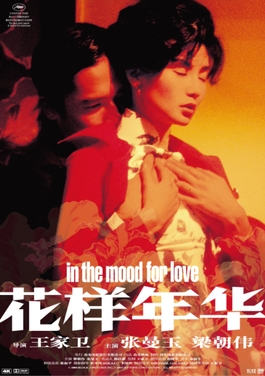
Behind the film
- Year
- 2000
- Director
- Wong Kar-wai
- Writers
- Wong Kar-wai
- Runtime
- 1h 38m
- Genres
- Romance, Drama
- Country
- Hong Kong, France, Thailand
- Cast
- Maggie Cheung, Tony Leung, Joe Cheung Tung-joe, Rebecca Pan, Roy Cheung, Paulyn Sun, Chin Tsi-ang, Julien Carbon
About the film
Contains story spoilers.
In 1962 Hong Kong, journalist Chow Mo-wan and secretary Su Li-zhen rent neighbouring rooms while their spouses are frequently absent. Matching gifts lead them to realise that those spouses are having an affair. They rehearse how it might have begun and grow closer while working on Chow's martial-arts serial, trying to avoid repeating the betrayal. When Chow leaves for Singapore, Su reaches their meeting place too late. She later visits his apartment there without speaking to him. Years afterwards, both return separately to their old building, but miss one another; Su now has a son. Chow eventually visits Angkor Wat and whispers into a hollow in a wall, sealing it with mud. The secret remains private, and the film does not supply a final reunion.
Wong Kar-wai builds the relationship around a problem of interpretation. Chow and Su have to understand something happening outside their direct knowledge, yet their attempt to reconstruct it begins to create an experience of their own. A rehearsed exchange can contain real feeling without making that feeling easy to name. The ambiguity is essential to the romance: words may belong to an imagined spouse, the person speaking or both at once. Viewers must pay attention to the distance between a scene's apparent purpose and its emotional effect. The film allows understanding to accumulate through small adjustments instead of treating an explicit declaration as the only reliable evidence of attachment.
Tony Leung and Maggie Cheung's characters exist within a social world that is crowded enough to make solitude conspicuous. Neighbours can offer company and belonging while also making privacy difficult to obtain. That gives every encounter another possible audience. The problem is not simply whether the pair believes its own conduct is defensible; appearances can acquire meaning before the people involved have settled what they are doing. Courtesy becomes a practical shield, but it can also limit what is said. The film's emotional pressure grows from that friction between a relationship experienced from within and a relationship imagined by others who see only fragments of it.
Their refusal to behave like their spouses gives restraint a moral purpose, yet a rule does not prevent feeling from changing. Chow and Su want to preserve something about themselves while responding to an intimacy which their original intentions cannot fully contain. That makes the situation more complicated than a choice between duty and desire. They also need a language in which acknowledging desire does not immediately seem to destroy the boundary they value. Silence can protect the relationship's meaning while depriving it of a future. The film keeps both possibilities alive, allowing a withheld action to carry as much weight as an impulsive one would in a more direct romantic drama.
The visual world makes those boundaries tangible. Christopher Doyle and Mark Lee Ping Bing's photography works with William Chang's production and costume design to give intimacy a shape within constrained surroundings. Colour, fabric and the edges of a space can draw attention to a person while also reminding viewers of everything around them. The frame does not have to provide a complete, comfortable view for a moment to feel emotionally clear. Partial access suits a story whose participants cannot fully disclose themselves. Elegance therefore has a dramatic role beyond creating a beautiful surface: it lets feeling become visible without removing the rules and interruptions which keep it contained.
Time is experienced through recurrence as well as forward movement. A familiar encounter can seem ordinary until a small change gives it another significance. That structure suits longing, which often depends on noticing what is almost the same rather than what is dramatically new. The title names a state of feeling rather than a completed action, and the film's rhythm makes that distinction meaningful. Viewers are invited to dwell in possibility without assuming that possibility will develop into fulfilment. Waiting can deepen affection while consuming the time in which something might have happened. The story's sadness belongs partly to that uncomfortable overlap between emotional growth and practical delay.
The attraction between the central characters also changes what companionship can mean. Their bond begins around a shared injury, but remaining together only to investigate that injury would give the absent spouses continuing authority over their lives. The relationship develops its own attention, pleasures and uncertainties. That is why its moral difficulty cannot be resolved by describing it solely as a reaction to betrayal. It becomes something with an identity of its own, even as the people involved hesitate to grant it a public form. The film allows viewers to recognise that identity without demanding a definitive label which would settle every question about what has passed between them.
The final movement makes memory a different kind of place from the rooms in which the relationship began. A private experience can remain vivid after its practical opportunities disappear, and keeping it does not necessarily mean turning it into a story another person will hear. In the Mood for Love gives that privacy a material image while leaving the contents unspoken. The result is a romance concerned with the limits of access: people cannot know every feeling around them, and an audience is not entitled to every secret a character carries. What remains is the texture of a connection, shaped by attention and restraint, whose emotional reality exceeds the future it was able to achieve.