
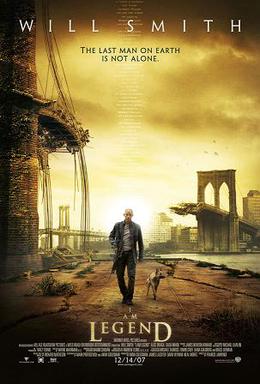
Behind the film
- Year
- 2007
- Director
- Francis Lawrence
- Writers
- Mark Protosevich, Akiva Goldsman
- Genres
- Post-apocalyptic, Vampire, Drama, Action
- Production
- Warner Bros. Entertainment, Original Film, Village Roadshow Pictures
- Country
- United States
- Cast
- Will Smith, Alice Braga, Charlie Tahan, Salli Richardson, Dash Mihok, Willow Smith, Emma Thompson, April Grace
About the film
Contains story spoilers.
Robert Neville moves through a Manhattan reclaimed by weeds, deer, and silence. In daylight he drives empty avenues with Sam, his German shepherd, hunts for food, and works in a fortified home near Washington Square Park. At night, infected creatures he calls Darkseekers emerge, so Neville bars the doors and waits for morning. His radio message invites survivors to meet him at the South Street Seaport, but nobody answers. This routine gives shape to a life otherwise made of grief, vigilance, and the stubborn belief that he can reverse the catastrophe. The city’s scale makes even ordinary errands feel exposed: one sound or late return can turn daylight freedom into a race against sunset.
Neville is a U.S. Army virologist, and his house is both refuge and laboratory. He tests possible treatments on rats, records observations, and tries to understand why the engineered virus meant to fight cancer devastated the population. Outside, abandoned streets mark the disaster’s scale; inside, carefully arranged equipment suggests a man keeping control through repeated procedures. Memories of his wife Zoe and daughter Marley interrupt that discipline, reminding us that the search began in a world where he had family and a future. His broadcasts are double-edged: they are practical attempts to find help, but repeating them also gives him a reason to keep speaking to an empty city. Sam is his companion and the last witness to a familiar human routine.
A deer hunt leads Neville and Sam into a building occupied by Darkseekers, and the near escape is followed by a troubling experiment. Neville captures a female Darkseeker and brings her into his lab, hoping his immunity and research can produce a treatment. The Alpha male pursues them but cannot follow into sunlight. His repeated attempts to reach the captive make the pursuit feel organized, though Neville continues treating her as a specimen rather than a member of a group. The tests initially appear to fail, leaving him unable to tell whether he is making progress or prolonging another captive’s suffering. The conflict is present in his methods before the film makes it explicit: his hope of saving people depends on actions that would look very different from the other side of the glass.
The balance collapses around a familiar mannequin that has appeared outside Grand Central Terminal. When Neville spots it in that unexpected place, he approaches and is caught in a trap, waking at dusk with little time to get home. The Darkseekers send infected dogs after him; Sam is bitten during the escape. Neville tries to save her with his serum, but when she begins to change he has to kill the companion who has kept him grounded. In grief, he attacks a group of Darkseekers and is overwhelmed. Anna and the boy Ethan, survivors who heard his broadcasts, find him and bring him home. Their arrival is not a simple rescue into safety: Neville has spent years assuming every stranger is impossible, while Anna must enter the guarded routine of someone who has learned to trust almost nothing.
Anna and Ethan have travelled from Brazil and are heading toward a settlement in Bethel, Vermont. Neville doubts that such a refuge exists because no one has answered his radio, and the disagreement exposes how completely he has organized life around proof he can see in the lab. Anna believes there are other survivors and that the journey north matters. Neville’s experiments meanwhile show a possible change in the captive female. Cooling her with ice appears to help, and for the first time his work suggests the virus may be reversible rather than merely containable. This shift also changes the stakes of the household: the newcomers are not simply sharing a hiding place, but asking Neville to consider a future beyond his own nightly survival and solitary experiments.
The breakthrough comes as Darkseekers attack Neville’s house and force the survivors into the basement laboratory. Behind reinforced glass, Neville sees the treatment working on the female captive. The Alpha male smashes at the barrier, and Neville draws a vial of blood from the recovering subject before sealing Anna and Ethan inside a coal chute. In the theatrical ending, he stays behind and detonates a grenade, killing himself along with the creatures closing in. Anna and Ethan reach the Vermont settlement with the sample; her account of Neville’s work turns his sacrifice into the story promised by the title. His cure leaves the basement and becomes a possibility for a community, even though he will not see whether it succeeds.
The film builds tension by making daylight a temporary advantage rather than a cure for loneliness. Wide views of a grass-covered city give way to tight rooms, locked doors, and lab glass that keeps Neville near the creatures he studies while separating him from them. Smith’s performance is shaped through repeated actions—broadcasting, testing, hunting, returning home—so small changes in routine register as major turns. The theatrical ending completes his research as a human rescue story. A separately released alternate ending changes the Alpha confrontation: the Alpha retrieves the female and Neville recognizes the Darkseekers’ attachment, then leaves with Anna and Ethan. That is a distinct version, not the conclusion described above; in the theatrical cut Neville dies and the cure reaches Bethel through Anna.