
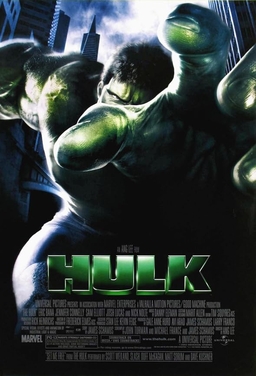
Behind the film
- Year
- 2003
- Director
- Ang Lee
- Writers
- Michael France, James Schamus, John Turman
- Genres
- Action, Science fiction, Drama
- Production
- Universal Pictures, Focus Features
- Country
- United States
- Cast
- Eric Bana, Jennifer Connelly, Sam Elliott, Josh Lucas, Nick Nolte, Cara Buono, Celia Weston, Daniel Dae Kim
About the film
Contains story spoilers.
David Banner’s genetic experiments and a childhood catastrophe leave Bruce with buried memories and an altered inheritance. As an adult researcher, Bruce works with Betty Ross on regenerative nanotechnology; an accident exposes him to gamma radiation and triggers the Hulk. General Ross confines him, while David reveals their connection and experiments on himself. After attacking Betty with mutated dogs, David drives Bruce’s transformations and exploits a security contractor’s interest in the Hulk. Bruce escapes custody and battles the army before Betty brings him back to himself. In a final confrontation, David absorbs electrical power and fights Bruce, who lets him absorb the Hulk’s rage until a military bomb destroys David. Presumed dead, Bruce later lives in the Amazon rainforest, where soldiers confront him and provoke another transformation during a supply raid.
The 2003 Hulk is Ang Lee’s adaptation of a comic-book figure, but its centre of gravity is closer to a family melodrama than a procession of superhero set pieces. That choice changes what the transformation means. Bruce’s enormous body is not simply a solution to an external threat; it is an expression of feelings he has spent years containing. The movie connects physical scale with emotional pressure, making the monster an uncomfortable extension of the quiet scientist rather than a separate, uncomplicated champion. Even when the imagery becomes spectacular, the underlying question remains intimate: what happens when a person has learned to treat anger as something frightening, yet cannot understand where it came from?
Bruce’s blank spaces are part of the character design. He is highly capable in a laboratory but uncertain about the history that explains his own reactions. Eric Bana plays him with a guarded quality that makes the Hulk’s outbursts feel less like a switch into a confident alter ego than a collapse of the control Bruce depends on. That contrast also affects how we read his intelligence. Knowledge cannot automatically repair personal memory, and being trained to study observable evidence does not make him an impartial investigator of himself. The film makes his scientific competence coexist with emotional confusion, a tension that gives the familiar origin story a distinctive shape.
Betty is more than a romantic anchor waiting at the edge of the action. Jennifer Connelly’s character is a scientist and the person best placed to recognise that Bruce is not reducible to the danger others see. Her connection to General Ross places affection and institutional power in the same family, so every attempt to protect Bruce becomes entangled with the question of who gets to define him. Sam Elliott’s Ross has the bearing of a man trained to manage threats through procedure and command. The difference between Betty and her father is not simply softness versus toughness: each approaches Bruce from a different idea of responsibility, and the film lets their shared history complicate both positions.
David Banner makes the family theme darker because his scientific curiosity has never been separated from entitlement. Nick Nolte gives him a volatile, theatrical presence, but the important feature is the way he converts discovery into a claim over his son. The film’s science-fiction premise makes inheritance visible and dramatic, while the father-son relationship gives that premise its emotional charge. David wants the power he associates with Bruce; Bruce wants an account of himself that does not leave him repeating David’s choices. Their conflict therefore reaches beyond a conventional rivalry. It is about whether knowledge can be used to understand another person or merely to possess and control them.
The editing and screen design echo that unstable perspective. Panels, split images and abrupt changes in visual scale invite the eye to move across the frame instead of settling into a neutral view. The technique can feel deliberately graphic, like a comic page being rearranged in real time, yet it also suits a story in which Bruce’s sense of continuity is unreliable. Shifts in size place intimate faces beside military hardware or monumental landscapes, giving private distress an outsized physical presence. Rather than hide the film’s comic-book origin, the visual language keeps reminding us that this is an adaptation interpreting an interior life through a medium built from bold images.
The Hulk’s changing size makes anger almost measurable, which is a striking way to translate an emotion into spectacle. It also risks making the transformation seem like a simple equation: greater fury equals greater strength. The film is more uneasy than that equation suggests. Bruce’s strength can protect, frighten and destroy, and its moral meaning depends on the relationships around it. Betty’s ability to reach him does not erase the danger; Ross’s fear does not make every method of containment wise; David’s interest in power does not amount to understanding it. The story repeatedly separates control from care, even when those ideas become difficult to distinguish under pressure.
This approach explains why the film can feel unusually reflective beside more straightforward origin adventures. The military pursuit supplies momentum, but the movie’s most persistent interest is the emotional history underneath the pursuit. Bruce’s body becomes an arena where family secrets, scientific ambition and social fear collide. Lee’s adaptation gives those ideas an operatic, sometimes strange presentation, with the visual form refusing to behave like a transparent window. For viewers approaching it as a superhero film, that emphasis is central to its identity: the Hulk is not just the largest presence in the frame, but the visible shape of a past the characters have failed to settle.