
Behind the film
- Year
- 2011
- Director
- Martin Scorsese
- Writers
- John Logan
- Runtime
- 2h 6m
- Genres
- Drama, Adventure, Mystery, Steampunk
- Production
- Infinitum Nihil, GK Films
- Country
- United States, United Kingdom
- Cast
- Asa Butterfield, Chloë Grace Moretz, Ben Kingsley, Sacha Baron Cohen, Jude Law, Helen McCrory, Michael Stuhlbarg, Christopher Lee
About the film
Contains story spoilers.
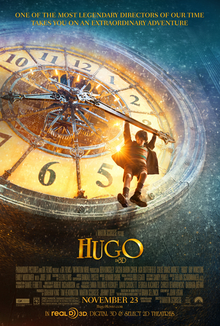
Hugo begins by turning a Paris railway station into something a child can read from the inside. Behind its public clocks are passages, ladders and mechanisms that give an orphan places to hide and work that keeps the building running. Hugo Cabret maintains those clocks after the disappearance of the uncle who brought him there, while trying to avoid an inspector who sends unattended children to the orphanage. Martin Scorsese presents the station as a miniature society: people pursue routines, romances and disappointments beneath a system they scarcely notice. Hugo can see them through openings in the machinery, but observation is not the same as belonging.
His father had been repairing an automaton, a mechanical figure designed to write or draw, before dying in a fire. Hugo keeps the unfinished project as the most tangible connection to him. Missing parts lead him to steal from a toy stall, where the proprietor catches him and confiscates his notebook. The drawings inside disturb the old man in a way Hugo does not understand. Ben Kingsley makes Papa Georges seem exhausted as well as angry, giving the encounter the weight of a history that exists before the boy arrives. Hugo initially sees only an obstacle between himself and the message he hopes the machine will produce.
Isabelle, Georges' goddaughter, becomes his companion in the investigation. Her love of books gives her a language for adventure, while Hugo's practical knowledge opens parts of the station she has never seen. Their differences keep the friendship active: she can introduce him to stories and other people, and he can turn an imagined quest into an actual route through a hidden door. The heart-shaped key she wears fits the automaton, giving the mystery a connection to her household. When the machine finally draws an image associated with A Trip to the Moon and signs Georges Méliès' name, Hugo's private repair becomes a question about someone else's past.
The film's interest in cinema develops through the children's curiosity rather than arriving as a separate history lesson. A secret visit to a screening of Safety Last! gives Hugo a new kind of mechanical wonder: a body and a clock can become an adventure through the way they are framed. Isabelle discovers an experience she has been forbidden to have, and the moving image becomes a shared pleasure before it becomes evidence. Books and a meeting with film enthusiast René Tabard then connect the drawings to an artist thought to have vanished from public life. The mystery is now about why a living person has allowed himself to become invisible.
Georges' response to that discovery makes the past painful rather than merely picturesque. His memories reveal a magician who found in cinema another means of creating impossible events, building sets, costumes and tricks around a camera. The colourful studio sequences change the feeling of the film: instead of a child secretly keeping an established machine operating, a group of adults constructs new worlds together. The loss of that work and the collapse of his career explain the toy stall's defensive quiet. These passages are part of a fictional adventure built around a real filmmaker, and the children's role in his rediscovery belongs to the story rather than a literal historical account.
The automaton connects Hugo's grief with Georges' withdrawal without acting as a magical resurrection. Hugo initially wants it to deliver something his father has left for him, but its drawing leads outward, toward work that another person has stopped believing matters. His idea that machines have a purpose becomes a way of asking whether people might have one too. Asa Butterfield gives that thought a child's urgency rather than presenting it as a settled philosophy. The station inspector also complicates the machinery metaphor: his damaged leg and awkward courtship reveal a vulnerable man beneath the authority Hugo fears, even though the threat of removal remains real.
When Hugo tries to retrieve the automaton, the station's physical dangers stop being a game of concealment. The fall onto the tracks and the approaching train put his wish to preserve an object against the more immediate possibility of losing his life. The inspector saves him, and Georges arrives to claim responsibility for the boy. That change matters because Hugo does not secure a home simply by being clever enough to escape the adults around him. Someone has to recognize him and act. The rescue brings the public station, the hidden clockwork and the fragile toy into one place, resolving the separation that shaped his everyday existence.
The tribute to Méliès and the gathering afterward join two forms of recovery: films can return to an audience, and people can return to one another. The ornate clocks, drifting steam and layered station spaces give Scorsese opportunities to make depth itself part of the experience, while the early-film passages reveal how a plainly constructed illusion can still produce wonder. Hugo's story is therefore about more than solving the identity behind a signature. It follows a boy from watching through narrow openings to becoming part of a household, and an older man from guarding his disappointment to allowing his imagination to be seen again.