
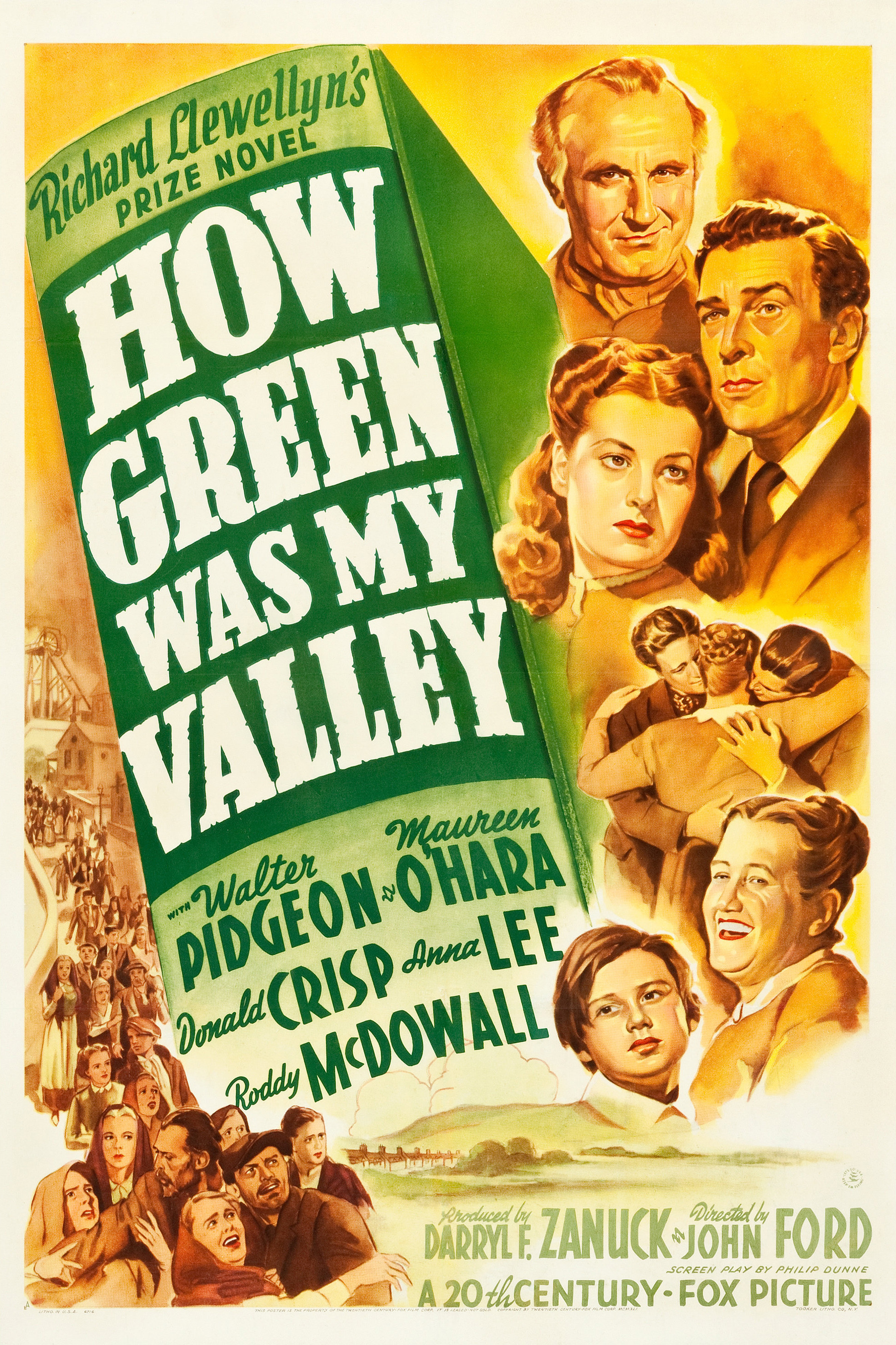
Behind the film
- Year
- 1941
- Director
- John Ford
- Writers
- Philip Dunne
- Genres
- Drama
- Production
- 20th Century Studios
- Country
- United States
- Cast
- Walter Pidgeon, Maureen O’Hara, Anna Lee, Donald Crisp, Roddy McDowall, Barry Fitzgerald, Sara Allgood, John Loder
About the film
Contains story spoilers.
How Green Was My Valley presents a place through the memory of someone preparing to leave it. That perspective gives even its warmest scenes a second meaning: the adult voice knows which people and forms of life the child has not yet lost. John Ford’s 1941 film, adapted by Philip Dunne from Richard Llewellyn’s novel, follows the Morgans in a Welsh mining community. Roddy McDowall plays young Huw, while Donald Crisp and Sara Allgood play the parents around whom the household is organised. The family’s home offers order, affection and familiar routines, but its security depends on work carried out elsewhere, below ground and under conditions the family does not control. The valley can be beautiful and economically harsh at the same time, with the film’s memories preserving that tension.
Huw’s father Gwilym and older brothers work in the mine. A wage cut and strike divide the family, while Beth and Huw are injured in freezing water after she defends her husband at a miners’ meeting. Mr. Gruffydd helps Huw recover, but his love for Angharad does not lead to marriage; she marries the mine owner’s son instead. Huw faces cruelty at school, and Ivor’s death leaves Bronwyn widowed. As unemployment disperses his brothers, Huw chooses mining over university. Gossip about Angharad prompts Gruffydd to resign, but a mine disaster brings him back to help. Huw finds Gwilym below ground and brings his father’s body to the surface. The closing memories return the family to the life that has disappeared.
Crisp’s Gwilym believes in obligations that once seemed sufficient to keep a household and community together. Work, parental authority and respect supply a moral order through which he understands disagreement. His sons encounter circumstances in which those inherited terms no longer protect their livelihoods. The strike brings that difference into the home, making a dispute with an employer into a disagreement between people who love one another. The film does not need to make their affection disappear for the disagreement to become painful. Family loyalty can pull in more than one direction when members disagree about what will preserve the family. Beth’s defence of her husband makes that loyalty visible as action, with a physical cost that Huw experiences beside her.
Walter Pidgeon’s Mr. Gruffydd provides a form of authority that can listen as well as instruct. His relationship with Huw connects spiritual and practical encouragement: the boy needs someone to believe in the possibility of recovery, not simply explain what has gone wrong. The minister’s position becomes more difficult in relation to Angharad, played by Maureen O’Hara. Mutual affection cannot overcome the way he imagines the material demands of marriage. His decision not to offer her a life he considers too hard helps send her towards a marriage without the same love. That gives his compassion a limit within the story. Wanting to spare someone hardship can still mean deciding, on that person’s behalf, which kind of hardship is acceptable.
The community’s scrutiny turns those private choices into public stories. Angharad’s return invites gossip, and people who do not know her circumstances are willing to supply an explanation that suits their judgement. The chapel becomes a place where moral authority can be used to exclude rather than support. Gruffydd’s response separates care for a person from compliance with a community’s preferred account of her. The film places that division beside the labour conflict, giving the valley more than one system through which people can be valued or rejected. Neither respectability nor hard work guarantees protection. A person can meet one obligation and still be punished by another set of expectations, leaving the home to absorb pressures created beyond it.
Huw’s childhood is shaped by institutions as well as family. The school introduces him to a setting where learning and humiliation become entangled, while the mine offers a future defined by the work his father already knows. His attachment to Bronwyn adds another reason to choose a life close to home after Ivor’s death. The decision is meaningful because education could have carried him elsewhere; remaining is an act of loyalty rather than the only imaginable route. Yet the mine’s danger prevents that loyalty from becoming a promise of safety. The story gives childhood tenderness and adult responsibility a continuous geography, so the same valley contains a boy’s first admiration, a family’s working life and the place where loss will make those memories impossible to separate.
Ford’s framing and Arthur Miller’s black-and-white cinematography give the village a collective presence. Lines of houses, groups moving through the streets and the miners’ singing make individual households part of a larger rhythm. A voice can belong to one character and then join others, expressing a kind of shared life that the economic conflicts threaten to break apart. The darker traces of mining in the landscape allow the title’s remembered green valley to become a measure of change. The film is a Hollywood dramatic adaptation, not unmediated evidence of every Welsh community’s experience. Its central subject is the way memory holds people and places together after their material circumstances have altered. Huw’s recollection cannot reverse the losses, but it can resist allowing the last disaster to become the only account of what his home was.