
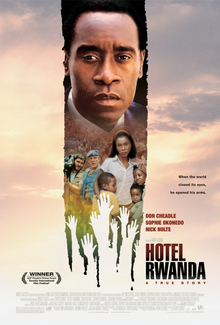
Behind the film
- Year
- 2004
- Director
- Terry George
- Writers
- Keir Pearson, Terry George
- Genres
- Drama, Biographical
- Production
- Miracle Pictures, Seamus Production, Kigali Films
- Country
- South Africa, United States, Italy, United Kingdom
- Cast
- Don Cheadle, Sophie Okonedo, Joaquin Phoenix, Nick Nolte, Fana Mokoena, Hakeem Kae-Kazim, Tony Kgoroge, Cara Seymour
About the film
Contains story spoilers.
Hotel Rwanda tells its story through the Hôtel des Mille Collines, a hotel whose polished routines become increasingly fragile as violence spreads through Kigali in 1994. Paul Rusesabagina is its manager, skilled at anticipating the needs of diplomats, business visitors and the hotel’s Belgian management. He is a Hutu married to Tatiana, a Tutsi, and the film establishes that their family life sits within a society already strained by ethnic politics and propaganda. Paul believes in negotiation and personal connections; the story tests how far those tools can protect people when violence is organized and ordinary protections collapse.
Paul’s professional instincts are visible in the way he handles suppliers, officials and military figures. He maintains relationships with General Bizimungu and with Georges Rutaganda, a supplier whose political position becomes increasingly dangerous. Tatiana’s brother Thomas warns Paul that the situation is deteriorating, while foreign reporter Jack Daglish encounters a reality he cannot make distant or abstract. Colonel Oliver represents the UN peacekeeping presence, but his authority is sharply limited. These characters reveal different kinds of access—to information, money, military power or foreign attention—without suggesting that any one connection can stop the crisis.
After the Rwandan president’s assassination, reprisal killings begin and the Arusha peace process collapses. Paul brings threatened neighbours into the hotel, where receptionist Gregoire occupies the presidential suite and threatens to expose the refugees if forced to work. The hotel owner, speaking from Belgium, apologizes but cannot arrange a safe passage. Foreign nationals are evacuated, leaving Rwandans behind. More people arrive from refugee camps, the Red Cross and orphanages, and the hotel becomes a crowded refuge of Hutu and Tutsi civilians. The film’s focus narrows to the daily work of keeping this improvised sanctuary functioning.
That work is practical and morally complicated. Paul must keep water, food and supplies moving, maintain the façade of an operating hotel, negotiate with armed men and reassure guests who understand that a locked gate offers no certainty. Tatiana searches for her relatives while caring for their own children and the people around her. Paul’s polished manner, business gifts and bargaining skill buy moments of safety, but they also show his dependence on relationships with men who have far more coercive power than he does. When he and Gregoire go to collect supplies from Rutaganda, they witness militia violence and encounter a road covered with bodies.
International withdrawal becomes a turning point. UN personnel attempt to evacuate refugees, including Paul’s family, but Gregoire betrays them to the militia. Paul’s family is separated from him, and the convoy is stopped after extremist radio broadcasts direct the attackers. The film makes media part of the violence’s infrastructure: radio language dehumanizes neighbours and helps coordinate people who may never see the political leaders issuing commands. Colonel Oliver can witness what is happening and plead for help, yet the international presence cannot offer the protection Paul expected. The gap between recognition and intervention defines much of the hotel’s peril.
Paul turns to Bizimungu when the hotel’s safety is again threatened. He offers the remaining valuables and liquor from his office safe and confronts the general over the failure to protect civilians. Their bargain is uneasy: Paul promises to testify on Bizimungu’s behalf in exchange for help, even as the general is entangled in the system driving the danger. The film does not present this as a clean victory for moral persuasion. It is a choice made under coercion, using the limited leverage available to keep people from being taken away.
Eventually the hotel’s refugees leave in a UN convoy. The route to safety is still dangerous, passing through displaced crowds and armed men, but they reach the area held by Tutsi rebels. Paul and Tatiana reunite with their nieces there. The film’s epilogue reports that Paul saved more than a thousand refugees, adopted the girls and relocated with his family; Tatiana’s brother and his wife were never found. That ending offers a narrow form of survival rather than repair. The family is together, but the absences remain, and the people inside the hotel have passed through a catastrophe no single act of negotiation could undo.
Terry George’s direction places Don Cheadle’s Paul within crowded rooms, service corridors and windowed public spaces, allowing the hotel’s ordinary architecture to become a visual measure of changing danger. The lobby begins as a place of hospitality and status; it gradually fills with families, bedding and the pressure of people listening for news. Sophie Okonedo gives Tatiana a resolve that is distinct from Paul’s social maneuvering, while Joaquin Phoenix’s reporter and Nick Nolte’s Colonel Oliver show how outsiders can see the crisis yet remain unable to redirect it. The film is a dramatization of historical events and should not be treated as a complete record of every person’s actions or the genocide’s full history. The restrained use of distant radio voices against the hotel’s guarded rooms keeps the story’s public catastrophe present even when the camera stays with one family. This structure offers human scale without pretending the hotel contains the whole national tragedy.