
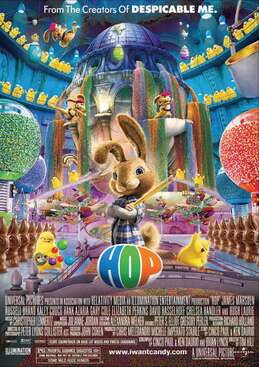
Behind the film
- Year
- 2011
- Director
- Tim Hill
- Writers
- Cinco Paul, Ken Daurio, Brian Lynch
- Runtime
- 1h 36m
- Genres
- Comedy, Fantasy, Teen, Family
- Production
- Illumination, Relativity Media
- Country
- United States
- Cast
- James Marsden, Russell Brand, Kaley Cuoco, Hank Azaria, Gary Cole, Elizabeth Perkins, Hugh Laurie, Chelsea Handler
About the film
Contains story spoilers.
E.B., heir to the Easter Bunny, runs away to Hollywood to pursue drumming instead of accepting his expected role. He meets Fred O'Hare, a young man whose plans for his own future have stalled. Their partnership turns Fred's wish for direction into training to take on Easter duties, while E.B. confronts his father's expectations. When Carlos the Chick attempts a coup on Easter Island, the two return to stop him. They reconcile with family and are crowned co-Easter Bunnies. The live-action and animated strands meet in this shared solution: neither character has to surrender an individual aspiration to become useful to others.
Hop's central idea is a collision between inherited duty and chosen vocation. E.B. is expected to take over a seasonal institution, but he understands himself through music; Fred wants a clear destination for his adult life but has not yet found one. Their comic pairing lets each character recognize something the other lacks. The story does not ask either to abandon ambition. Instead, it builds toward a shared model of responsibility in which personal talent and communal obligations can coexist. The family resolution gives that argument a broad, reassuring shape suited to an all-ages holiday comedy. Each lead contributes differently, so the friendship itself becomes the answer to their uncertainty.
The live-action and animation hybrid makes the two leads' different worlds physically visible. E.B.'s animated body can move through human spaces with elastic speed and expressive exaggeration, while Fred's live-action performance supplies an ordinary scale for embarrassment and aspiration. Their scenes depend on eyelines, timing and reaction: a joke often lands in the gap between what a human character sees and what the audience knows about the rabbit. The technique is not simply a showcase for visual effects; it establishes the film's comic grammar, allowing a fantasy visitor to disrupt recognizable suburban and workplace routines. The contrast keeps the central relationship legible across styles.
The film's comedy repeatedly turns performance into a test of identity. E.B. wants to drum, and his skill becomes a way of making himself legible outside the role assigned to him. Fred's attempts to move toward a purposeful life are similarly staged as public tests, where confidence and competence do not always arrive together. Music and stage-like moments give both characters room to try on an identity before it becomes a permanent responsibility. The jokes soften the uncertainty, but they also keep the underlying question in view: is a role something inherited, practiced or chosen? This lets ambition feel playful while still carrying emotional weight.
Family is presented as both a source of expectation and a possible place of repair. E.B.'s conflict with his father concerns succession and trust; Fred's relationship with his relatives carries an adjacent pressure to become dependable. The parallel helps the film avoid making the human plot a mere side quest to the Easter Island adventure. Each side of the hybrid story participates in the same emotional design. The eventual reconciliations tie growing up to renewed connection rather than escape from family altogether. This gives the finale closure while keeping the central pair as a bridge between two households and two kinds of inheritance.
Carlos's coup supplies a broad adventure threat that contrasts with the smaller identity dilemmas. The shift from Hollywood misadventures to factory peril increases scale, brightens the action and lets E.B.'s musical ability become practically useful. Seasonal production, candy imagery and the Egg Sleigh give the climax its own visual vocabulary. Because the conflict is framed as a playful takeover, the danger remains stylized and family-oriented. The shift is not especially subtle, but it gives the film a clear destination and lets its central friendship carry the final action rather than leaving the resolution to a new hero. Fantasy machinery becomes a stage for cooperation.
Hop's tone relies on quick changes between slapstick, pop-culture appearances and sentimental family beats. The cameos and music jokes give the comedy a contemporary, noisy surface, while the emotional through-line stays uncomplicated: Fred and E.B. help one another become more capable of accepting a role. The pace can feel episodic because the story moves through set pieces, but those interruptions also suit a film built from two contrasting worlds. Each detour supplies another shared experience that nudges the pair toward cooperation. The cumulative effect is less about surprise than cheerful recognition, with visual jokes refreshed through the characters' reactions.
The film works best as a seasonal fantasy about collaboration across differences. E.B. does not trade music for tradition, and Fred does not become fulfilled by copying the rabbit's life; the co-leadership ending makes room for both identities. The comedy's broadness and bright hybrid design serve that accessible message, while the contrast between animated and human characters keeps the premise lively. Hop is more than a holiday mascot adventure: it is a buddy comedy in which growing up means learning to contribute without surrendering the part of yourself that first made you run away. The resolution makes compromise feel constructive rather than defeatist.