
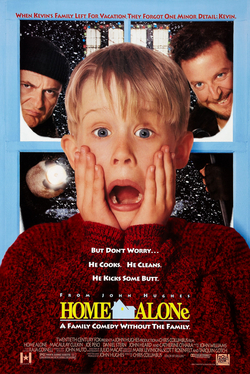
Behind the film
- Year
- 1990
- Director
- Chris Columbus
- Writers
- John Hughes
- Runtime
- 1h 42m
- Genres
- Comedy, Family, Adventure, Christmas
- Production
- Great Oaks Productions, 20th Century Studios
- Country
- United States
- Cast
- Macaulay Culkin, Joe Pesci, Daniel Stern, Catherine O’Hara, John Heard, Roberts Blossom, Devin Ratray, John Candy
About the film
Contains story spoilers.
Home Alone starts with a crowded household in a Chicago suburb preparing for an early flight to Paris. Kevin McCallister is the youngest child and the target of his siblings’ teasing; after a quarrel with Buzz, his mother Kate sends him to sleep in the attic. In anger, Kevin wishes his family would disappear. Overnight, a windstorm cuts the power and resets the alarm clocks. The family wakes late and scrambles for the airport, accidentally leaving Kevin behind. The premise makes a wish briefly come true, but the film does not let his first thrill last: freedom quickly becomes the much more difficult question of how an eight-year-old manages without the people who usually make home safe.
Kevin wakes to an empty house and believes he has gotten what he wanted. He raids Buzz’s room, eats whatever he likes and enjoys not having to follow anyone else’s rules. But he is also unnerved by Old Man Marley, a neighbor Buzz has described as dangerous, and by the Wet Bandits, Harry and Marv, who have been robbing empty houses. Kevin tricks them into thinking the McCallister home is occupied, buying time while he tests the boundaries of his new independence. Meanwhile, Kate realizes midflight that Kevin is missing. The family reaches Paris, but full flights make a quick return difficult; Kate begins moving through a chain of airport connections and uncertain rides to get back to Chicago.
The film cuts between Kevin learning to run a household and Kate’s increasingly frantic journey. Kevin shops for groceries, cooks, cleans and tries to build confidence, but small tasks become comic because he has to invent the rules as he goes. The burglars circle the neighborhood and keep testing whether the house is empty. At church, Kevin encounters Marley and learns that the stories about him are rumor; the older man is estranged from his son and misses his granddaughter. Kevin recognizes a family problem much like his own and encourages Marley to make peace. The conversation adds emotional weight to the story: Kevin’s desire to be alone is different from the loneliness of an adult who has stayed away too long.
Kate finally reaches Scranton, where flights to Chicago are full, and accepts a ride with Gus Polinski, the leader of a polka band headed toward Milwaukee. The odd arrangement keeps her moving even when ordinary travel routes fail. At home, Harry and Marv discover that the house is empty and decide to break in on Christmas Eve. Kevin overhears them and prepares the house. His traps are made from everyday objects—paint cans, ornaments, hot handles and slippery stairs—but their sequencing turns the familiar interior into a maze. The comedy depends on the contrast between the burglars’ confidence and the child’s careful planning, while the danger remains clear enough that each trick feels like a risky attempt to hold them off.
Harry and Marv enter the house and are repeatedly injured by Kevin's traps as they try to reach him. Kevin escapes across a zipline to his treehouse, then runs to the Murphy house, where he has told the police to come. The burglars intercept him in its basement before he can escape. Marley intervenes with a snow shovel, knocking the men unconscious and carrying Kevin to safety. Police arrest Harry and Marv that same Christmas Eve. Kate arrives home first and finds Kevin waiting; the rest of the family returns later from Paris. Kevin has managed to survive the night, yet the ending matters because his relationships are repaired rather than because he has permanently escaped them. He sees Marley reunited with his son and granddaughter through the window, a quiet echo of the reconciliation Kevin himself has been waiting for.
Chris Columbus directs the slapstick with clear geography, letting the audience understand where each trap is placed and why the burglars fall for it. John Williams’s score shifts between adventurous orchestral movement and a warm holiday sound, helping the movie move from anxiety to comedy without making Kevin’s isolation feel entirely carefree. The house becomes an elaborate playground, but the film’s repeated return to family photographs, empty rooms and the church gives the physical comedy an emotional frame. Kevin’s competence is entertaining precisely because it grows out of a situation he should not have faced alone; the tricks solve an immediate danger, but the story still values reunion over solitary mastery.
The 1990 film is a family comedy built around a child’s exaggerated independence and a pair of burglars whose plans collide with household ingenuity. It does not present Kevin as self-sufficient in every sense: he learns to miss his family, takes Marley’s loneliness seriously and is relieved when Kate returns. The traps are the set pieces, but the parallel journeys provide the structure, with mother and son each finding a way through obstacles that they cannot control. The final family reunion does not erase the opening conflict; it changes how Kevin sees it. Home becomes meaningful again because it includes people who can frustrate, protect and forgive one another.