
Behind the film
- Year
- 1997
- Director
- Raja Gosnell
- Writers
- John Hughes
- Genres
- Action, Comedy, Christmas, Family
- Production
- Great Oaks Productions, Hughes Entertainment
- Country
- United States
- Cast
- Alex D. Linz, Olek Krupa, Rya Kihlstedt, Lenny Von Dohlen, David Thornton, Haviland Morris, Marian Seldes, Scarlett Johansson
About the film
Contains story spoilers.
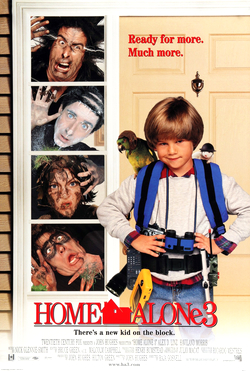
Criminals steal a valuable microchip and hide it inside a radio-controlled car, but a mix-up sends the toy to Alex Pruitt’s neighbour. Alex receives the car and later discovers what is inside while home sick with chickenpox. When his calls to the authorities do not stop the search, he watches the criminals and prepares his house. They break in, trigger his traps and chase him through the rooms. Alex frees his neighbour, Mrs. Hess, who has been restrained, and the police arrest most of the group after receiving a tip. The leader hides in the backyard, where the family’s parrot exposes him with a string of fireworks. Alex’s father returns, the family celebrates, and the criminals are shown catching Alex’s illness in their mugshots.
Home Alone 3 rebuilds the premise around Alex rather than relying on Kevin McCallister or the emotional continuity of the earlier films. That choice makes the movie’s identity depend on a new child’s way of solving problems. Alex is not presented as a miniature action hero with adult resources; his advantage is attention, patience and a willingness to turn familiar things into tools. The story’s comedy grows from the gap between how seriously the adults take the situation and how carefully he has been observing it. The house becomes a space he understands more fully than the intruders do.
Alex’s illness gives the film a reason to keep him at home, but it also creates a specific kind of vulnerability. He is separated from school and ordinary contact with neighbours, which makes his attempts to alert others feel more difficult. His condition becomes part of the comic machinery, though the underlying situation is still a child carrying responsibility that adults around him do not yet recognise. The movie uses that imbalance to create suspense without making Alex invincible. His ingenuity is impressive because it works within limited means, not because the story pretends he has the power or judgment of an experienced law-enforcement officer.
The criminals are designed for broad comedy, but their contrast with Alex is also structural. They move through the neighbourhood with a plan, a target and the confidence of people who assume a child cannot interfere. Their error is not a lack of resources; it is a failure to take the person watching them seriously. That makes the conflict legible to younger viewers. The adults’ apparent competence does not matter if they ignore local knowledge, while Alex’s size does not prevent him from seeing patterns the intruders overlook.
The house functions almost like a map of Alex’s imagination. Hallways, stairs, doorways and everyday objects become possible parts of a defensive plan because he knows how the space fits together. This is where the film makes its comedy physical: a viewer can understand what the criminals are trying to do and anticipate how an object might change the outcome. The pleasure comes from setup and payoff, from recognising that a familiar item has been given a new job. The traps are less about mechanical realism than about playful transformation of a child’s environment into a place he can navigate with confidence.
Mrs. Hess gives the story a relationship beyond the immediate contest inside the Pruitt home. At first she can appear strict and distant from Alex’s perspective, but the plot makes room for him to see her as a person rather than a neighbourhood obstacle. Their connection helps the film avoid reducing every adult to either a clueless parent or a faceless criminal. It also gives Alex a reason to act beyond protecting himself. The comedy is built from his resourcefulness, while the emotional thread comes from a small expansion of concern toward someone he had not initially understood.
The film’s ensemble includes family members who remain largely outside the main action. Their absence is functional: it leaves Alex temporarily on his own without presenting the household as emotionally empty. When the family returns, the story can rejoin ordinary domestic life after its comic emergency. That framing makes the episode feel self-contained. The new protagonist and family dynamic distinguish this installment from the franchise’s earlier holiday story, even as the basic appeal remains the same: a child takes an adult threat seriously before the adults around him do.
Raja Gosnell’s direction keeps the action within a clear, accessible register. The humour depends on knowing where characters are and what they can see, so the staging favours readable movement through the home and neighbourhood. This is not the tense geography of a crime thriller; it is a family comedy that converts danger into a series of comic reversals. The result asks viewers to enjoy Alex’s planning rather than worry that the film’s antagonists will overpower the tone. Its stakes remain understandable, and its set pieces are organised around visual cause and effect. The film’s place in the franchise is most interesting as a variation rather than a continuation of one hero’s life. Alex is a different child in a different household, and the movie lets the premise begin again without asking audiences to follow an ongoing character arc. That reset can make the story feel more like a standalone family adventure than a chapter in a single biography. Its central idea remains accessible: paying attention can give a young person agency in a situation where adults underestimate them. The ending returns the family to normal life, while leaving Alex’s ingenuity as the story’s lasting comic pleasure.