
Behind the film
- Year
- 1992
- Director
- Chris Columbus
- Writers
- John Hughes
- Runtime
- 2h 0m
- Genres
- Comedy, Christmas, Family, Mystery
- Production
- Great Oaks Productions, 20th Century Studios
- Country
- United States
- Cast
- Macaulay Culkin, Joe Pesci, Daniel Stern, John Heard, Tim Curry, Brenda Fricker, Catherine O'Hara, Eddie Bracken
About the film
Contains story spoilers.
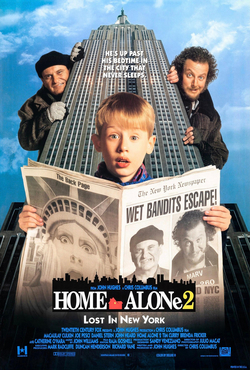
Kevin McCallister gets another Christmas on his own, this time in a city large enough to make being lost look like an adventure. His family is bound for Miami, a destination he dislikes because it seems to offer none of the snowy holiday he wants. After another argument with his older brother Buzz and a chaotic departure from Chicago, Kevin follows the wrong passenger through the airport and boards a flight to New York. His parents reach Florida before realizing he is missing. The mistake gives him a startling combination of freedom and resources: his father's bag has traveled with him, including the wallet and credit card that make an expensive hotel suddenly seem available.
The Plaza becomes Kevin's imagined version of grown-up life. He can order food, watch television and enjoy a room without a family member interrupting him, provided he can convince the staff that an adult is responsible for the bill. A recording and a convincing performance help him negotiate that problem, while the suspicious concierge keeps looking for an explanation. The pleasure is comic because Kevin has money without authority and confidence without much knowledge of how a hotel works. Macaulay Culkin plays him as someone who can devise a complicated deception yet still become completely absorbed in the simple luxury of room service. His independence is built on borrowed permission.
New York also contains Harry and Marv, the burglars Kevin defeated at home the previous Christmas. They have escaped prison and are planning a fresh robbery, while their delight at finding Kevin gives the city a threat he recognizes immediately. His trouble at the hotel makes that encounter more dangerous. The credit card has been reported missing, the staff confront him, and the comfortable room is no longer somewhere he can hide. The film moves him from a place where he could pretend to be an adult into streets where two actual adults are pursuing him. Harry and Marv retain their mutual irritation and disastrous confidence, but their intention to harm Kevin makes his need for refuge real within the comedy.
Duncan's Toy Chest gives Kevin a reason to act beyond keeping himself safe. Mr. Duncan explains that the shop's Christmas takings will help a children's hospital, so stealing the money would hurt people Kevin has never met. Duncan also gives him two small turtledoves, describing them as a symbol of friendship. The presents enter a story where Kevin has initially treated being alone as a reward. In Central Park, he meets a woman who cares for pigeons and has withdrawn from others after being hurt. He is frightened by her appearance before he gets to know her. Their conversation replaces that first reaction with an understanding of why she is lonely.
Kevin has another temporary refuge in his uncle's empty townhouse, which is being renovated. The unfinished building provides a new arena for his confrontation with the burglars, exchanging the first film's familiar family house for rooms that are already disrupted and full of work. He interferes with the toy-shop robbery and draws Harry and Marv toward the townhouse, where their pursuit becomes an escalating series of physical disasters. The injuries follow cartoon logic, with the men repeatedly recovering enough to make another terrible decision. Joe Pesci and Daniel Stern divide the comedy between Harry's angry attempts to regain control and Marv's bewildered enthusiasm. Kevin remains small enough for their presence to threaten him despite the spectacle.
His planned escape does not make him invulnerable. After leaving the house and calling the police, Kevin is caught in the park, and the pigeon lady intervenes when he can no longer rescue himself. Her birds overwhelm the burglars long enough for them to be arrested. The friendship formed during his night in the city becomes practical protection. Mr. Duncan later learns why Kevin broke the shop window from the note left behind, allowing him to distinguish the damage from the robbery it interrupted. These exchanges give Kevin's actions consequences outside his own family: one person can recognize his good intention, and another can answer the kindness he has shown her.
Kate's search provides the other route through New York. Catherine O'Hara gives Kevin's mother an urgency that cuts through the holiday decorations and the hotel comedy; once she reaches the city, she has to imagine where her son would choose to go. His love of Christmas trees leads her to Rockefeller Center, where they finally find one another and apologize. The reunion takes place in the kind of Christmas setting Kevin had wanted at the start, but being there alone has lost its attraction. The rest of the family joins the celebration, and Duncan sends gifts in thanks. Kevin then returns to the park with one turtledove for his new friend, keeping a relationship formed outside the McCallister household.
Chris Columbus makes the change of location feel larger than a simple substitution of buildings. The city offers crowds, hotel corridors and spectacular public decorations, while Kevin moves through them with the peculiar freedom of a child nobody realizes is unaccompanied. John Hughes's screenplay keeps returning to the difference between seeming independent and having someone willing to help. Kevin can bargain, perform and outwit a concierge, but he still needs his mother and the woman in the park. The holiday setting allows public spaces to become temporary homes: the toy shop offers generosity, the hotel offers a borrowed domestic routine, and the Christmas tree becomes a meeting place. Kevin's adventure expands his circle of trust as well as his collection of impressive escape stories.