
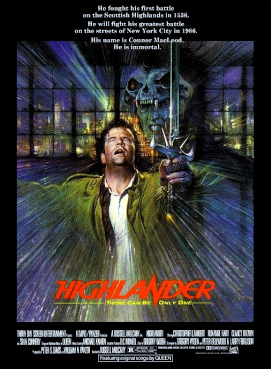
Behind the film
- Year
- 1986
- Director
- Russell Mulcahy
- Writers
- Gregory Widen, Peter Bellwood, Larry Ferguson
- Runtime
- 1h 50m
- Genres
- Fantasy, Adventure, Thriller, Action
- Production
- EMI Films, Davis-Panzer Productions
- Country
- United Kingdom, United States
- Cast
- Christopher Lambert, Roxanne Hart, Clancy Brown, Sean Connery, Beatie Edney, Alan North, Jon Polito, Sheila Gish
About the film
Contains story spoilers.
Connor MacLeod survives a fatal-looking wound in sixteenth-century Scotland and is cast out. The immortal Ramirez teaches him that their kind can die by decapitation and must eventually compete for a final Prize. Connor loves Heather, who ages while he does not; the Kurgan kills Ramirez and remains his enemy. Centuries later, Connor lives as antique dealer Russell Nash in New York. Killing another immortal draws police scrutiny, and specialist Brenda Wyatt follows the evidence toward his impossible history. The Kurgan abducts Brenda to force a confrontation. Connor defeats him at Silvercup Studios and becomes the last immortal. His reward includes mortality and insight into humanity, leaving him able to share an ordinary future with Brenda. The final victory gives his life a limit as well as a new beginning.
That mixture of grandeur and limitation shapes the film's idea of immortality. Extending a life does not ensure that its owner knows what to do with the extension. Connor's difference can look like freedom when measured against an ordinary lifespan, yet freedom becomes difficult to inhabit when the surrounding relationships cannot share it. His burden is therefore emotional as much as supernatural. A long memory contains attachments that the present cannot simply reproduce, and another era does not arrive with a clean version of the person entering it. Russell Mulcahy lets the fantasy's extravagant rules sit beside this more recognisable problem: surviving an experience and knowing how to live beyond it are separate achievements.
Brenda introduces a different understanding of time. Her expertise treats the past as something that can leave evidence, inviting careful examination rather than awe. That gives the fantasy a practical counterweight: an extraordinary claim still has to meet another person's questions. Connor's secrecy may protect him, but it also limits the possibility of being known. The tension between their approaches makes intimacy a problem of disclosure rather than attraction alone. Someone who has spent so much time controlling what others can discover must decide whether trust can involve surrendering part of that control. Brenda's curiosity therefore matters beyond the investigation; it asks whether his accumulated caution has begun to function as another kind of confinement.
The flashback structure treats memory as a series of encounters with changing values. Scotland’s open landscape gives way to the dense street grid and industrial surfaces of New York, but the sword remains a constant object linking both eras. Connor’s battle in the wet parking garage is a modern echo of older duels, while the water and electrical burst make an immortal death visible in an otherwise ordinary space. The film’s rhythm often shifts from a contemporary investigation to a memory triggered by a face, a weapon or a place. That structure lets several centuries be experienced as a personal burden instead of background chronology.
Ramirez’s arrival adds humor and theatrical energy to Connor’s isolation. He is a mentor, but also an outsider who has learned to survive by adapting his identity and manner to the time around him. His training of Connor is not only sword instruction; it puts survival and attachment into uneasy competition. Heather’s life with Connor complicates that lesson because she faces aging and mortality while he cannot share her time. The film’s immortal code can sound grand, but its most intimate consequence is the uneven duration of love.
Brenda’s growing knowledge and Connor’s reluctance to explain himself create a relationship built around conflicting kinds of evidence. She trusts artifacts, records and physical observation; he has spent centuries learning that proof can expose people to danger. Her work is not a simple route to the fantasy world but the ordinary profession that makes the fantasy legible. The police also read Connor as a suspect because their evidence is incomplete: the audience knows the centuries behind the apparent crime, while the investigators see a modern killing and a valuable antique. The split in knowledge supplies suspense without making Brenda foolish.
The opposition between Connor and the Kurgan makes the immortal contest a disagreement about the value of other lives. Clancy Brown's imposing presence gives aggression a bodily certainty, while Christopher Lambert's more reserved bearing allows survival to feel less complete. Winning a confrontation and choosing a worthwhile future are not interchangeable goals. The film gives that distinction an extravagant physical form through swordplay and supernatural energy, but its underlying question remains intimate: what kind of person has the contest trained each survivor to become? The scale of the mythology can threaten to turn everyone else into a passing figure. Connor's attachment challenges that reduction, making another person's limited time something to honour rather than merely outlast.
The film’s music and transitions contribute to its deliberately hybrid scale. A contemporary rock sound sits beside imagery of armor, horses and older Scottish settings, while sharp cuts make the centuries feel near rather than remote. City night scenes use neon and reflective surfaces to make New York a visual counterpart to the Highland landscapes, not merely a later date on a timeline. Sword choreography carries the same practical rhythm across both settings: bodies have weight, weapons meet obstacles, and the surroundings become part of the fight. Those choices keep the elaborate mythology legible as physical experience, even when the film enlarges an individual duel into a supernatural event.