
Behind the film
- Year
- 2008
- Director
- Kenny Ortega
- Writers
- Peter Barsocchini
- Genres
- Romantic comedy, Musical, Teen, Drama
- Production
- Walt Disney Pictures, Borden Rosenbush Entertainment
- Country
- United States
- Cast
- Zac Efron, Vanessa Hudgens, Ashley Tisdale, Lucas Grabeel, Corbin Bleu, Monique Coleman, Olesya Rulin, Alyson Reed
About the film
Contains story spoilers.
High School Musical 3: Senior Year places a deadline around a world that has made its characters recognisable to one another. East High supplies roles, relationships and routines that have become familiar across the earlier films. Graduation makes those arrangements temporary. The anxiety is not simply that school must end; it is that the place where somebody has learned to be themselves cannot promise to accompany them into every next decision. The musical gives that transition a shared form, allowing a group of friends to celebrate what they have built while admitting that continued closeness may no longer mean continuing in the same direction.
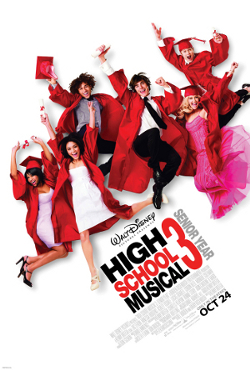
Kenny Ortega directs the 2008 film, written by Peter Barsocchini. Zac Efron plays Troy, Vanessa Hudgens plays Gabriella, Ashley Tisdale plays Sharpay and Lucas Grabeel plays Ryan, with Corbin Bleu as Chad and Monique Coleman as Taylor. This third entry concludes the original trilogy through the characters' final school year. A spring production gives their uncertainty somewhere to become public, transforming worries about the future into an activity they can make together. The premise lets the musical numbers operate as part of a farewell rather than merely as performances whose completion returns everyone to an unchanged routine.
The seniors prepare a musical while negotiating college plans and romantic separation. Gabriella leaves early for Stanford, and Troy struggles with expectations about basketball and theatre. He visits her, then returns with her for the performance. Ryan and Kelsi receive Juilliard scholarships, while Troy chooses Berkeley, combining basketball and theatre near Gabriella's college. The friends graduate and take their final bows. The conclusion distributes the futures rather than putting everybody into one plan, allowing the school experience to end as a shared achievement whose participants can carry different ambitions beyond it.
Troy's conflict concerns the difficulty of choosing when several valued relationships already contain expectations. A familiar future can look reassuring to the people proposing it because it continues the role they know him in. A different possibility may feel like rejection even when it grows from another genuine part of his life. The film makes that tension legible through two forms of performance: sport and theatre. They are not simply rival labels competing for ownership of a teenager. They are experiences through which he has developed abilities and attachments, so deciding what follows requires more than proving that one matters and the other should be discarded.
Gabriella's departure gives the romance a practical limit that affection alone cannot remove. A valuable opportunity arrives before the shared school ending, asking whether staying together must mean staying in the same place. This makes separation more substantial than a misunderstanding that a confession can instantly repair. Both characters have futures to consider, and the relationship needs a form that can accommodate those futures. The film's eventual reassurance works because it seeks an arrangement rather than declaring ambition incompatible with love. The problem is not that leaving proves insufficient feeling, but that feeling must now operate under circumstances it has not previously had to negotiate.
The scholarship competition places a different pressure on the theatre group. A production requires cooperation, while an opportunity can appear to reward only one participant. That tension gives ambition both a useful energy and a capacity to distort how people regard one another. Sharpay's determination is part of what makes performance matter to her, but it can also make other people's contributions seem like obstacles or possessions. The film keeps that friction within the communal project, allowing a farewell performance to contain rivalries instead of requiring everybody to become equally selfless before they can share a stage and contribute to the same event.
Ryan and Kelsi's opportunities make the closing distribution of recognition important. A visible lead is not the only person whose work can have a future. Collaboration contains different kinds of skill, and a production's success can depend on contributions that do not all occupy its most prominent position. That gives the graduation theme an additional meaning. Leaving school can make room for abilities to be understood differently from the hierarchy through which classmates have previously recognised them. The musical's shared activity provides a last familiar frame, while the announced futures suggest that recognition need not remain fixed to the roles people occupied when the group first came together.
The final bows give the ending a theatrical clarity without pretending that every future difficulty has been answered. These characters can acknowledge completion even though their relationships will require further work beyond it. That is the film's central farewell: a shared world becomes something to remember and carry, rather than something whose value depends on preventing change. High School Musical 3: Senior Year uses its production to turn impending separation into collective expression. Its optimistic ending allows different directions to remain compatible with gratitude, making graduation the point where belonging can change its form without being dismissed as something the characters have simply outgrown.