
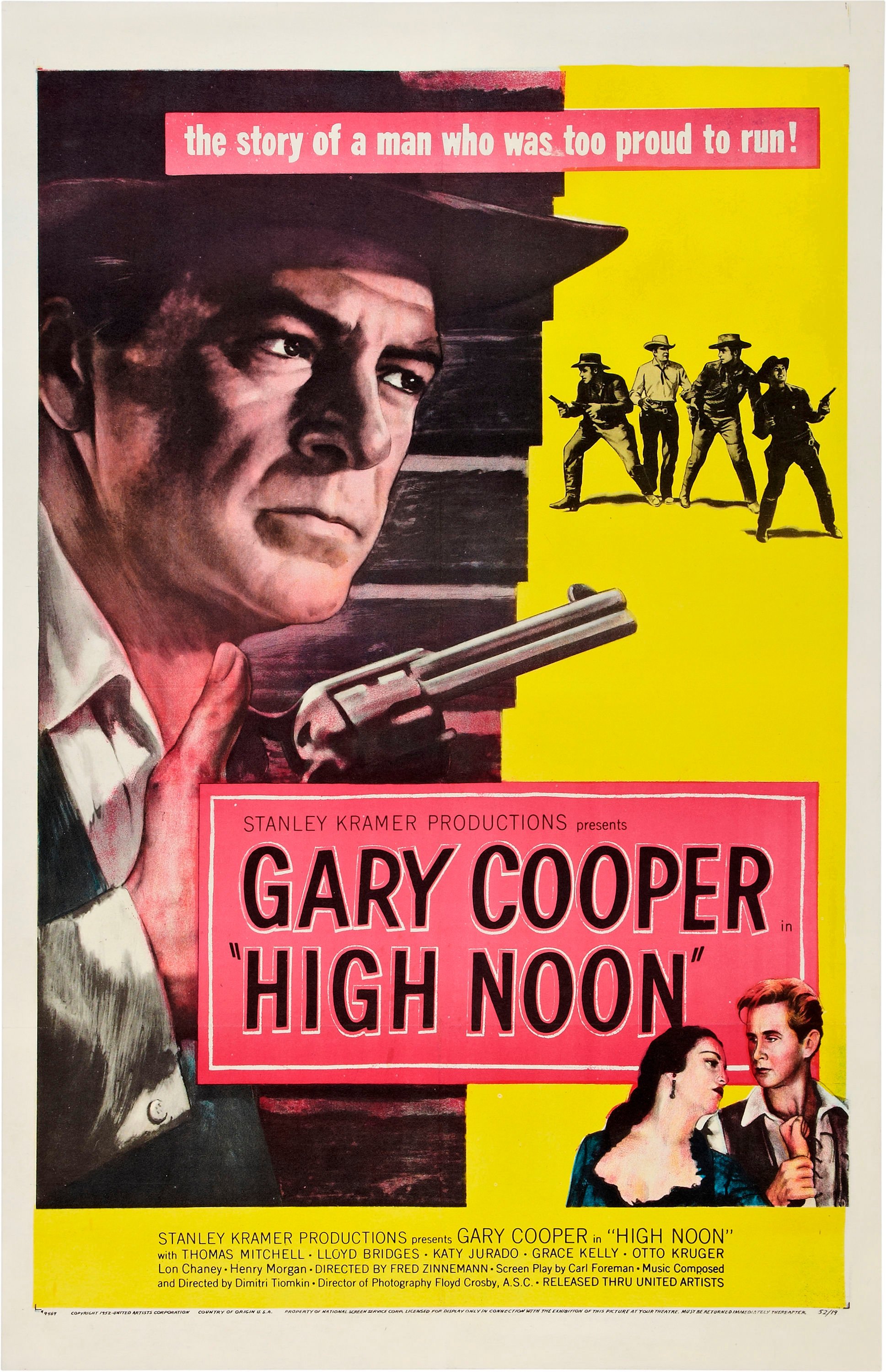
Behind the film
- Year
- 1952
- Director
- Fred Zinnemann
- Writers
- Carl Foreman
- Genres
- Western, Revisionist western
- Production
- United Artists
- Country
- United States
- Cast
- Gary Cooper, Grace Kelly, Thomas Mitchell, Lloyd Bridges, Katy Jurado, Otto Kruger, Lon Chaney Jr., Harry Morgan
About the film
Contains story spoilers.
Marshal Will Kane has just married Amy Fowler and plans to leave Hadleyville when word arrives that Frank Miller, an outlaw Kane sent to prison, has been released and is coming on the noon train. Kane decides to stay, knowing Miller may pursue him. He asks former allies to help form a posse, but the judge flees, deputy Harvey Pell resigns, townspeople refuse, and the church offers no support. Amy, a Quaker pacifist, prepares to leave on the train; Helen Ramírez, a former partner of Miller, Kane, and Pell, is also leaving. When Miller arrives with his gang, Kane faces them alone until Amy returns and shoots one attacker. Kane kills Miller, then drops his marshal’s star in the street and leaves with Amy.
The film’s near-real-time design turns an abstract ethical dilemma into a visible countdown. Clocks, train schedules, and characters glancing toward the station keep noon present even when the marshal is moving through town. The audience can feel the deadline approaching without needing a narrator to explain the stakes. This pacing also changes the western’s scale: rather than a broad journey across a frontier, the story follows one man from office to saloon to church and back. Each location is another attempt to discover whether the community will share responsibility.
Will Kane is not introduced as a hero eager for one last gunfight. He is newly married and has prepared for retirement, so staying is a decision that disrupts an intended ordinary future. Gary Cooper plays him with a measured physical economy. He is neither a young gunslinger nor a figure who seems excited by danger; his bearing conveys fatigue and obligation. The role’s tension comes from watching a person continue after it becomes clear that help may not come. His determination feels less like confidence in victory than refusal to abandon the town to a returning threat.
Amy’s pacifism gives the conflict a second moral vocabulary. She has already decided that violence cannot be the answer, and the choice to leave is consistent with the beliefs that shape her life. Grace Kelly plays her resolve with composure rather than indifference; she knows what Kane is risking and still cannot simply adopt his role. Her return during the attack does not erase that conviction. Instead, the film shows a person making an action under immediate pressure that conflicts with her usual principles, leaving the viewer to consider what the emergency has demanded of her.
Helen Ramírez offers another perspective on the same town. Her past relationships with Miller, Kane, and Pell place her outside the marshal’s official authority but close to the history that shaped it. Katy Jurado gives Helen an observant independence: she is leaving because she sees no reason to remain trapped in the town’s old conflicts. Her conversation with Amy clarifies that Kane’s refusal to leave is not simply a lingering romance. The exchange broadens the story beyond the marshal’s conscience, showing two women reasoning through the costs of violence and attachment from different experiences.
The town’s refusals are specific rather than interchangeable. Pell wants advancement and is bitter about Kane’s succession choice; the judge fears Miller; others want to protect business or believe the fight is not theirs. A handful of people are frightened, self-interested, or physically unable to help. The result is a portrait of civic life in which no single motive explains the whole crowd. Kane’s search for a posse becomes a map of private calculations, and the near-empty street at noon is the accumulated outcome of many separate decisions.
Fred Zinnemann’s direction keeps the visual field plain and purposeful. Streets and public rooms are composed to show who is present, who withdraws, and how much space separates Kane from potential allies. The film’s black-and-white photography and measured cutting support the pressure of time without disguising the action in elaborate spectacle. The town becomes recognizable through repeated routes rather than a changing landscape. This visual restraint places emphasis on gestures: a turned back, a closed door, or a person who watches from a threshold.
The western setting makes civic responsibility concrete without making it comfortable. Protection is something the town has benefited from, but sharing its cost becomes much harder when danger arrives with an identifiable deadline. The film tests the distance between praising a public role and supporting the person who occupies it. Kane's isolation is therefore an accumulated social fact rather than merely a heroic pose. Zinnemann lets the audience spend time with that accumulation, observing how respectable explanations can end in the same empty street. The tension does not depend on deciding that every frightened person is alike. It depends on recognizing how individual choices combine. High Noon makes courage demanding by giving refusal so many ordinary forms, then asking what a community means when its members expect duty to be somebody else's burden.