
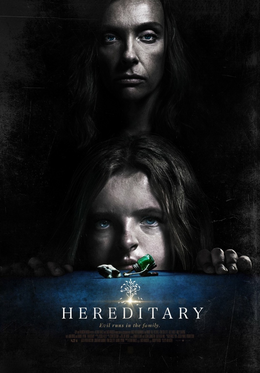
Behind the film
- Year
- 2018
- Director
- Ari Aster
- Writers
- Ari Aster
- Genres
- Horror, Drama
- Production
- PalmStar Media, A24
- Country
- United States
- Cast
- Toni Collette, Alex Wolff, Milly Shapiro, Ann Dowd, Gabriel Byrne
About the film
Contains story spoilers.
Ari Aster’s Hereditary follows the Graham family after the death of Ellen, Annie’s mother. Annie makes miniature models of rooms and houses, a craft that gives the film a visual language for distance: people can be carefully arranged and observed without being able to control what happens to them. At the funeral, Annie speaks about Ellen’s complicated presence in the family, while her husband Steve and their children Peter and Charlie remain close by but not necessarily in agreement about how to grieve. The house is full of quiet corners, attic access and bedrooms that make family life feel exposed. The film builds unease through routine details before it reveals how much of the family’s history remains undisclosed.
Charlie is an unusual, solitary thirteen-year-old who makes small figures from household objects and carries a history of intense attachment to her grandmother. Peter is older and wants more independence; Annie insists that he take Charlie with him to a party. There Charlie eats cake containing nuts, and Peter drives her away when she begins to react. On the dark road she leans out of the car window for air; Peter swerves to avoid a dead animal, and Charlie’s head strikes a roadside pole. Peter stops but cannot bring himself to turn around and face what happened. He drives home and leaves her body in the car. Annie finds it the next morning, and the family’s grief takes on a different shape: Peter’s silence, Annie’s anger and Steve’s efforts to keep the household functioning all become part of the same wound.
Annie attends a support group and meets Joan, who describes a way to contact a dead relative. Annie is skeptical but desperate enough to try a séance at home. The experience appears to let her speak with Charlie, and the apparent contact briefly gives the family a language for loss. Steve does not share her belief and worries that Annie’s state of mind is worsening. Peter, meanwhile, becomes frightened by disturbing experiences at school and at home. The film connects these events without immediately settling whether they arise from trauma, a supernatural force or both. Its focus remains on how grief changes the family’s interpretation of each other: a look can seem like accusation, while an ordinary disagreement begins to feel like evidence that the house is no longer safe.
Annie’s miniatures become more than an artistic motif when she discovers evidence that her mother had been involved in occult practices. The discovery reframes the family’s history, but the film ties it to Annie’s guilt and fear rather than treating it as a tidy explanation for every emotion. Annie’s experiences grow more violent, and she throws Charlie's sketchbook into the fireplace. Steve bursts into flames as the book burns; Annie watches in horror as the act has an immediate supernatural consequence. Her movement and expression change as the force affecting her takes greater control. Peter sees what is happening but remains trapped inside the house.
The final stretch makes the family’s home feel like a route through a nightmare. Annie pursues Peter through the house and into the attic. Peter locks himself in, while Annie, suspended above him, repeatedly strikes her own neck with a wire. Peter eventually jumps from the attic window and lies motionless on the ground. A light enters his body, and he rises to follow the figures gathered in the treehouse. The cult gathers around him and hails him as Paimon. Their ceremony treats this as a success, but the scene is not presented as a comforting rescue or a conventional explanation that restores the family. The audience sees Peter’s body and identity absorbed into a plan that began before he understood it.
Hereditary’s horror depends on the intimate scale of its tragedy. The film does not make the Graham home a maze of spectacular effects; it keeps returning to the kitchen, bedrooms, attic and miniature studio where characters cannot escape their shared history. Toni Collette’s Annie moves between professional precision and emotional collapse, while Alex Wolff’s Peter conveys fear through the way he withdraws from conversation and from his own body. The visual match between a model house and the real house suggests that people can be made to feel like objects in someone else’s design. By the end, the family has not found a way to mourn together: the rituals that promise contact instead complete the harm that has been gathering around them.
The film’s objects also carry the family’s secrets from one generation to the next. Annie’s mother leaves behind an occult book and photographs that point toward a hidden network, while the miniature rooms turn private moments into scenes that can be revisited at a distance. These details make the title feel less like a claim that a single trait passes through blood and more like the experience of inheriting relationships and obligations one never chose. Charlie’s connection to Ellen is visible before the family understands its significance; Peter’s distance from both his sister and his mother then becomes another pressure point. Aster keeps returning to enclosed rooms, careful compositions and small figures so that the occult plot remains attached to family life. Even when the events become overtly supernatural, the characters are still responding to loss, fear and the harm they have done to one another.