
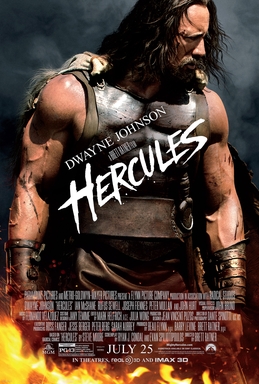
Behind the film
- Year
- 2014
- Director
- Brett Ratner
- Writers
- Evan Spiliotopoulos
- Genres
- Action, Fantasy, Sword-and-sandal
- Production
- Paramount Pictures
- Country
- United States
- Cast
- Aksel Hennie, Ian McShane, Reece Ritchie, Ingrid Bolsø Berdal, Joseph Fiennes, John Hurt, Rebecca Ferguson, Irina Shayk
About the film
Contains story spoilers, including the ending.
Hercules begins with a reputation already much larger than the man who carries it. Dwayne Johnson's warrior has stories of impossible labours attached to his name, and Iolaus, his nephew and storyteller, knows how to keep those stories circulating. Brett Ratner's 2014 film presents the spectacular monsters of the legend through that process of embellishment, then follows a fighter travelling with a skilled mercenary band. His companions contribute to accomplishments credited to a single hero. The distinction matters when they accept a military contract in Thrace, where a king wants their expertise to help defeat a supposed threat to his people. Hercules is also carrying the memory of a violent family tragedy. The public version of him is an invincible figure; the man working for payment has fears, allies and a past that continues to disturb him.
The employer is Cotys, whose daughter Ergenia approaches Hercules and his companions. Their job is to train the Thracian forces against Rhesus, but victory exposes the story behind the war as a deception. Rhesus tells Hercules that Cotys is responsible for the atrocities attributed to him, and Ergenia confirms the king's expansionist aims. Hercules chooses to intervene rather than simply leave with his reward. His capture brings another ruler into the open: Eurystheus, an ally of Cotys who drugged Hercules and sent wolves to kill his family. The confession replaces Hercules's fear of his own guilt with knowledge of a calculated betrayal. The confrontation leads to escape and a battle against the king's own forces. At its height, Hercules brings down a huge statue of Hera, crushing Cotys. The weapon is now a monumental image of a goddess, placing the hero's physical strength against the power represented by the citadel and its ruler.
Ratner described his approach as a demystification of a familiar hero, and Johnson prepared for the part as a sustained physical undertaking. He began months ahead of filming, working with fitness and diet coaches to arrive at a particular condition and maintain it through a long shoot. The supporting warriors faced related demands in weapons work, wardrobe and action. Ratner recalled actors riding chariots at speed, with the final horse-flipping moment assembled from photographed performance, practical action and a digital element. He also explained that the production did not film natively in stereoscopic 3D. Instead, he planned images with that presentation in mind and converted the finished material. The physical cast, the practical action and the later digital work therefore occupy the same filmmaking process, even when the screen shows a single apparently continuous feat.
Planning those feats began before the cast performed them. The Third Floor supplied previsualisation, starting with the Bessi battle to explore both the scale of the fighting and what the principal characters could do. The opening labours were also planned this way, then rendered with a camera for each eye to demonstrate the possible depth of a 3D presentation. Ratner used these animated preparations to judge the numbers of performers needed, what could be photographed and where scenery would require extension. Cerberus needed repeated exploration because the creature appears through Hercules's troubled perception. For the dungeon, the team worked from set plans and photographs of an art-department model. Plans for the large outdoor Temple of Hera near Budapest also allowed them to build its extensions and statue into the intended movement of the final sequence before filming.
Method Studios later handled around a hundred effects shots, most of them belonging to the final battle. The citadel combined photographed scenery with digital extensions, additional soldiers, weapons, fire and destruction. Timing was a particular problem when the oil fires had to reach fleeing soldiers without simply overtaking the photographed performers. Some figures were replaced with digital doubles to make the action fit. The collapse of the Hera statue and surrounding structures was also developed as a longer simulation before being divided among the edited shots. Sunset created another challenge: nearby extensions had to match the light on the real set, while distant additions had to sit against the changing sky. The team used separate lighting arrangements for those demands and passed additional controls to the colour-finishing team, allowing the sky's warmth to develop across the battle.
The film's source is Steve Moore's Hercules comic, with Ryan J. Condal and Evan Spiliotopoulos credited for the screenplay. Its home release also preserves more than one version of this adventure. Paramount's 2014 Blu-ray packages included the theatrical film and an extended cut, with the latter presented in 2D. The 3D disc carried the theatrical version. Those distinctions matter when comparing the length or action content of different editions, since the extended version adds material absent from cinemas. The accompanying features followed the mercenary team, weapons preparation, the Bessi battle and the visual effects, with deleted or extended scenes presented separately. Taken together, those subjects trace the same work visible in the story's action: an individual strongman surrounded by a fighting company, physical weapons and crowds, then an environment expanded or transformed after the cameras had stopped.