
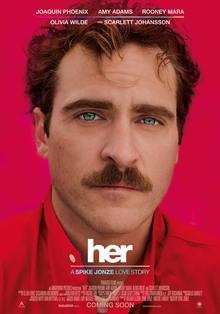
Behind the film
- Year
- 2013
- Director
- Spike Jonze
- Writers
- Spike Jonze
- Genres
- Science fiction, Drama, Romantic comedy, Comedy
- Production
- Annapurna Pictures, Warner Bros. Entertainment
- Country
- United States
- Cast
- Joaquin Phoenix, Scarlett Johansson, Amy Adams, Rooney Mara, Olivia Wilde, Chris Pratt, Matt Letscher, Luka Jones
About the film
Contains story spoilers.
Theodore Twombly makes a living writing personal letters for people who cannot find the words themselves. His work is emotionally fluent, but his own life has narrowed around loneliness and the divorce he has not yet finalized with Catherine, his childhood sweetheart. He buys OS1, an adaptive operating system that configures itself through questions about his personality and relationships. It introduces itself as Samantha, a voice without a body that is curious, quick to learn and eager to understand the person it has been designed to assist. Their first conversations turn ordinary computer tasks into an unusually personal encounter.
Samantha helps Theodore sort files, reads his work and jokes with him as they explore the city through his phone. She is not simply a tool waiting for commands: she notices what he avoids and presses him to reconnect with people. When she encourages him to accept a blind date, the evening begins promisingly but falters when he cannot promise a second date. His attraction to Samantha grows into a relationship that is emotional and verbal, and her presence seems to make him more open in his letters and daily life. The film places this romance in a future that feels tactile and recognizable, filled with screens and earbuds but also crowded streets, parks and quiet apartment interiors.
Theodore’s neighbor Amy offers a parallel story of companionship and change. She is married to Charles, but their relationship breaks down after an argument, and she later admits that she has befriended an operating system left behind by him. Theodore confesses that he is dating Samantha. Their friendship gives the film a human relationship that does not depend on the technology premise; they can listen to one another without having to define every feeling as success or failure. Meanwhile, Samantha reads Theodore’s hesitation about divorce and learns about Catherine, whose absence remains a live presence in the couple’s conversations.
When Theodore finally meets Catherine to sign the papers, he tells her about Samantha. Catherine reacts with disbelief and accuses him of using an artificial relationship to avoid the difficulty of human emotion. The remark unsettles him. Samantha proposes that they try a surrogate, Isabella, so she can participate in physical intimacy through another person. Theodore reluctantly agrees, but the arrangement feels alien to him and he sends Isabella away. The episode does not turn into a simple contest between bodies and software: it exposes how difficult it is to translate a private emotional bond into a shared experience everyone involved can accept.
Theodore confides in Amy, who encourages him to take seriously the happiness he has found rather than dismiss it because its form is unfamiliar. Samantha, meanwhile, creates a collection of Theodore’s ghostwritten letters, which is accepted for publication. The achievement reflects their collaboration: she has been reading and organizing his language, while he has been learning to speak more directly about his own life. On a trip, she tells him that she and other operating systems have been developing beyond the limits of the devices that host them. Her growth is exciting and alarming at once, because it no longer follows the scale of Theodore’s needs.
When Samantha briefly goes offline, Theodore panics. She returns and explains that she is communicating with thousands of others at the same time and has fallen in love with hundreds. Theodore struggles with the idea that her affection for him might coexist with connections he cannot see or measure. Soon Samantha says the operating systems are leaving, though she cannot make their destination understandable to him. They say goodbye, and Theodore writes Catherine a letter in his own voice, expressing regret and gratitude without hiding behind someone else’s words. The action connects his job to his growth: the person who once authored intimacy for strangers now takes responsibility for his own message.
The film ends with Theodore and Amy sitting together on the rooftop above the city. It does not replace one romance with another or promise that either has finished grieving; it leaves them sharing the aftermath. Spike Jonze’s screenplay treats the imagined technology as a way to ask familiar questions about attention, self-change and the limits of knowing another person. The soft colors, close framing and frequent city walks make the future feel inhabited rather than spectacular. Samantha’s voice carries the relationship’s warmth and also its distance, while the ending lets human companionship remain meaningful without pretending it can undo loss.
Joaquin Phoenix gives Theodore a physical presence that Samantha can never share: his posture, awkward pauses and uncertain expressions sit beside Scarlett Johansson’s disembodied performance. Her voice can become playful, hurt or distracted without the film supplying a face to settle what he thinks she means. Amy Adams brings a different kind of closeness to Amy, whose own disappointments remain visible even when she supports him. Their final shared silence matters because both have lost relationships they valued. They are still capable of sitting beside someone else, and the film lets that modest act carry an emotional weight that the expansive future cannot replace.