
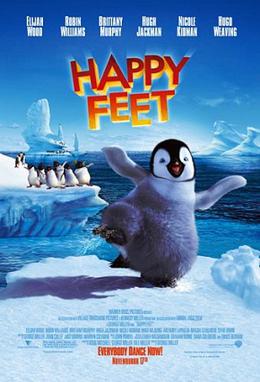
Behind the film
- Year
- 2006
- Director
- George Miller
- Writers
- George Miller, John Collee, Judy Morris, Warren Coleman
- Genres
- Buddy, Musical, Comedy, Family
- Production
- Warner Bros. Entertainment, Kennedy Miller Mitchell, Animal Logic
- Country
- Australia, United States
- Cast
- Elijah Wood, Robin Williams, Brittany Murphy, Hugh Jackman, Nicole Kidman, Hugo Weaving, Magda Szubanski, Steve Irwin
About the film
Contains story spoilers.
Happy Feet imagines a community whose most important social language is music, then places a dancer at its centre. Emperor penguins find their partners through individual songs, so Mumble’s inability to sing seems to deny him a place in the ordinary future of the colony. His feet offer another form of expression, one that the surrounding birds do not know how to accept. George Miller’s 2006 animated musical uses that mismatch to ask how a group decides which differences are tolerable. The Antarctic landscape adds a physical scale to the question. A penguin can seem very small against ice, ocean and distant mountains, while the judgements of the colony still feel enormous from within. Mumble’s movement connects a private difficulty to a world that turns out to contain much larger problems.
Mumble grows up with Norma Jean and Memphis, unable to produce the heartsong expected of him. Gloria matters to him, but his dancing attracts the elders’ suspicion as food becomes scarce. Outside the colony, the Adelie penguins known as the Amigos welcome him, and Lovelace’s plastic neck-ring provides a trace of human activity. Mumble’s search leads past predators and fishing boats to human captivity. His dance finally attracts attention there, and he is returned to Antarctica with a tracking device. When humans observe the dancing colony, the film’s fictional resolution links that attention to action against overfishing. A trait once used to blame Mumble becomes a way for the colony to be seen.
The musical premise makes expression a necessity rather than decoration. Singing carries identity, attraction and membership all at once, so being unable to perform it is different from simply lacking a popular talent. Elijah Wood voices Mumble as someone who has to participate in a society whose expectations are not designed for him. The story does not solve that problem by giving him a conventional singing voice after sufficient practice. Dance remains his means of reaching others. That distinction gives the musical numbers a dramatic purpose: they establish a shared language while letting a different rhythm disrupt it. His movement can be comic and joyful without cancelling the loneliness created when everyone else measures him by another skill. What seems natural to him remains something he must defend.
His parents make the question of belonging more intimate. Nicole Kidman’s Norma Jean and Hugh Jackman’s Memphis bring different responses to a child who does not fit the familiar pattern. The father’s concern is complicated by a belief that conformity will keep Mumble safe and accepted. That creates a recognisable tension inside the film’s fantasy: love can become pressure when a parent treats an existing rule as the only route to a good life. Gloria, voiced by Brittany Murphy, offers another connection to the world Mumble wants to inhabit. Her musical ability embodies the standard he cannot meet, but their relationship gives that standard a human-scale emotional cost. He is seeking more than an abstract right to be unusual; he wants companionship within the place he knows.
The colony’s explanation of its food shortage reveals how easily a social judgement can become an answer to a material crisis. Mumble’s difference is visible, close at hand and already unpopular, making it convenient to treat as a cause. The actual source of scarcity lies beyond the birds’ immediate knowledge. The adventure therefore widens as the community’s explanation narrows. Meeting the Amigos gives Mumble evidence that another group can value the same behaviour differently. Lovelace introduces a more complicated kind of authority, with a story about his apparent distinction concealing the danger of the plastic caught around his neck. A visible sign of special status can be a sign of damage instead. The film repeatedly separates the meaning a community assigns to something from the conditions that produced it.
Miller’s animated world moves between collective choreography and abrupt vulnerability. Penguins can fill the frame as a coordinated group, then become isolated bodies pursued through ice and water. Predators interrupt the musical exuberance without turning the Antarctic setting into a simple background for songs. The scale of the human world changes the terms again. Mumble cannot explain the colony’s situation to people in the way he communicates with other penguins. His dance becomes an attempt to attract recognition across a gap that words cannot cross. The mixture of animated animals and live-action humans gives that encounter a distinct visual boundary. It places the audience beside a character trying to make himself understood by figures who belong to a different level of the film’s world.
The ending brings movement, belonging and environmental pressure into the same image: the colony dances together while being watched from outside. It is a deliberately optimistic resolution within a fictional musical, rather than a record of how a real conservation policy came about. The birds’ songs, social judgements and relationships likewise belong to the story’s invention, even when their landscape evokes an actual place. Happy Feet uses that invention to move from a young penguin’s unwanted difference towards a change in collective behaviour. The community does not become safer by silencing him. It gains another way to respond when it accepts what he can do. Mumble’s final place among the others depends on their willingness to change the terms of membership, as well as his persistence in travelling beyond them.