
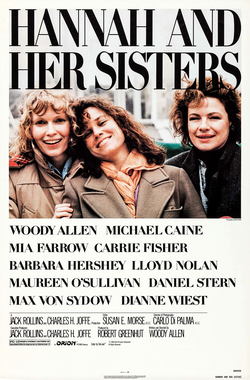
Behind the film
- Year
- 1986
- Director
- Woody Allen
- Writers
- Woody Allen
- Runtime
- 1h 46m
- Genres
- Romantic comedy, Drama
- Production
- Orion Pictures
- Country
- United States
- Cast
- Mia Farrow, Michael Caine, Barbara Hershey, Dianne Wiest, Woody Allen, Carrie Fisher, Max von Sydow, Maureen O'Sullivan
About the film
Contains story spoilers.
Across three Thanksgiving gatherings, Hannah's husband Elliot conducts an affair with her sister Lee, who leaves the controlling artist Frederick but eventually tires of Elliot's indecision. Hannah's other sister Holly struggles with acting, a catering venture and dependence on Hannah's money before turning to writing. Hannah's former husband Mickey survives a health scare, falls into despair about life's meaning and eventually finds comfort in comedy. He and Holly reconnect after an earlier disastrous date, and he admires her new work. By the final gathering, Lee has married a professor, Hannah and Elliot have reconciled, and Holly is married to Mickey and pregnant. Around them, their parents' volatile marriage offers another model of attachment. The family's continuity contains major changes that its familiar social rituals do not immediately reveal.
Hannah appears to be the person around whom other people's lives can safely organise themselves. Mia Farrow's character gives the film an emotional centre without making her viewpoint the only one available. Being dependable carries an awkward cost: people may rely on someone's strength while resenting the comparison it creates. Help can feel generous to its provider and humiliating to its recipient at the same time. The family therefore contains several incompatible versions of the same relationships. A woman can regard herself as offering practical support while another experiences that support as proof of failure. The film's intimacy grows from letting those perceptions coexist rather than declaring one account sufficient for everyone.
Elliot's dissatisfaction reveals how easily a person can turn private longing into a persuasive explanation of his own conduct. Michael Caine's character is capable of recognising other people's qualities, yet recognition does not prevent him from arranging them around his needs. Wanting to feel necessary can become a reason to undervalue someone who seems self-sufficient. That makes the romantic triangle about more than which partner is more attractive. It concerns the emotional jobs people expect a relationship to perform for them. Desire promises an escape from an established role, but the person pursuing that escape may carry the same habits into the next arrangement. The film leaves room to see the appeal and the selfishness together.
For Lee, intimacy is entangled with the authority to interpret her own life. Barbara Hershey's character inhabits relationships in which attention can arrive with instruction attached. Being admired is not necessarily the same as being granted independence. A partner who believes he understands the world may also assume that understanding gives him a special claim over somebody else's future. Her place among the sisters adds another pressure: personal decisions alter a family network, so a relationship cannot remain entirely private even when it is secret. The film's shifting perspective keeps that network visible. What looks like an individual romantic adventure from one angle becomes a problem of trust and belonging from another.
Holly's uncertainty gives the family a different kind of vulnerability. Dianne Wiest's character wants to find work that fits her without having every attempt become another measure of inadequacy. Creative ambition makes rejection unusually personal because it can seem to judge not just a skill but an entire self. The story allows her restlessness to be frustrating and understandable at once. Her relationship to Hannah shows how love and comparison can become inseparable between siblings: somebody else's stability is reassuring until it begins to look like an accusation. The possibility of finding a voice matters because it gives achievement a meaning beyond outperforming another person or finally satisfying the family's expectations.
Mickey's search for certainty expands those anxieties into a comic confrontation with mortality. Woody Allen's character approaches existence as if enough thought might produce a reassuring final answer. The impulse is recognisable even when his attempts become absurd: knowledge can feel like protection against a future nobody can control. Comedy offers a different relationship to that uncertainty, one based on participation and pleasure rather than complete explanation. His place in the ensemble keeps the romantic disappointments from looking like isolated problems. Everyone is trying to establish some reason to feel secure, whether through another person's love, professional recognition, intellectual authority or a view of life that will stop shifting beneath them.
New York gives the relationships a shared cultural space. The film moves through a world where work, art, conversation and family gatherings overlap, allowing private anxieties to circulate through apparently ordinary social encounters. Carlo Di Palma's photography belongs to an ensemble drama whose attention can pass between people without losing the sense that they inhabit the same city. Its intermittent narration and title cards add another layer: thoughts and the arrangement of the story need not coincide with what characters are willing to say aloud. That gap is useful for a film about concealment and misreading. A civil exchange can contain emotions which the speaker is still trying to organise.
The recurring celebrations make change visible through repetition. Returning to the family does not mean returning to an unchanged emotional arrangement, even when the gathering looks familiar. The ending permits hope without establishing that every earlier hurt has been understood or repaired. Its satisfaction depends on accepting that people may find workable lives before they achieve complete self-knowledge. Hannah and Her Sisters treats happiness as something assembled among imperfect relationships, rather than a reward reserved for characters who have solved themselves. The family can absorb change, but it cannot make desire predictable or dependence uncomplicated. That is what gives the comedy its warmth and its discomfort: living together remains a negotiation between affection and private needs.