
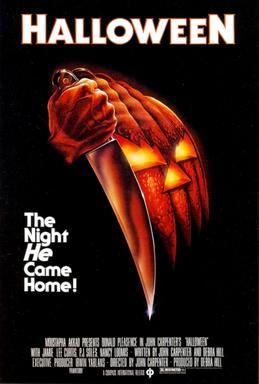
Behind the film
- Year
- 1978
- Director
- John Carpenter
- Writers
- John Carpenter, Debra Hill
- Runtime
- 1h 33m
- Genres
- Horror, Slasher, Teen, Drama
- Production
- Compass International Pictures
- Country
- United States
- Cast
- Donald Pleasence, Jamie Lee Curtis, Nancy Kyes, P. J. Soles, Nick Castle
About the film
Contains story spoilers.
John Carpenter’s Halloween begins with a brief childhood crime and then jumps forward fifteen years, establishing that Michael Myers has escaped the institution where he was held. The opening is shot from a child’s point of view as six-year-old Michael takes a knife and kills his sister Judith; only at the end does the camera reveal who has been watching. On October 30, Dr. Loomis and nurse Marion Chambers drive to Smith’s Grove Sanitarium to escort Michael to a court hearing. Michael escapes, attacks Marion, and steals the car while Loomis is opening the gate. The film then moves to Haddonfield, where Michael takes clothes from a mechanic before walking through streets preparing for Halloween.
Laurie Strode notices the strange figure before she knows who he is. She is a high-school student who spends the afternoon with friends Annie Brackett and Lynda Van der Klok, while also agreeing to babysit Tommy Doyle. Annie has a more confident, teasing manner; Laurie is observant and cautious, but the film does not frame that caution as a special power. Michael appears at a distance, behind trees, across a clothesline, or through a car window. His stillness makes ordinary gaps in the suburb’s visual landscape feel threatening. Loomis, meanwhile, understands that Michael has returned to Haddonfield and tries to warn Sheriff Brackett, but his urgent certainty is difficult to communicate to a town that sees only a quiet autumn evening.
The film follows several neighboring houses, letting domestic routines gradually acquire a second meaning. Annie is meant to watch Lindsey Wallace, while Laurie keeps Tommy company at the Doyle home. The children play and talk about monsters; Laurie and Annie trade jokes and make plans. Michael moves between the Wallace and Doyle houses, using windows, parked cars, and dark rooms as hiding places. The camera often shows him before Laurie can see him, so the audience has to sit with the difference between what is visible and what the characters have reason to suspect. The suburban setting matters because the danger arrives without changing the town’s familiar appearance: porch lights, hedges, and quiet streets remain in place.
Annie is killed while heading out to meet her boyfriend. Michael attacks her in the parked car at the Wallace home, turning an ordinary departure into a trap before she can drive away. Lynda and her boyfriend Bob later arrive there; Michael kills Bob and then Lynda, who tries to call Laurie from upstairs. Laurie hears the call but does not understand what has happened. The film keeps these deaths largely within the stalking pattern rather than turning them into elaborate set pieces. That choice preserves the uncertainty of the night: each apparent pause can be followed by another glimpse of Michael, and the audience understands that Laurie’s friends are not simply late or teasing her.
When Laurie goes to the Wallace house to investigate, she finds the bodies arranged in a room upstairs, including Annie beneath a gravestone taken from the cemetery. Michael attacks her, and she barely escapes to the Doyle house, where Tommy and Lindsey are still waiting. She is wounded and exhausted, but she gets the children to safety and sends them to seek help. Michael follows her inside. Laurie fights back with a knitting needle, a wire hanger, and a kitchen knife, each improvised because there is no weapon or plan ready for her. She briefly knocks him down more than once, but he keeps returning. Loomis reaches the room and shoots Michael, who falls from the balcony outside.
The ending refuses to turn that rescue into a clean victory. Loomis looks down from the balcony and sees that Michael has vanished after falling there from the room where Loomis shot him. The film cuts to a series of places from the evening, now empty but still marked by his presence. The implication is not that Laurie failed, but that the immediate night has ended without the danger being fully contained. Carpenter’s spare score, measured camera movements, and repeated views of unoccupied space help maintain that uncertainty. The film’s horror comes from the way a familiar environment offers little protection once someone can watch unseen. Halloween builds its suspense through ordinary time—walking home, babysitting, checking a room—and leaves the town itself looking almost unchanged after everything that has happened.
The film also uses Loomis as a counterpoint to Laurie’s limited knowledge. He has spent years watching Michael and recognizes the escape as a return to the same town, but his warnings arrive in a form the sheriff and townspeople can dismiss as exaggeration. Laurie has no such background; she has to decide what to do from what she can see in the moment. The difference between Loomis’s certainty and Laurie’s practical responses keeps the story from becoming a simple hunt by an expert. As night deepens, ordinary Halloween masks and costumes make it harder to identify the figure following her. The film’s sparse dialogue lets these contrasting kinds of knowledge coexist: the doctor understands the scale of the threat, while the babysitter must survive the next few minutes and protect two children who cannot fully understand why she is afraid.