
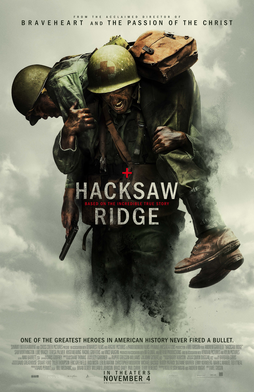
Behind the film
- Year
- 2016
- Director
- Mel Gibson
- Writers
- Robert Schenkkan, Andrew Knight
- Genres
- Biographical, Drama, War
- Production
- Summit Entertainment
- Country
- United States, Australia
- Cast
- Andrew Garfield, Vince Vaughn, Sam Worthington, Luke Bracey, Hugo Weaving, Ryan Corr, Teresa Palmer, Richard Pyros
About the film
Contains story spoilers.
Hacksaw Ridge follows Desmond Doss from a Virginia childhood shaped by faith, family conflict and a vow not to kill, into the Army of World War II. Doss is not a pacifist who avoids service: he enlists because he wants to save lives as a combat medic. His refusal to hold a rifle turns that intention into a confrontation with the institution around him. The tension is concrete rather than abstract. Doss wants to stand beside men who will face combat, while the Army insists that a soldier who will not train with a weapon cannot be trusted to serve.
A childhood incident with his brother helps explain Doss’s promise, while his father Tom carries scars from his own war service and fears what military life will do to his son. Doss meets nurse Dorothy Schutte after bringing an injured man to hospital; their relationship gives the film a quieter measure of his character. He is sincere but stubborn, awkward and unprepared for how hostile his conviction will make his fellow recruits. Dorothy understands his medical ambitions even as the men in uniform see only someone refusing orders.
At training, Sergeant Howell and the other soldiers treat Doss’s refusal to handle a rifle as insubordination. Pressure escalates from ridicule to a beating, and Doss is arrested for disobeying orders. He refuses a discharge that would let him leave without resolving the conflict. His father intervenes at the hearing with a letter from a former commanding officer, helping establish his right to conscientious objection. The ruling allows Doss to serve as a medic without carrying a weapon. It is a compromise, but not a comfortable one: he remains in the unit with men who resent the exception.
The film shifts sharply when the unit reaches Okinawa. Training-ground arguments give way to a battlefield where visibility is poor, bodies and equipment lie across the slopes, and a steep escarpment separates fighting from relative safety below. Doss’s decision to stay with the wounded becomes a repeated physical task. He treats men under fire, moves them toward the cliff edge and lowers them by rope, returning to search for more even after the unit withdraws. His courage appears less as a single charge than as a series of deliberate returns.
As Japanese forces counterattack, Doss continues the rescue through the night. He prays for one more life to save, keeps searching the battlefield, and carries wounded soldiers to the ridge and down to waiting hands. The film presents the action through noise, abrupt movement and close physical detail, contrasting chaos with Doss’s narrow focus on each person he can reach. His unit’s understanding changes as the men realize that the man they considered a liability is taking risks for them without asking who deserves help.
Captain Glover's apology marks a change in the unit's understanding of Doss. Before the next assault, the soldiers wait for his Sabbath prayers rather than treating them as an inconvenience. The renewed attack brings another danger when an apparent Japanese surrender becomes an ambush. Doss protects other men from grenades and is wounded himself. He is lowered from the ridge holding Dorothy's Bible, now dependent on the comrades he has spent the night helping. The ending connects the dramatization to the real Doss through archival material and his testimony, identifying the seventy-five rescues for which he received the Medal of Honor. It closes on a person's remembered service rather than treating the battlefield victory as the entire meaning of his life.
Andrew Garfield plays Doss with an openness that can look painfully out of place among men protecting themselves through aggression. His hesitation in ordinary conversation sits beside an extraordinary refusal to retreat from the promise he has made. Vince Vaughn's Howell uses ridicule as a training instrument, delivering insults with the authority of somebody who expects immediate obedience. Once the unit reaches combat, the same recognizable voice belongs to another vulnerable body that may need carrying. Sam Worthington's Glover must change his judgment while still bearing responsibility for the group. That is a different task from simply deciding he likes Doss. At home, Hugo Weaving's Tom shows how military experience can continue shaping a family long after a war ends; his son's decision lands inside wounds that were already there. Teresa Palmer's Dorothy gives Doss somebody to speak to without having to defend every word as a principle. Their quieter exchanges make the departure for training more consequential. The screenplay by Robert Schenkkan and Andrew Knight builds these separate relationships around a difficult question: how can a man remain useful to a collective whose usual definition of usefulness excludes his deepest conviction?
Mel Gibson’s film contrasts small domestic spaces in Doss’s early life with the exposed, vertical terrain of the ridge. The change in scale gives the story a visual argument: belief begins as an intimate rule and becomes a way of acting amid collective danger. The film dramatizes the real Desmond Doss’s wartime service rather than providing a complete historical record, and compresses events for narrative force. Its focus stays with a specific ethical problem: Doss enters danger, but defines service through protecting others rather than killing an enemy.