
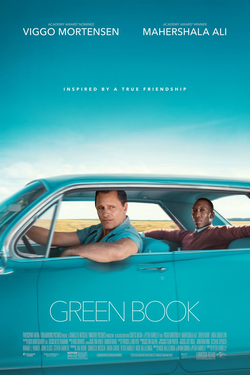
Behind the film
- Year
- 2018
- Director
- Peter Farrelly
- Writers
- Nick Vallelonga, Brian Currie, Peter Farrelly
- Runtime
- 2h 10m
- Genres
- Comedy drama, Comedy, Biographical, Drama
- Production
- DreamWorks, Amblin Partners, Participant
- Country
- United States
- Cast
- Viggo Mortensen, Mahershala Ali, Linda Cardellini, Sebastian Maniscalco, Dimiter Marinov
About the film
Contains story spoilers.
Green Book opens in the Bronx in 1962, when Tony Vallelonga, a nightclub bouncer known as Tony Lip, finds himself out of work because the Copacabana is renovating. He interviews with Don Shirley, an accomplished pianist who needs a driver for an eight-week concert tour through the Midwest and Deep South. Tony is hired for his references and practical toughness, then handed a copy of the Negro Motorist Green Book, the travel guide listing businesses that served Black motorists. The assignment quickly becomes more than driving: the two men have different habits, expectations and ways of protecting themselves, and each initially reads the other's manner as a problem.
The film charts the tour through the friction of the car and the rooms they enter. Tony dislikes being corrected about his manners; Don expects discipline and refinement from someone he has hired to work closely beside him. Tony is impressed by Don's playing, but the difference between the audience's admiration and the hostility Don encounters away from the stage becomes impossible to ignore. In Louisville, white men beat and threaten Don, and Tony rescues him, insisting he should not go out alone. Don helps Tony write affectionate letters to his wife Dolores, giving Tony language he struggles to find himself. Their intimacy grows through routine, but the film keeps showing how unequal their risks remain.
Their experiences are not reduced to one sort of danger. Don is caught in a sexual encounter with a white man in a public shower, and Tony pays off the police officers rather than let Don be arrested. Later, in Mississippi, police stop and arrest them in a sundown town; after one officer insults him, Tony punches him. In jail, Don asks to call his lawyer but instead reaches Attorney General Robert F. Kennedy, whose intervention secures their release. The episode strains the partnership because Don criticizes Tony's impulsiveness, while Tony sees his own action as defense. Their argument exposes Don's isolation: some white hosts treat him as an ornament, while he feels he does not fit comfortably within the Black community either.
The tour's climax comes in Birmingham, where Don is expected to perform at a country club but is refused entry to its whites-only dining room. Tony threatens the manager, yet Don makes the decision himself: he will not play unless he can dine with the audience. The record company wants the scheduled concert protected, but Tony chooses to leave with Don instead of accepting the manager's offer. They eat at a Black blues club, where Don joins the musicians at the piano. On leaving, Tony scares off two men who appear ready to rob Don after noticing the money he displayed; the moment reveals Tony's protective instincts while also unsettling Don, who sees the gun as another form of risk.
As they head north toward New York by Christmas Eve, a blizzard and a flat tire delay them. A police officer stops them, but this time only to help with the tire, a small encounter that contrasts with their earlier arrest. Tony becomes too tired to continue driving and worries he will miss Christmas dinner; Don takes the wheel and drives while Tony sleeps in the back. Tony invites Don to join his family. Don initially declines, then changes his mind and arrives to a warm welcome. When a relative makes a racist remark, Tony objects. The last gathering gives their friendship a domestic setting, but it does not pretend one dinner resolves the discrimination that shaped the journey.
The movie's road structure makes the guidebook a recurring practical object rather than a decorative title. It marks a map of where Don can safely eat or sleep, while each concert hall offers an uneasy contrast between his public prestige and private exclusion. Tony and Don's changing routines—music, letters, food, arguments and roadside delays—make their relationship legible in small increments. The story is a dramatized depiction inspired by Tony Lip and Don Shirley, and the film's account has been disputed by Shirley's family; its scenes should be understood as the film's version of the relationship, not a documentary record.
Dolores remains part of the journey through Tony's letters. At first he reports events in blunt, ordinary terms; Don helps him express affection with a fluency that surprises the family reading them at home. This exchange gives Don something to offer that Tony cannot obtain through toughness or bargaining. It also lets the film connect the car's developing friendship to a household far from the tour. Meals expose their differences in another register. Tony's enthusiasm for eating and his casual habits collide with Don's controlled presentation, creating comic disagreements within a schedule where the choice of restaurant can also be dangerous. The distinction matters: a roadside meal and a whites-only dining room are both stops on the route, but only one forces Don to negotiate whether his dignity is part of the price of admission. By Christmas, inviting him to Tony's family table carries more meaning than completing a professional driving assignment.