
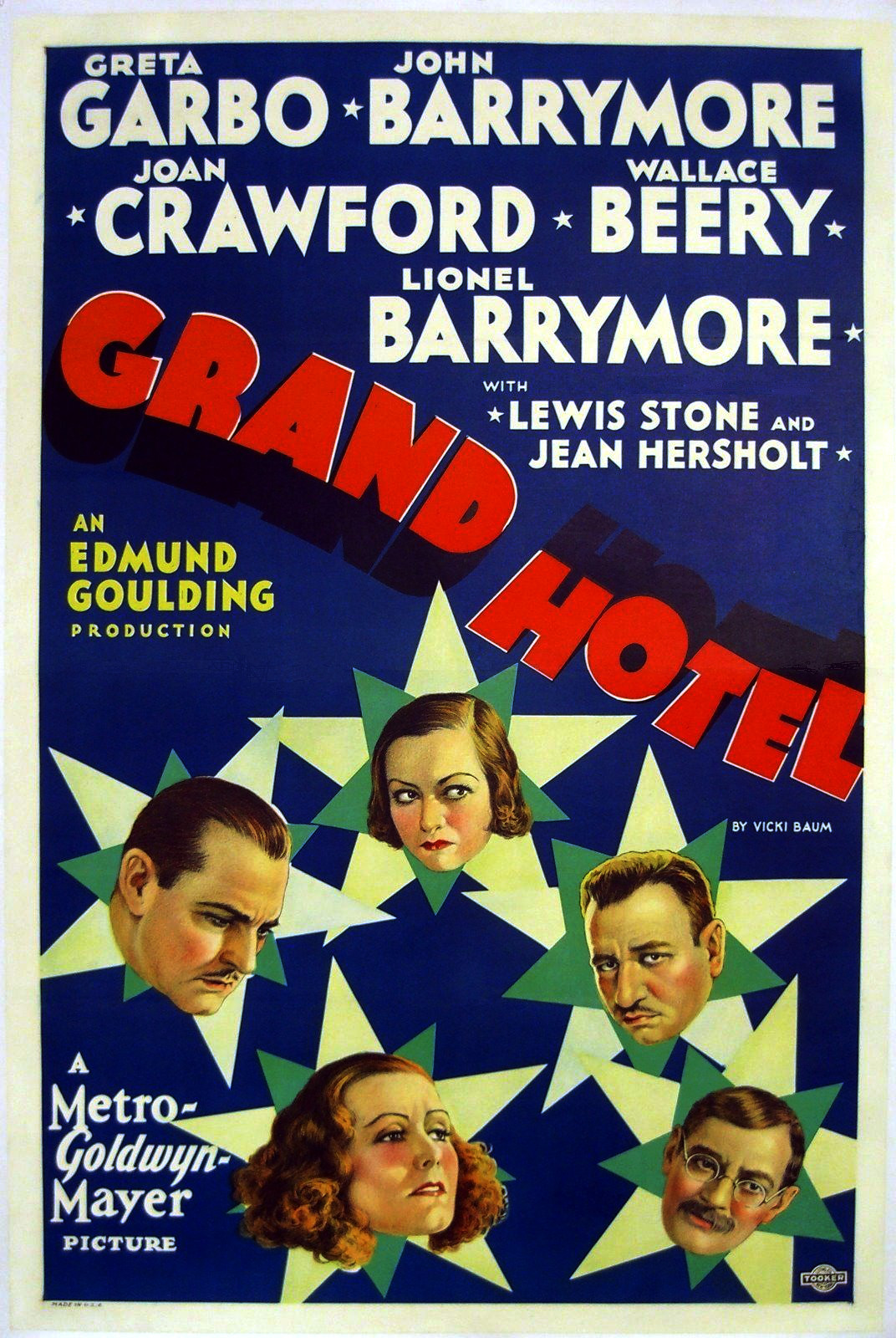
Behind the film
- Year
- 1932
- Director
- Edmund Goulding
- Writers
- William A. Drake
- Runtime
- 1h 55m
- Genres
- Drama, Romance
- Production
- Metro-Goldwyn-Mayer
- Country
- United States
- Cast
- Greta Garbo, John Barrymore, Joan Crawford, Wallace Beery, Lionel Barrymore, Lewis Stone, Jean Hersholt, Rafaela Ottiano
About the film
Contains story spoilers.
At Berlin’s Grand Hotel, a group of guests cross paths over a short stay. Dancer Grusinskaya is losing her audience; Baron von Gaigern is a card player and thief who plans to take her pearls; dying bookkeeper Otto Kringelein wants to spend his last days in luxury; stenographer Flaemmchen hopes for an acting career; and her employer, industrialist Preysing, is pursuing a merger. The Baron and Grusinskaya fall in love, while the Baron befriends Kringelein. Preysing later kills the Baron during a struggle. Kringelein summons the police rather than help conceal the crime, and Preysing is arrested. Grusinskaya leaves expecting to meet the Baron; Kringelein and Flaemmchen depart together, while resident Dr. Otternschlag observes that people still come and go.
The hotel gives Grand Hotel a natural architecture for an ensemble story. Guests can arrive with separate histories and meet in rooms, corridors, bars, and the lobby without requiring the film to invent a coincidence for every crossing. These common spaces are neither fully private nor entirely public. A character can overhear, be observed, or find a stranger seated nearby. The setting compresses social distance: a celebrated dancer and a dying clerk occupy the same building, and a business magnate cannot keep his private ambitions separate from those around him.
The story’s central pleasure comes from watching each person arrive with a different idea of what time remains. Grusinskaya fears her professional life is fading; Kringelein knows his health is failing; Flaemmchen imagines a future beyond stenography; Preysing treats time as a resource for completing a deal. The Baron lives by quick improvisation, trying to convert charm into money and escape. Their differences give the hotel an emotional range that is larger than the physical space. A guest’s crisis does not erase another’s, but proximity makes each one harder to ignore.
Greta Garbo’s Grusinskaya carries a theatrical quality that fits a dancer aware of her own fading reception. Her performance places an inner loneliness behind the public image of elegance. Joan Crawford’s Flaemmchen moves differently through the same hotel: brisk, watchful, and conscious that work can be a route toward something else. John Barrymore makes the Baron’s charm feel both practiced and sincere, while Lionel Barrymore’s Kringelein gives the sick clerk an unexpectedly buoyant appetite for experience. The ensemble depends on these contrasts rather than a single protagonist’s journey.
The film adapts Vicki Baum’s hotel story through a concentrated screen space. The main lobby and repeated interiors function almost like a theatrical stage, but the camera can shift attention from one cluster of guests to another. A conversation begun in a public room may acquire a new meaning when the audience learns what a character wants in private. The film’s interlocking structure lets storylines echo without making them identical: romance, survival, ambition, and financial calculation all unfold under the same roof.
Dr. Otternschlag frames the hotel as a place of repetition, but the movie complicates that claim. People do come and go, yet the interval inside the building can change what they expect from themselves. The hotel is at once a temporary shelter and a social sorting space. Staff and guests know who belongs in which room, while money determines who can linger and who must keep serving. Its elegance makes the structure attractive, but the film’s character work keeps status from becoming a simple measure of human worth.
The actors' differing presences make the ensemble a pleasure to follow. Garbo's distance, Crawford's alertness and the Barrymores' contrasting energies give a conversation a different texture depending on who enters it. Goulding can shift the centre of attention without making the film feel as though it has abandoned a main character, because the hotel's shared life supplies continuity. This is an effective use of a setting in which recognition and status matter. The guests present versions of themselves they hope others will accept, while the audience can notice the effort behind those versions. Performance becomes part of the social world: charm, confidence and elegance each have a practical use, but none guarantees that somebody is as secure as they appear.
A temporary stay also changes how responsibility is understood. The guests can imagine leaving their problems at the door, yet an encounter with another person can create an obligation that outlasts the visit. Grand Hotel finds drama in that possibility. Its setting permits anonymity without making anonymity complete, so someone who expects to pass through unnoticed may still affect another life. The interlocking stories gain meaning from these uneven connections rather than from one solution that benefits everyone. Some desires are answered, others become harder to bear, and the building cannot make those outcomes fair. The hotel's elegance remains attractive while its apparent promise of escape becomes more complicated. What looks like an interval outside ordinary life turns out to be another place where ordinary needs, choices and consequences must be faced.