
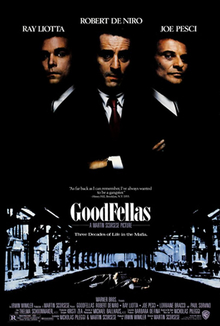
Behind the film
- Year
- 1990
- Director
- Martin Scorsese
- Writers
- Nicholas Pileggi, Martin Scorsese
- Runtime
- 2h 26m
- Genres
- Biographical, Gangster, Crime thriller, Crime
- Production
- Warner Bros. Entertainment, Warner Bros. Pictures
- Country
- United States
- Cast
- Ray Liotta, Robert De Niro, Joe Pesci, Lorraine Bracco, Paul Sorvino
About the film
Contains story spoilers.
Martin Scorsese’s Goodfellas begins with Henry Hill recalling the pull of the gangsters who work near his Brooklyn home. As a teenager, he starts doing errands for Paulie Cicero’s crew, impressed by the men’s cars, money and ability to command attention. Jimmy Conway takes an interest in him, and Tommy DeVito becomes a close friend whose temper can turn a joke into a threat. Henry’s narration moves through years of work and crime at a brisk pace, presenting the crew’s lifestyle through his own enthusiasm. Henry’s confident narration gives scenes a self-assured edge, while the camera and editing sometimes reveal the fear or violence that sits behind the stories he tells.
Henry leaves school and becomes useful to the crew, first with small tasks and later with stolen goods and robberies. An early arrest over cigarette sales ends with him refusing to cooperate with police, earning the men’s approval. He meets Karen on a double date arranged by Tommy, initially neglects her, then brings her to the Copacabana, where they bypass the line and enter through the kitchen. Karen gets a glimpse of Henry’s importance to the people around him, but he lies about his work. Their relationship draws her into the circle of wives and girlfriends, where cash, gifts and criminal risk coexist. She becomes accustomed to the lifestyle even as she understands more of its danger.
Henry and Tommy take part in the Air France robbery at Idlewild Airport, and the proceeds help make the group’s criminal work feel like a stable business. A later episode turns more violent when Billy Batts, a made member of another family, insults Tommy about his old job shining shoes. Tommy and Jimmy attack Batts while Henry locks the bar door. The three men hide him in Henry’s car and stop at Tommy’s mother’s house before discovering that Batts is still alive in the trunk. They kill and bury him, but the murder of a made gangster creates a problem beyond personal revenge. Tommy later shoots Spider, a young man at a card game, after he talks back. The crew’s private rules protect its members only when they suit those with power.
Henry’s home life becomes increasingly unstable. He has an affair with Janice Rossi, and Karen tracks her down before waking Henry with a gun pointed at him. Paulie intervenes, telling Henry that divorce is not acceptable and sending him back to his family. During a job in Tampa, Henry and Jimmy extort money from a local gangster; the man’s sister works for the FBI and reports them. Henry and Jimmy are convicted and sent to prison. Karen smuggles drugs in for Henry, while their arguments over money and Janice continue. Prison does not end the operation. Henry and Paulie maintain a relatively comfortable arrangement inside, and Henry returns to the outside with his connections intact.
After his release, Henry promises Karen and their daughters a better life but secretly resumes drug dealing, despite Paulie’s order to stay away from narcotics. He and Karen develop cocaine habits, and Jimmy becomes involved in the Lufthansa heist, which brings the crew a huge amount of cash. Jimmy grows suspicious of anyone spending too openly and orders killings to prevent witnesses or loose talk from drawing attention. Tommy is told that he is about to be formally inducted into the Mafia, but the ceremony is a trap: he is killed in retaliation for Batts. His death removes one of Henry’s closest friends and leaves Jimmy’s control of the group even more frightening.
The film’s most pressured sequence follows Henry through a day in 1980, when a helicopter seems to be tracking him as he moves between family obligations and drug deliveries. He takes his brother Michael home, prepares dinner, carries a cocaine shipment and tries to keep the people around him from making mistakes that could expose the business. Lois, a drug courier, adds another complication to an already frantic day. Henry is arrested by narcotics officers and discovers that his suspicions about surveillance were justified. Karen disposes of his remaining cocaine, leaving them without the drugs he had counted on selling. On bail, he fears that Jimmy or Paulie may kill him to prevent him from talking. He decides to cooperate with federal agents and identifies both men in court.
Henry and his family enter witness protection and move to a suburban neighbourhood, where he complains that he must live like an ordinary person. The closing voiceover and image of Henry in his new circumstances leave him alive but stripped of the identity he once wanted. Scorsese’s editing and music often move faster than conventional scene transitions, carrying the viewer from a club to a robbery or from a home dinner to a drug run. The Copacabana tracking shot gives Henry’s world a seductive fluidity, while the later helicopter sequence turns ordinary errands into frantic surveillance. The film lets Henry’s charm shape what we see, then makes the consequences of his chosen life impossible to avoid.