
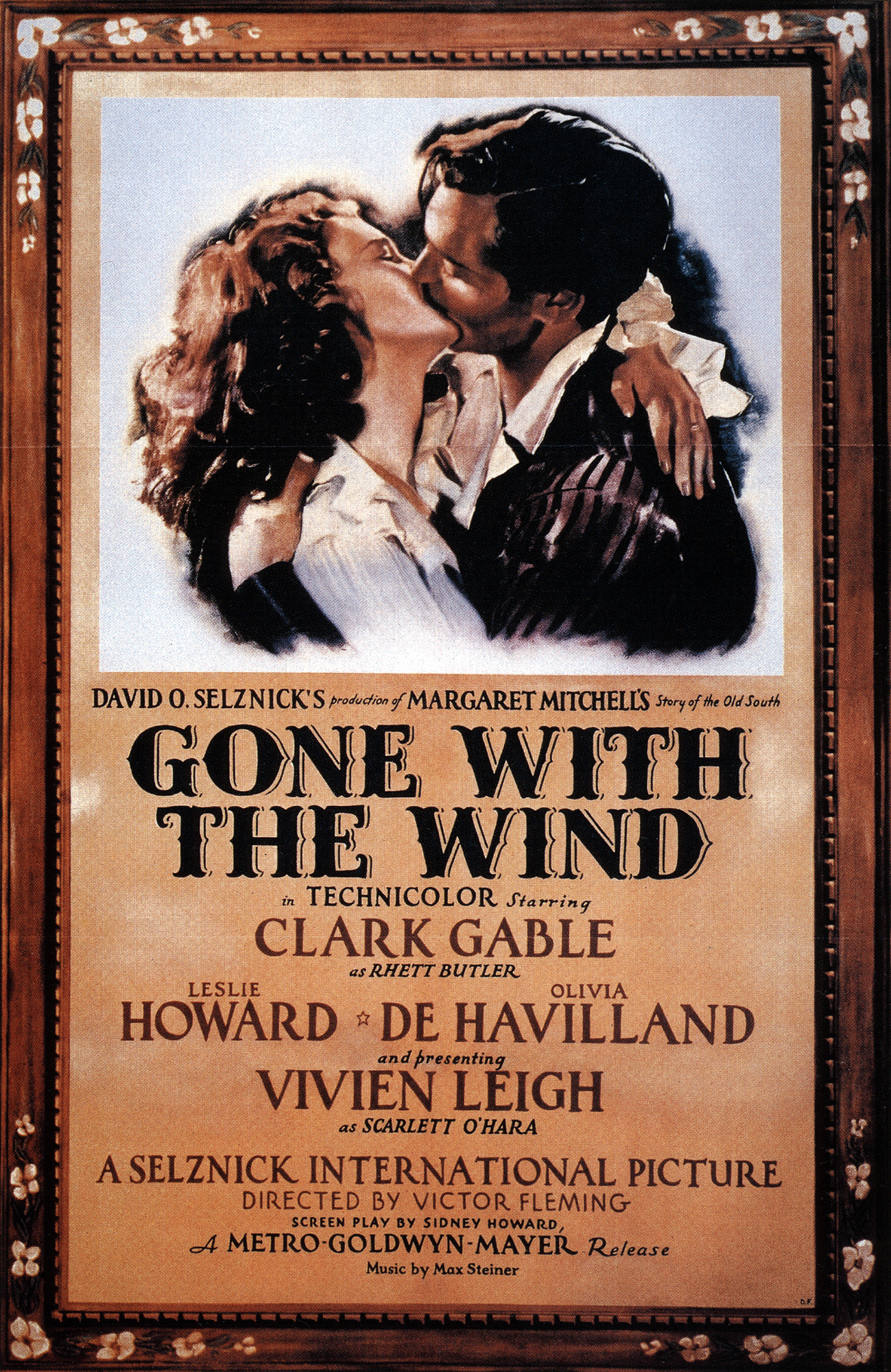
Behind the film
- Year
- 1939
- Director
- Victor Fleming
- Writers
- Sidney Howard
- Runtime
- 3h 40m (theatrical running time)
- Genres
- Romance, Drama, Historical, War
- Production
- Metro-Goldwyn-Mayer, Selznick International Pictures
- Country
- United States
- Cast
- Vivien Leigh, Clark Gable, Olivia de Havilland, Leslie Howard, Hattie McDaniel
About the film
Contains story spoilers.
Victor Fleming’s Gone with the Wind follows Scarlett O’Hara from the eve of the Civil War into the years of Reconstruction. She grows up at Tara, a Georgia plantation, surrounded by wealth and by a social order built on slavery. The film initially presents this world through a romantic prologue and Scarlett’s own narrowed priorities: she wants attention, comfort and especially Ashley Wilkes, who intends to marry Melanie Hamilton. When Ashley confirms his choice, Scarlett’s anger and self-confidence shape the drama more than any careful explanation of why the war begins. That omission matters. The movie invites viewers into the plantation’s picturesque image before it asks them to consider the human system beneath it, and it never gives the people enslaved there equal control of the story.
At Twelve Oaks, Scarlett flirts with the young men around her, including the Tarleton twins, and secretly tells Ashley that she loves him. Rhett Butler overhears her rejection and recognizes both her pride and her desire to escape the rules surrounding her. War is declared, the men depart, and Scarlett impulsively marries Charles Hamilton, who dies soon afterward. As a widow in Atlanta, she chafes at mourning customs and welcomes Rhett’s attention, even when it takes the form of teasing rather than conventional courtship. Melanie’s patience offers a contrast to Scarlett’s restlessness. She is not merely an obstacle to Scarlett’s desire for Ashley; she becomes a sustaining presence whose generosity repeatedly helps the people around her survive the upheavals of war.
The story’s scale changes when Atlanta falls. Scarlett tends to Melanie during childbirth while Union forces threaten the city, and the two women flee in a wagon with Prissy, who remains enslaved within the O’Hara household at this point in the story. Their return to Tara reveals a looted estate, Scarlett’s mother dead of illness and her father mentally broken. Scarlett’s vow never to go hungry again drives the film’s second half. She works to preserve the land and, when taxes threaten it, marries her sister Suellen’s suitor Frank Kennedy by misleading him about Suellen’s plans. She takes over Frank’s store and lumber business, using her own energy to secure resources that her childhood world had treated as guaranteed. The film recognizes this new competence, though it continues to frame survival chiefly through the fortunes of the white O’Hara family.
Scarlett’s carriage is attacked by scavengers near a shantytown, and Big Sam, a formerly enslaved man from Tara, rescues her. The men in her circle then organize a retaliatory raid; Frank dies and Ashley is wounded before Rhett helps keep the others from arrest. Scarlett later accepts Rhett’s proposal and gives birth to Bonnie, whose presence seems for a time to soften his cynicism. Their marriage brings comfort and display, but it cannot make Scarlett forget Ashley. She continues to mistake her idealized memory of him for a possible future, while Melanie’s trust in her makes the cost of that fixation harder to ignore. The performances and lavish domestic settings can make these emotional rivalries absorbing, even as the film keeps Black characters largely at the margins of the world they help maintain.
The film’s romantic view of the Old South is not a neutral record of the past. It gives slavery little sustained attention and often presents Black people through stereotypes or as supporting figures in white characters’ stories. Mammy, played by Hattie McDaniel, has forceful presence and authority within the O’Hara household, but the film does not grant her a life beyond service to Scarlett. Prissy is treated as comic relief, and Big Sam appears chiefly at the moment he can save Scarlett. The historical reality was more violent and complex than this screen world allows. Reading the film in context means noticing how its pageantry, music and nostalgia shape what it shows and what it leaves outside the frame.
The final stretch turns on loss rather than the restoration Scarlett expects. Bonnie dies after a riding accident, and Rhett withdraws from their marriage. Scarlett then recognizes that Ashley’s appeal depended on an imagined version of him, not the person who chose Melanie and remained devoted to her. Melanie’s death removes one of the few people who consistently offered Scarlett kindness without bargaining. When Rhett finally leaves, Scarlett asks him to stay, but he refuses. She returns to Tara in her thoughts, convinced that home may give her another chance to begin. The ending does not settle her life; it converts a story of pursuit into a promise that she can try again, while leaving the consequences of her choices unresolved.
The production’s famous sweep—from the Atlanta fire to the wide view of Tara—helps explain why the film became an enduring landmark, but scale and craft should not erase its politics. David O. Selznick’s production adapts Margaret Mitchell’s novel, and Sidney Howard received the screenplay credit; the novel and film share a romanticized historical frame that modern viewing should examine rather than adopt as fact. The picture’s emotional center is Scarlett’s resilience, a compelling dramatic engine, yet its world is deliberately selective about who suffers and whose future counts. A fuller encounter with the film holds both truths together: its visual and performance accomplishments, and the racist representation and historical distortion embedded in its nostalgia.