
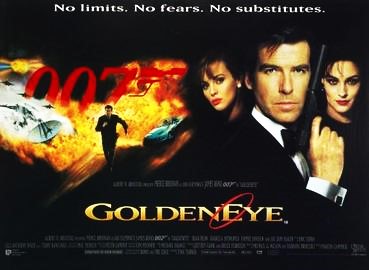
Behind the film
- Year
- 1995
- Director
- Martin Campbell
- Writers
- Jeffrey Caine, Bruce Feirstein
- Genres
- Action thriller, Spy, Action
- Production
- Eon Productions, United Artists
- Country
- United Kingdom, United States
- Cast
- Pierce Brosnan, Sean Bean, Izabella Scorupco, Famke Janssen, Judi Dench, Joe Don Baker, Robbie Coltrane, Desmond Llewelyn
About the film
Contains story spoilers.
James Bond and Alec Trevelyan open the story as partners infiltrating a Soviet chemical-weapons facility at Arkhangelsk. Their escape is compromised when Colonel Ourumov appears to execute Trevelyan in front of Bond. Bond destroys the installation and escapes in a stolen aircraft, believing his colleague dead. Nine years later, after the Soviet Union has dissolved, Bond is at a military demonstration in Monte Carlo. He fails to stop Xenia Onatopp from taking a Eurocopter attack helicopter. The same machine soon appears at a radar installation in Siberia, where an electromagnetic pulse suddenly destroys the site and disables its electronics.
MI6 identifies the source as GoldenEye, an orbital weapon designed to unleash an electromagnetic pulse, and sends Bond to investigate. The new M suspects the Janus crime syndicate may be behind the attack. Bond travels to St Petersburg, where CIA officer Jack Wade directs him to Valentin Zukovsky, a former KGB agent turned gangster who can arrange a meeting with Janus. There Bond discovers Trevelyan alive and leading the organization. Trevelyan’s anger is tied to his parents, Lienz Cossacks whom he says the British betrayed through postwar repatriation to the Soviet Union. Bond understands the grievance, but sees the danger in what Trevelyan intends to do with it.
Natalya Simonova, a programmer at the Siberian station, survived the blast and knows that her colleague Boris also survived. Bond is captured alongside her after they escape from the helicopter before it explodes, then interrogated by Russian Defence Minister Mishkin. Natalya identifies Ourumov’s role in the attack, but Ourumov kills Mishkin and takes her to a missile train used by Trevelyan. Bond pursues in a tank, stops the train by blocking its path, boards it, and kills Ourumov. He and Natalya escape just before Trevelyan’s explosives destroy the train. She is no longer only a witness: her programming knowledge is essential to finding Boris and understanding the next attack.
Natalya traces Boris to a location in Cuba, and she and Bond fly over the jungle to search. Their plane is shot down, and Onatopp attacks after descending from a helicopter. Bond brings down the aircraft while she is still tethered to it; the impact drags her into the trees and kills her. The pair then see an artificial lake drain away, exposing a concealed satellite dish and the entrance to a base. Bond gets inside to place explosives, but Trevelyan’s people capture him. Trevelyan explains that he means to steal money from the Bank of England and use the EMP to erase financial records, hiding the theft in a nationwide collapse.
Natalya changes GoldenEye’s orbit so that it will burn up in the atmosphere. After a distraction gives Bond the chance to break free, he reaches the dish and jams its mechanism, preventing Boris from sending an override. Bond and Trevelyan fight on the antenna structure above the base. Bond drops his former partner, who survives the fall only to be killed when the installation collapses. Boris is caught in the destruction and frozen by escaping liquid nitrogen. Natalya returns in a helicopter and rescues Bond before the collapse reaches him. They later meet Wade’s team, with the financial attack prevented through her programming and his physical intervention.
Bond’s exchanges with M give the new era some friction. She considers him a relic who treats the world like a playground, while he thinks her caution misses what field agents face. Their disagreement sits alongside the collapse of the Soviet system: former officials, criminal networks, and newly independent institutions are competing over the same weapons and information. The satellite is frightening because it makes distance irrelevant. A strike from orbit can erase the evidence of a theft and disable infrastructure without occupying territory, so Bond’s investigation must connect a remote weapon to financial motives and personal history.
Natalya’s role keeps the plot from treating computer access as magic. She is the survivor who can identify Boris and explain the systems behind the attack, but she also makes her own decisions about when to cooperate and how to redirect the satellite. Bond’s work depends on her knowledge, not simply her rescue. The film’s locations move from a frozen radar installation and government offices to a tank chase through St Petersburg and a concealed Cuban base. These shifts give a traditional espionage pursuit a post-Cold-War geography, where the old Soviet hardware remains active even as its political world has changed.
Q’s equipment provides small comic introductions to objects that become consequential later. The explosive pen, in particular, passes from a briefing-room demonstration into Boris’s nervous habit of clicking it while he works. Bond has to recognize that ordinary-looking gesture as a chance to interrupt the confrontation inside the base. These details give the gadgets a place in the action rather than leaving them as decorative promises. Alongside the spectacular tank chase and concealed dish, the film keeps finding room for observation: knowing a former colleague, identifying a habit, and trusting someone else’s expertise can change the outcome as decisively as a weapon.