
Behind the film
- Year
- 1944
- Director
- Leo McCarey
- Writers
- Frank Butler, Frank Cavett
- Genres
- Comedy drama, Drama, Romantic comedy, Musical
- Production
- Paramount Pictures
- Country
- United States
- Cast
- Bing Crosby, Barry Fitzgerald, Risë Stevens, Frank McHugh, James Brown, Gene Lockhart, Jean Heather, Porter Hall
About the film
Contains story spoilers.
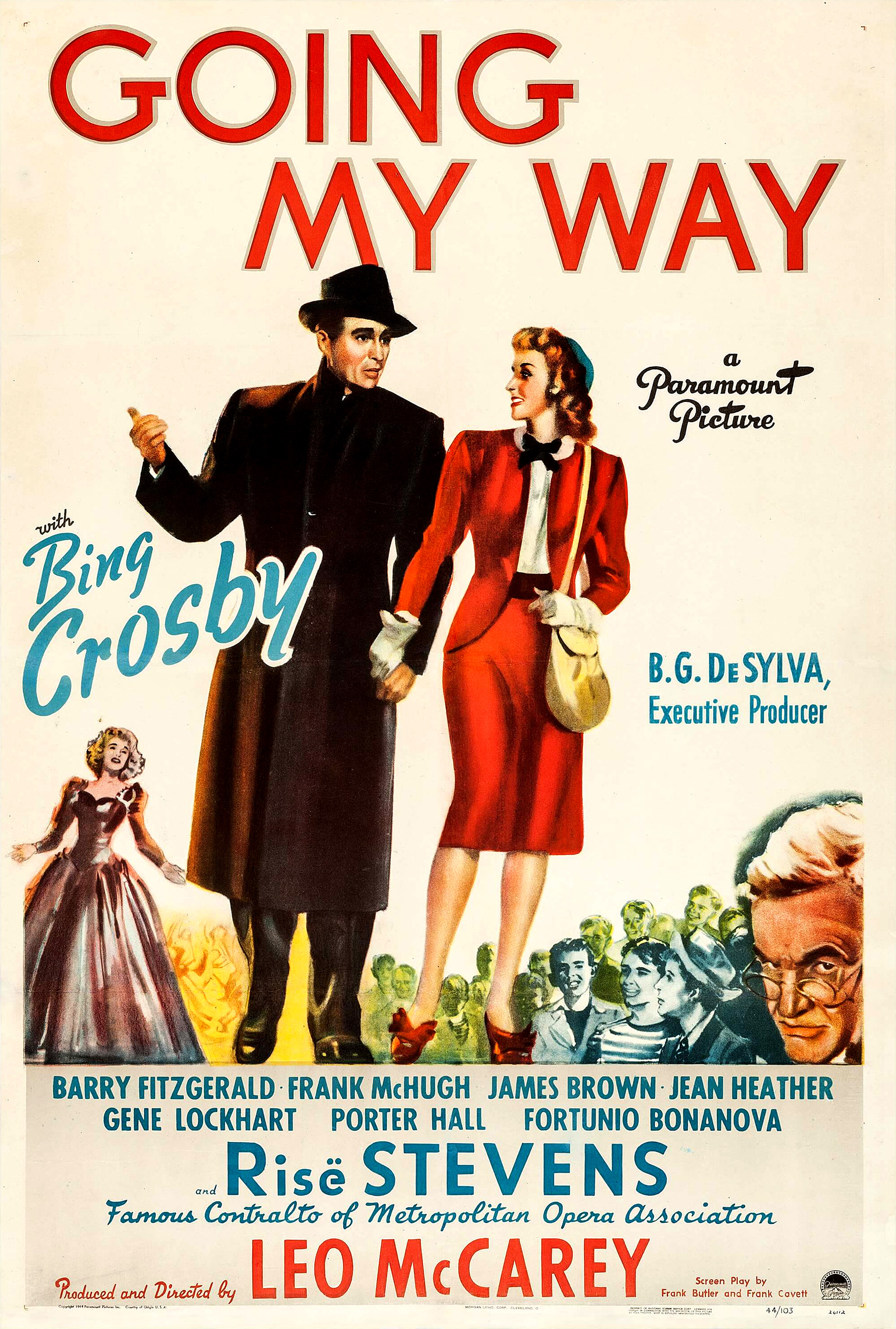
Going My Way makes a church’s financial difficulties the centre of a much more personal story about work, age and belonging. Leo McCarey directs Bing Crosby as Father O’Malley and Barry Fitzgerald as Father Fitzgibbon, two priests whose different temperaments make cooperation awkward before it becomes possible. The setting is a parish woven into the ordinary life of its New York neighbourhood. Money matters because the church needs to survive, but the deeper question concerns what survival is for. A building can stay open without reaching the people around it. The film’s warmth comes from connecting that practical problem with the older priest’s fear of becoming unnecessary.
O’Malley arrives to help a parish threatened by its mortgage, concealing that he has been sent to take charge. Fitzgibbon distrusts his informality, while O’Malley forms local boys into a choir. An old acquaintance, opera singer Genevieve Linden, helps his musical fundraising efforts. A runaway’s romance with the mortgage broker’s son provides another connection between the parish and the neighbourhood. A song sale eases the financial pressure, but fire subsequently destroys the church. At the Christmas farewell before O’Malley moves on, Fitzgibbon receives a different gift: a reunion with the mother he has not seen for decades. The younger priest quietly leaves that reunion to them.
The central relationship is stronger because the film does not make Fitzgibbon merely an obstacle to a clever newcomer. His habits represent a life of service, and his resistance contains understandable anxiety. Being told that a different approach works better can sound like being told that the years spent using the old approach were wasted. O’Malley has to recognise that emotional difficulty if his practical changes are to become more than a victory over someone else. The parish’s problem therefore calls for tact as well as energy. Repairing the institution requires preserving the dignity of a person who has given much of his life to it.
Crosby’s ease is important to that tact. O’Malley’s relaxed presence lowers the temperature of encounters that could otherwise become arguments about discipline or authority. He can meet people where they are without making every conversation a formal statement of his position. That does not mean he has no responsibilities or standards; it means the way he establishes contact differs from Fitzgibbon’s. The film makes approachability a practical resource. A person who feels able to speak to a priest may become reachable in ways that someone intimidated by the office would not. The character’s charm belongs to his method of work, rather than existing as a decorative extra.
Music gives that method a communal form. A choir asks people to do something together, with cooperation built into the activity itself. It also changes how unruly energy is understood: voices that could be dismissed as trouble become part of a shared performance. The musical scenes let the parish appear through the people it can bring into relationship, rather than only through a building or an account book. This is a musical comedy-drama whose songs have work to do inside the story. They create attention, open conversations and establish a sense of collective possibility. The money they may generate is one consequence of that larger change.
Genevieve’s connection with O’Malley broadens the portrait of a life devoted to the church. Their shared past suggests that his present vocation exists alongside other paths he might have taken. That makes him less abstract than a character whose identity begins and ends with his title. Likewise, the younger people’s troubles bring the parish into contact with decisions that do not unfold neatly within its walls. The story’s interest in romance and ambition allows the neighbourhood to retain lives of its own. O’Malley’s task is to participate responsibly in those lives, not to turn every person into a supporting figure in a tale of priestly achievement.
The fire prevents the financial solution from being the last word. Even successful work remains vulnerable to events that cannot be prevented by charm, talent or good intentions. That change of scale shifts attention towards what the congregation and its leaders have built between them. If the film’s sense of community depended entirely on the standing church, the destruction would leave only defeat. Instead, its relationships supply a basis for continuing. The disaster also keeps O’Malley’s achievements from becoming a tidy record of uninterrupted success. His contribution matters without giving him permanent control over the parish’s future or guaranteeing that its troubles have ended.
The final family reunion answers Fitzgibbon’s loneliness more directly than any professional reassurance could. It lets the elderly priest become a son again, with an attachment older than his years in charge of the church. O’Malley’s discreet departure completes his approach to service: he can arrange something valuable without remaining at its centre. Going My Way ultimately draws its emotional force from that balance between initiative and humility. Its priestly disagreements, neighbourhood stories and songs converge on the idea that renewal need not erase the people who carried an institution this far. Change becomes humane when it attends to what those people need as well as what they can do.