
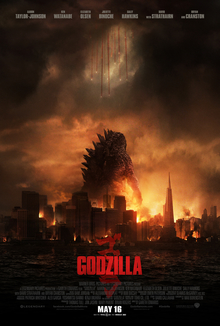
Behind the film
- Year
- 2014
- Director
- Gareth Edwards
- Writers
- Max Borenstein
- Genres
- Science fiction, Kaiju, Action
- Production
- Legendary Pictures, Warner Bros. Entertainment
- Country
- United States, Japan
- Cast
- Aaron Taylor-Johnson, Ken Watanabe, Elizabeth Olsen, Juliette Binoche, Sally Hawkins, David Strathairn, Bryan Cranston
About the film
Contains story spoilers.
After a nuclear plant disaster in Japan, Navy officer Ford Brody returns to the country to help his father investigate the event. The discovery of a creature called a MUTO brings Ford into the path of a military response and the secretive Monarch scientists, who explain that Godzilla is also active. A second MUTO appears, and the two creatures move toward San Francisco. The military tries to use nuclear weapons against them, but the MUTOs take a warhead into the city. Ford joins a team sent to disarm it while Godzilla fights the creatures. The warhead is carried to sea and explodes; Godzilla defeats the MUTOs, collapses, then wakes and returns to the ocean. Ford survives and reunites with his family as the public hails Godzilla as the King of the Monsters.
Gareth Edwards approaches the kaiju film through human scale. The creatures are enormous, but the story’s viewpoint often belongs to people who only see fragments of what is happening: distant movement, emergency broadcasts, glimpses through smoke or a sudden change in a crowded space. That partial access gives the spectacle a quality of discovery. The audience does not simply receive a steady display of monster action; it is asked to register scale through the reactions of people who cannot fully understand it. The result makes the city feel vulnerable without turning every sequence into a close-up of destruction.
Ford Brody is an unusual anchor for a monster story because his profession is practical and his emotional goal modest. He wants to get back to his wife and child, while his military training repeatedly makes him useful in circumstances much larger than himself. Aaron Taylor-Johnson plays him with a grounded, disciplined presence rather than a grand heroic aura. That choice helps the film maintain a distinction between human courage and human control: Ford can act decisively in a crisis, but he cannot dictate what the giant creatures do. His competence gives the action a point of entry while leaving the central force of the film beyond his command.
The older generation supplies the story’s grief and its disputed memory. Bryan Cranston’s Joe Brody remains consumed by an event that official explanations have reduced to a public incident, while Ford has built a life that depends on moving beyond it. Their conflict is not only about whether Joe is right; it is about the cost of living with a question that nobody else wants to keep asking. The family connection makes institutional secrecy personal. When authorities contain information, they also reshape the way survivors understand their losses. The film uses that tension to link a monster mystery with the more ordinary damage caused by dismissal and silence.
Ken Watanabe’s Ishiro Serizawa offers a contrasting relationship to the unknown. His calm presence suggests a scientist who has spent years studying forces that cannot be safely reduced to a weapon or a convenient explanation. Serizawa’s role is important because the film’s human institutions are not all portrayed as equally reckless. Some characters favour immediate military solutions; others recognise that observation may be the more responsible response. That difference does not make scientific knowledge omnipotent. It presents knowledge as a form of attention, with its limits visible whenever the creatures exceed the categories built around them.
The film’s camera often delays complete views of Godzilla, allowing sound, movement and the reactions of witnesses to establish his presence first. This makes revelation a structural choice rather than a mere visual tease. The creature feels like a force that occupies the world before the humans can fit him into their plans. When the frame finally grants a clearer view, the scale has already been prepared through buildings, weather and frightened crowds. That visual strategy connects the monster to the tradition of disaster cinema, where spectacle becomes more unsettling when ordinary routines are shown failing around it.
Godzilla also gives military technology an ambiguous role. Aircraft, transport and specialist teams provide ways to move through danger, but the most confident weapons strategy repeatedly risks worsening the situation. Human ingenuity matters, yet the film avoids pretending that ingenuity makes people sovereign over nature. This is where the creature’s long cultural history gives the film useful weight: Godzilla is not simply another opponent to be defeated by greater firepower. The drama is more interested in the consequences of treating every unknown as a target, and in how a crisis can expose the difference between responding to danger and assuming it can be commanded.
The family reunion offers an intimate counterpoint to the city-scale images, but it does not erase the devastation that made it possible. Edwards keeps returning to the tension between private life and public catastrophe: people want to reach loved ones, while roads, communications and institutions become unreliable. That familiar impulse helps anchor a story whose central figures are far beyond human scale. The film’s emotional register is therefore less about an individual conquering a monster than about people trying to preserve connection while powerful systems and creatures reshape their world. Its spectacle works best when it remains tied to that fragile human perspective. The human thread keeps destruction from becoming a purely abstract demonstration of effects or scale.