
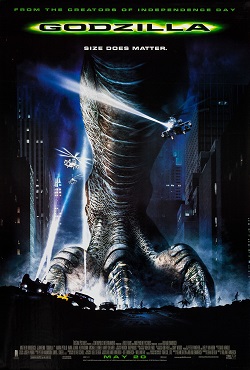
Behind the film
- Year
- 1998
- Director
- Roland Emmerich
- Writers
- Dean Devlin, Roland Emmerich
- Genres
- Science fiction, Monster, Thriller, Horror
- Production
- Centropolis Entertainment, Fried Films, Independent Pictures
- Country
- United States
- Cast
- Matthew Broderick, Jean Reno, Maria Pitillo, Hank Azaria, Kevin Dunn, Michael Lerner, Harry Shearer, Arabella Field
About the film
Contains story spoilers.
Godzilla approaches its enormous creature as a problem that an enormous city has to understand before it can solve. The monster is plainly visible when it appears, yet visibility does not mean that anyone knows what it is doing, where it will move or what it needs. That gap supplies much of the film's disaster-movie structure. New York has troops, machinery, public authorities and television coverage, but those systems cannot simply substitute force for knowledge. Roland Emmerich's version places a scientist in the middle of the spectacle, giving observation a role beside firepower. The city becomes both the site of destruction and a complicated environment in which the destructive animal can operate.
French nuclear testing produces the mutated creature, which reaches Manhattan. Scientist Nick Tatopoulos realises it is reproducing. His former girlfriend Audrey's leaked material gets him removed from the investigation, while her television superior takes credit. French agent Philippe recruits Nick to find the nest. Audrey and cameraman Animal join them; eggs in Madison Square Garden hatch, and the group alerts the military before the building is bombed. The surviving adult pursues them until bridge cables trap it and missiles kill it. Nick and Audrey reconcile, but a remaining egg hatches. What looked like a battle against one animal has threatened to become an expanding population, and the final image refuses complete reassurance.
The monster's role as an animal changes the kind of question the film asks. A destructive intention is harder to assign when the creature's actions can be understood through movement, feeding and reproduction. The danger remains enormous, but it does not need the calculation of a human villain. This gives Nick's scientific perspective a purpose: understanding behaviour can reveal a threat that a simple count of enemies would miss. The city is not dealing only with the size of a body. It is dealing with that body's capacity to use its surroundings. The distinction turns the investigation into a search for an ecological problem inside an urban disaster.
Manhattan supplies an interesting setting because a city is designed around the assumptions of its usual occupants. Streets, tunnels, buildings and infrastructure make sense at human scale. Introduce something radically larger and the same arrangement becomes a set of hiding places, obstacles and vulnerable structures. A map that seems familiar can stop being useful when the thing moving through it does not follow the same routes or rules. The film's appeal as a city-wide spectacle comes from that disruption. Ordinary places acquire frightening possibilities without losing their recognisable identities. The viewer does not need to know every street to understand the reversal: a place built to make life possible is suddenly helping a danger persist.
Matthew Broderick's Nick and Jean Reno's Philippe bring different forms of expertise into that environment. One works towards an explanation; the other represents a state interest in what the explanation might reveal. Their cooperation allows useful action without pretending that all the people involved have identical motives. The French connection also makes responsibility part of the investigation. A disaster is not always an event that begins when the public first notices it. Someone may have contributed to its origin, and someone may have reasons to limit what becomes public. That makes secrecy a practical obstacle, even when those keeping secrets are also trying to prevent further harm.
The television story creates another contest over information. Audrey wants professional recognition, while the ownership of her work becomes vulnerable to a more powerful person. In a disaster, news can be both a public service and an opportunity for someone to advance themselves. The film uses those competing functions to complicate the relationship between knowing something and doing something useful with it. Information can be released in a way that damages cooperation, withheld in a way that delays action, or shared in a way that makes action possible. Maria Pitillo's reporter and Hank Azaria's cameraman give the media thread a place within the danger rather than keeping it entirely outside as commentary.
The transition from a single huge threat to the possibility of many smaller ones changes the scale of fear. Size makes the adult spectacular, but multiplication makes the problem harder to contain. A city might imagine an end to one chase or one bombardment; reproduction challenges the idea that an apparent victory can be measured by the disappearance of the original target. The film therefore has a reason to shift between wide disaster and more enclosed pursuit. These are different expressions of the same danger. The enormous creature unsettles the city's physical limits, while its potential offspring unsettle the limits of the response itself.
This 1998 incarnation presents Godzilla through an American urban action film, with a creature whose immediate behaviour organises the investigation. Its nuclear origin remains central, but the story's working questions concern discovery, containment and survival. The closing possibility of another beginning suits that structure. Authorities can declare a battle over only on the basis of what they have found, and this story has repeatedly shown how much lies outside the current explanation. The final uncertainty is consequently more than a sequel invitation. It brings the film back to its original problem: being able to see something large and terrifying does not mean that the full danger has become visible.