
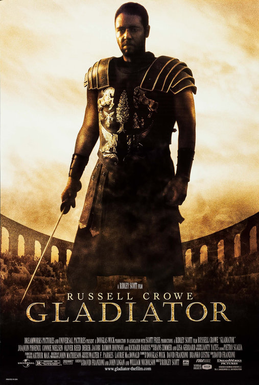
Behind the film
- Year
- 2000
- Director
- Ridley Scott
- Writers
- David Franzoni, John Logan, William Nicholson
- Runtime
- 2h 35m
- Genres
- Sword-and-sandal, Melodrama, Action, Drama
- Production
- Universal Pictures, DreamWorks, Scott Free Productions
- Country
- United Kingdom, United States
- Cast
- Russell Crowe, Joaquin Phoenix, Connie Nielsen, Oliver Reed, Richard Harris, Djimon Hounsou
About the film
Contains story spoilers.
Ridley Scott’s Gladiator opens during a Roman campaign in Germania. General Maximus leads the army and wins the battle, after which Emperor Marcus Aurelius tells him he wants Rome returned to senatorial rule. Marcus’s son Commodus arrives and learns that his father intends to pass over him. Commodus kills Marcus and declares himself emperor. Maximus refuses to pledge loyalty, escapes execution, but reaches his home too late to save his wife and son. Soldiers have killed them and left their bodies outside the family estate. The film makes this personal loss the hinge between Maximus’s military identity and the brutal life that follows; his opposition to Commodus is no longer only a dispute over succession.
Maximus is captured and sold into slavery. The trainer Proximo buys him and teaches him to fight for crowds in provincial arenas. Maximus keeps his past hidden and becomes known as a powerful performer, but he refuses to turn himself into a willing entertainer. His skill draws attention, and he is sent to Rome, where Commodus stages gladiatorial spectacles to win public affection. In the Colosseum, Maximus is forced to fight against other men before the emperor and a vast audience. He uses tactical skill to keep his group alive and reveals his identity only after the spectacle is underway. The crowd’s response complicates Commodus’s authority: the emperor can command the arena, but he cannot decide which fighter the people admire.
Commodus confronts Maximus directly but does not kill him in public. Lucilla, Commodus’s sister and Maximus’s former ally, works with senator Gracchus to organize opposition. She hopes to use the games and the crowd to weaken the emperor’s grip, while Maximus remains focused on escaping and avenging his family. The conspiracy depends on timing, secrecy and Proximo’s contacts. Commodus discovers the plan and arrests Gracchus. Proximo and the other gladiators help Maximus escape the arena, but the wider plan fails. Maximus hopes to meet Cicero and reunite with the army; an ambush kills Cicero and Maximus is captured again. Commodus has used Lucilla's concern for her son to expose the conspiracy, cutting off the allies Maximus needed outside the arena. The failed escape makes the political conspiracy more dangerous and forces the final confrontation back into the Colosseum.
Maximus returns to the Colosseum for a final confrontation. Commodus, unwilling to face him on equal terms, wounds him before the fight begins and hides the injury beneath armor. The two men battle before the spectators. Maximus defeats Commodus, but the wound he received beforehand proves fatal. With his last strength he orders the release of political prisoners and supports the restoration of the Republic. Lucilla survives, and the arena crowd carries Maximus away as a hero. The ending gives him a form of victory over the man who destroyed his family, but it does not undo those deaths or present Roman political reform as a simple consequence of one duel.
The film’s arena sequences shape its account of power. Commodus uses public combat to demonstrate control, while Maximus turns military discipline into a means of keeping fellow fighters alive. Russell Crowe’s restrained performance makes Maximus’s fame feel like something imposed on him rather than a role he seeks. Joaquin Phoenix’s Commodus moves between childlike need for approval and calculated violence; his insecurity is visible even when he commands the room. The scenes around Lucilla add a quieter political thread, since she has to negotiate family loyalty and the risks of opposing her brother. Gladiator’s Roman setting draws on historical names and institutions, but its central hero and much of its political plot are fictional and heavily dramatized.
The production also sets the film’s political story against two different kinds of public spectacle. The opening battle is a field operation in which Maximus directs soldiers through smoke and close combat; later, the arena turns organized violence into a show watched by citizens and the emperor. That shift changes the meaning of his military skill: in Germania it serves an army, while in Rome it is forced into entertainment. The Colosseum’s scale lets the film place a single fighter beneath the gaze of a crowd, making approval itself part of Commodus’s contest for power. The contrast is a dramatic device, not a reconstruction of Roman military or arena practice in every detail.
The production turns the Colosseum into more than a location for combat: its scale makes each fighter visible to thousands, while the emperor’s box places political authority in the same frame as the crowd. Maximus’s fighting style reflects his earlier command experience, but the arena imposes rules designed to make that skill into entertainment. Commodus tries to shape the audience’s response with staged appearances and an unfair final duel. Lucilla’s conspiracy gives the story a political route beyond revenge, yet the ambush destroys that route before Maximus can use it. The film closes with his death in the arena and the people carrying his body away; its vision of a restored Republic is a dramatic resolution, not a reliable account of Roman succession.