
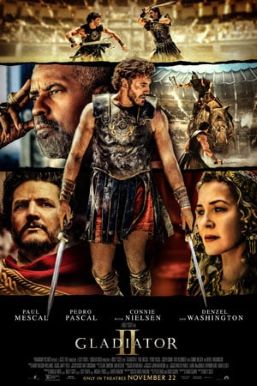
Behind the film
- Year
- 2024
- Director
- Ridley Scott
- Writers
- David Scarpa
- Runtime
- 2h 28m
- Genres
- Action, Drama, Sword-and-sandal, Adventure
- Production
- Paramount Pictures, Scott Free Productions, Universal Pictures
- Country
- United Kingdom, United States
- Cast
- Paul Mescal, Denzel Washington, Pedro Pascal, Connie Nielsen, Joseph Quinn, Fred Hechinger, Derek Jacobi, Lior Raz
About the film
Contains story spoilers.
Roman forces conquer Lucius's North African home, kill his wife and enslave him. Gladiator owner Macrinus buys him and encourages revenge against General Acacius. In Rome, Lucilla recognises Lucius as her son and reveals that Maximus was his father. Her plan with Acacius to overthrow the twin emperors is exposed. Lucius refuses to kill Acacius in the arena, but the guards execute him. Macrinus exploits the ensuing unrest, helps Caracalla murder Geta and manoeuvres towards control. Lucius rallies fellow gladiators while seeking support from Acacius's troops. Macrinus kills Caracalla and Lucilla, then flees. Lucius catches and defeats him between opposing forces, reveals his identity and calls for unity. Afterwards, he returns to the arena to mourn, with Rome's promised future still requiring more than victory in a duel.
Lucius's starting position gives the sequel a different relationship with Rome from Maximus's. The empire is something experienced through conquest before it becomes a possible inheritance. That makes the appeal to restore its better ideals difficult rather than automatic. A place can possess admirable traditions while using its power destructively, and attachment to those traditions cannot erase what its victims have endured. The film gives its returning hero a reason to distrust the language of glory. His central challenge is to decide whether a political world which has taken so much from him contains anything he can responsibly defend, rather than simply replacing hatred with loyalty.
Macrinus offers a competing answer built around opportunity. His ability to read ambition, resentment and weakness makes the surrounding order useful even when he has no reason to respect it. Power can be pursued through an institution without believing in the ideals it claims to represent. That creates a distinctive danger for Lucius: a person who understands his anger can direct it towards a purpose of his own. Sympathy and manipulation may begin with the same recognition of suffering. The difference lies in what the listener intends to do with it. Macrinus's relationship with his gladiator makes that ambiguity part of the story's political machinery, not merely a private deception.
The arena joins that machinery to public entertainment. People made vulnerable by conquest become performers through whom rulers and patrons display authority. Skill can increase a fighter's value without ending the conditions which make him property. The spectacle therefore carries two different accounts of agency at once. A gladiator may act with courage and ingenuity inside a contest while having little freedom to refuse the contest itself. That distinction gives the battles meaning beyond their immediate outcome. Winning is a form of survival, but it can also strengthen the system which requires another performance. The audience's enthusiasm and the fighter's achievement do not settle the question of who benefits.
Lucilla's presence carries the earlier film's history into this new struggle while making family recognition a contested experience. Being able to name a relationship does not undo the years lived without it or determine how the person being recognised should respond. Lucius has an identity formed beyond Rome, and returning does not simply remove it. The sequel's inheritance story becomes more demanding when it allows those layers to coexist. Parentage can supply a connection and a political claim, but it cannot automatically create trust. Reconciliation needs room for the life that happened in the absence, including the explanations that each person has carried for the other's decisions.
Acacius complicates the idea that an opponent's institutional role tells the whole story about him. A general can participate in imperial violence while coming to oppose the rulers demanding its continuation. That does not make the earlier harm disappear, and Lucius's anger does not become irrational merely because another aspect of the general emerges. The tension asks whether judgement can change when new knowledge becomes available. Holding someone responsible and recognising a different present intention are difficult to combine, especially after a personal loss. The film places that problem inside an action narrative where refusing a familiar revenge may require more independence than completing it.
Its ancient world should be understood as historical fiction organised for that drama. Names, monumental settings and political institutions give the story a recognisable frame, but the events and relationships are shaped around an invented continuation of Gladiator. Treating the film as a direct lesson in Roman history would confuse its purposes. Its Rome functions as a place where public ideals, private ambition and collective spectacle struggle over legitimacy. That is useful to the narrative because a regime can lose moral authority before it loses the machinery of command. The distance between those two failures gives ambitious people opportunities and leaves ordinary participants uncertain about what their obedience is serving.
The ending addresses an immediate struggle for power while leaving the harder work of renewal ahead. Defeating a rival does not itself establish a fairer political order, and identifying an heir cannot answer every question about the people's future. Lucius's movement towards a unifying purpose matters because it reaches beyond the revenge that first made him useful to others. He has to imagine an obligation which does not repeat the system's appetite for another enemy. The sequel finds its central contrast there: the ability to win a fight and the capacity to offer a future are separate achievements. Its arena can test the first, but the promise of the second must survive outside it.