
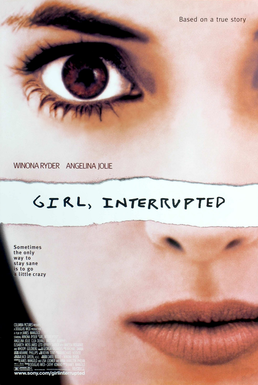
Behind the film
- Year
- 1999
- Director
- James Mangold
- Writers
- James Mangold, Lisa Loomer, Anna Hamilton Phelan
- Genres
- Biographical, Drama, Coming-of-age
- Production
- Columbia Pictures
- Country
- United States
- Cast
- Winona Ryder, Angelina Jolie, Clea DuVall, Brittany Murphy, Elisabeth Moss, Whoopi Goldberg, Vanessa Redgrave, Jared Leto
About the film
Contains story spoilers.
In 1967, eighteen-year-old Susanna Kaysen enters Claymoore psychiatric hospital after an overdose. She forms friendships with fellow patients and becomes especially drawn to Lisa, whose charisma and defiance make resistance feel like freedom. The pair escape and stay with recently discharged Daisy. After Lisa cruelly confronts her, Daisy dies by suicide. Disturbed by Lisa's response, Susanna returns to Claymoore and begins engaging with treatment and writing. Lisa later returns and uses Susanna's diary against her, provoking a confrontation about the harm inside their relationship. Before discharge, Susanna reconciles with her friends and offers Lisa compassion without following her lead. The film adapts Kaysen's memoir into a dramatic account of institutional life; its resolution belongs to this character rather than providing a general model of recovery.
Girl, Interrupted places the uncertainty of becoming an adult inside a setting where other people possess formal authority to name what is wrong. That arrangement makes self-understanding a disputed process. Susanna can distrust the explanations offered to her without necessarily knowing what alternative account would be adequate. James Mangold's film gives the audience access to that uncertainty through a young woman's experience rather than treating the hospital simply as an outside observer's problem to solve. Its emotional world concerns how a person can feel misread and still need help, and how finding a voice differs from insisting that every unwelcome interpretation must be false.
Winona Ryder's Susanna gives that problem a hesitant centre. The performance allows observation to precede commitment, so the audience spends time with someone who can recognise other people's habits more easily than decide what to make of herself. Her reserve contrasts with the dramatic force of the people around her. That contrast keeps the film's central journey from becoming a sequence of confident revelations. A person can participate in a shared world while remaining unsure of the terms on which she belongs there. The role makes uncertainty active, allowing attention, evasion and curiosity to occupy the same expression.
Angelina Jolie's Lisa has a different relationship with attention. Her confidence makes her seem able to define a room's possibilities, and the attraction of that ability is especially strong where other people's rules are everywhere. Yet the film places charisma beside the capacity to wound. Independence becomes difficult to admire without qualification when it depends on refusing concern for somebody else's vulnerability. Jolie's energy gives the relationship its pull; the drama has to make the cost of that pull equally visible. The question is not whether a rebellious person can be entertaining, but what someone seeking belonging might overlook in order to stay near her.
The ensemble makes the ward a social world rather than a single relationship enlarged to fill a building. Clea DuVall, Brittany Murphy and Elisabeth Moss give different kinds of presence to people whose lives cannot be adequately represented by a diagnostic label alone. The screenplay can still use heightened dramatic shorthand, which is one reason the film should not be treated as a clinical guide. Its meaningful attention lies in the friendships, boundaries and misunderstandings that occur between individuals. Shared confinement does not make people interchangeable, and sympathy does not automatically supply the knowledge needed to understand the difficulty someone else is experiencing.
Whoopi Goldberg's Valerie and Vanessa Redgrave's Dr. Wick bring distinct kinds of adult authority into that world. A rule can be experienced as intrusive while a relationship with the person enforcing it remains more complicated than opposition. The film asks the audience to distinguish care from mere control without making every distinction easy. Its historical setting also matters: this is a dramatisation of a particular institutional experience, not an account of what psychiatric services everywhere do today. The characters' changing responses to staff belong to the story's social relationships rather than demonstrating the effectiveness or failure of a treatment for a real viewer.
Writing introduces another difficulty: private description can help a person organise experience while also exposing other people to her judgment. A diary is not a neutral record merely because its author finds it necessary. The film uses that tension to place responsibility beside self-expression. Discovering a voice does not eliminate the need to consider how the voice describes someone else, particularly within a close and vulnerable community. This gives the title's interrupted life a form of continuity. Susanna begins finding a way to tell her story, but the act of telling must remain answerable to people who are more than supporting figures in her account.
Mangold's adaptation, written with Lisa Loomer and Anna Hamilton Phelan, draws on Kaysen's memoir while reshaping experience into a feature-film arc. Its story includes suicide, abuse and psychiatric distress, and those elements carry emotional force beyond the pleasures of a coming-of-age ensemble. The ending finds value in separating compassion from imitation. Someone can care about a friend without granting that friend the authority to define her future. Girl, Interrupted offers that distinction within Susanna's dramatic journey, leaving the other patients with lives that do not end when she departs. Her movement forward matters without becoming a verdict on everybody whose circumstances remain different.