
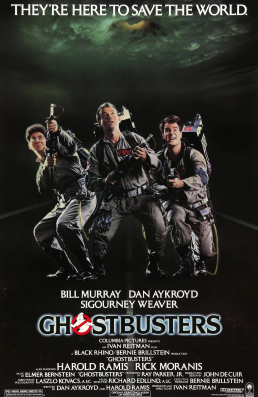
Behind the film
- Year
- 1984
- Director
- Ivan Reitman
- Writers
- Dan Aykroyd, Harold Ramis
- Runtime
- 1h 45m
- Genres
- Fantasy, Comedy horror, Monster, Action
- Production
- Columbia Pictures
- Country
- United States
- Cast
- Bill Murray, Sigourney Weaver, Rick Moranis, Dan Aykroyd, Harold Ramis, Ernie Hudson, Annie Potts, William Atherton
About the film
Contains story spoilers.
Ghostbusters starts with a place that normally promises quiet and order: the New York Public Library. An apparition disrupts that everyday setting, giving three university researchers an encounter they cannot dismiss. Peter Venkman, Ray Stantz and Egon Spengler are not equally interested in the work for the same reasons, and their response is considerably less composed than their scientific language suggests. Losing their academic positions pushes them toward a practical alternative. If ghosts really exist, perhaps someone will pay to have them removed. They acquire a firehouse, assemble equipment and advertise a service that has no established market until New York begins supplying customers.
Ivan Reitman directs the comedy around that gap between an impossible problem and an ordinary business. Ray's enthusiasm helps get the venture moving, Egon's technical concentration gives it machinery, and Peter's willingness to talk confidently provides a sales pitch. Their first major hotel job exposes how untested the combination is. The green apparition they pursue is difficult to catch, and their energy weapons damage the surroundings almost as enthusiastically as they threaten the ghost. They eventually secure it and insist on payment. It is an important shift: the men can now demonstrate a working service, but their success does not make the equipment harmless or their behavior professionally reassuring.
Dana Barrett brings them a more disturbing case. A musician living in a large apartment building, she finds a grotesque presence in her refrigerator and has no ready way to explain what has happened. Peter visits her apartment, mixing an investigation with personal interest that she does not simply accept as expertise. Her neighbor Louis Tully supplies a different kind of social discomfort, continually trying to make connections through invitations and business talk. The film spends time with these ordinary habits because the supernatural events will soon occupy their bodies and homes. Dana and Louis are not visiting a mysterious place to seek danger; something concealed inside their familiar building is reaching out to them.
As haunting spreads, the Ghostbusters become a recognizable part of the city, fielding calls and adding Winston Zeddemore to the team. Winston approaches the job more plainly than the original researchers, giving their elaborate terminology someone who can ask what it actually means. Janine Melnitz handles the office with a manner that makes the extraordinary work sound like another frustrating workplace. The growing demand appears to confirm the business model, but Egon recognizes that the rise in activity is more ominous. Catching individual ghosts cannot account for whatever is generating them, and the containment unit beneath the firehouse is approaching a dangerous limit. Their visible success is accumulating an invisible problem.
The conflict with environmental official Walter Peck gives that problem an immediate consequence. Peter refuses Peck access, escalating suspicion through mockery rather than explaining the equipment. Peck returns with authority to shut it down, and the Ghostbusters' warnings do not prevent the containment system being switched off. The result releases their captured ghosts and turns the citywide disturbance into a crisis. Dana and Louis, meanwhile, have become the hosts of entities called the Gatekeeper and the Keymaster. Their meeting is part of a larger design embedded in the apartment building, whose architecture was created to concentrate supernatural energy rather than merely provide housing. What looked like separate customer calls has been pointing toward the same structure.
In custody, the team explains that the building's designer, Ivo Shandor, belonged to a cult devoted to Gozer. The city's deteriorating situation makes their apparently absurd account useful to the mayor, who authorizes their return to work. At the roof, Dana and Louis complete the process that allows Gozer to enter. The entity asks for the form through which it will bring destruction, and Ray's attempt to imagine something harmless supplies the gigantic Stay Puft Marshmallow Man. The joke depends on his memory being comforting at a human scale and disastrous once made physically enormous. Childhood reassurance becomes a moving threat among the streets the team has been serving.
Egon's earlier warning against crossing the weapon streams now becomes the basis for a desperate alternative. The four men direct their combined equipment at the dimensional opening, accepting a risk they previously treated as unthinkable. The gateway is destroyed and Gozer's manifestation collapses, covering the aftermath in marshmallow rather than leaving a conventional monster corpse. Dana and Louis are recovered from the shells of their transformed bodies, and the surviving team emerges to a public celebration. The ending does not say that paranormal activity has ceased to exist; it resolves the particular arrival their investigations uncovered. Their strange occupation has proved necessary precisely because the city had no ordinary institution prepared to handle it.
Dan Aykroyd and Harold Ramis's screenplay lets practical concerns remain present inside the spectacle: rent, staffing, customer fees and inspections never disappear simply because the threat is ancient. Bill Murray's Venkman can deflate a solemn explanation, while Aykroyd and Ramis give Ray and Egon enough conviction to keep the premise functioning. Ernie Hudson's Winston adds a grounded perspective, and Sigourney Weaver and Rick Moranis make the possessed neighbors distinct before the transformation. New York's libraries, hotels, streets and apartment buildings give the fantasy a recognizable physical world. The film's comedy comes from watching that world absorb impossible events without losing its familiar capacity for commerce, impatience and improvisation.