
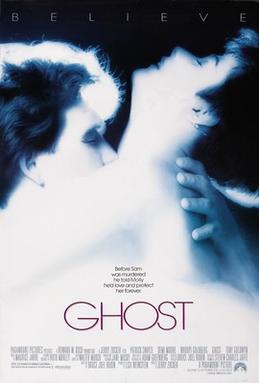
Behind the film
- Year
- 1990
- Director
- Jerry Zucker
- Writers
- Bruce Joel Rubin
- Genres
- Romance, Fantasy, Drama, Ghost
- Production
- Paramount Pictures
- Country
- United States
- Cast
- Patrick Swayze, Demi Moore, Whoopi Goldberg, Tony Goldwyn, Rick Aviles, Vincent Schiavelli, Stephen Root, Phil Leeds
About the film
Contains story spoilers.
Ghost begins with a shared home taking shape. Banker Sam Wheat and artist Molly Jensen move into a Tribeca loft with help from Sam’s friend and colleague Carl Bruner. Their happiness breaks when a mugger attacks them on the street. Sam chases him, only to return to Molly and realize that his own body lies bloodied in her arms. A light opens above him, but he cannot leave her behind. The romance is transformed into a problem of communication: Sam can see the living world but cannot make himself heard or touch the people he wants to protect.
Sam’s first attempts at intervening are small and frustrating. When the mugger breaks into Molly’s apartment, Sam cannot fight physically; he scares the cat, which scratches the intruder. In pursuit, Sam encounters a hostile ghost on the subway who can move objects but offers him a hostile reception. Sam tracks the mugger to learn his name, Willie Lopez, and discovers that his own death was not random. Then he finds Oda Mae Brown, a medium who has spent her life pretending to hear the dead and is startled to find that Sam is real.
Oda Mae becomes Sam's only route back to Molly, though she is reluctant to be involved. A private phrase helps Molly recognize something of Sam in the warning. The police then reveal Oda Mae's fraudulent past, giving Carl a way to dismiss her account while pretending to be a concerned friend. Sam discovers that Carl ordered the robbery to obtain his bank-password book and move criminal money. The familiar colleague has been hiding a second life inside the routines of their workplace. Molly's trust makes his visits especially dangerous: the person who appears available to help with her grief is connected to the violence that caused it.
The ghost story gains a comic counterpoint through Oda Mae’s pragmatic skepticism. She is not an eager believer or pure-hearted oracle; she has built a living by performing a role and is now asked to risk that life because the dead man is real. Sam uses her to move a large sum of money out of Carl’s reach, and she makes a choice that costs her comfort and safety. Sam then persuades her to give the money to nuns, despite her reluctance to surrender it, showing that her transformation is not simply conversion to belief but a change in what she thinks she owes other people.
Sam returns to the subway ghost to learn how to move objects. Concentration gives anger a physical outlet, letting him interrupt the plot rather than simply witness it. When Willie pursues Oda Mae, Sam frightens him into traffic, where he is killed and taken away by dark figures. Later, a floating penny helps convince Molly that Sam is near. Oda Mae allows him to possess her briefly so he can hold Molly, but the effort leaves him exhausted. Their reunion therefore creates a new vulnerability just as Carl arrives. The story makes contact possible without turning it into a permanent escape from death.
Carl’s pursuit ends inside Molly’s loft. Sam uses his new strength to defend her, and Carl dies when the hook he swings toward Sam breaks a window and a large shard impales him. The same dark presence that claimed Willie appears for Carl, who is dragged away as Sam shields Molly. With the threat gone and his promise fulfilled, Sam is finally visible to Molly. They share a last farewell, and the light returns to take him onward. Oda Mae is left behind as a living witness to what she once dismissed, while Molly must grieve Sam again knowing he stayed near her as long as he could.
Jerry Zucker's direction moves between romantic melodrama, urban fantasy, suspense and broad comedy. The loft's renovation materials, crowded subway and ordinary street corners keep the ghost story grounded in recognizable places. Bruce Joel Rubin's screenplay gives the afterlife rules enough clarity to create suspense: Sam can watch and hear, but he has to learn how to affect matter. Maurice Jarre's score moves between the warmth of attachment and the unease of being trapped outside ordinary life. Spaces change meaning without needing to change shape. The apartment that once offered a future together becomes a place where Molly can be threatened by someone she trusts. A train offers Sam a teacher, while a bank supplies Oda Mae with a stage on which to perform a supposedly respectable identity.
Whoopi Goldberg's Oda Mae has a particularly difficult kind of double performance. She is used to pretending she has supernatural knowledge, but genuine contact leaves her improvising with much less control than she enjoyed as a fraud. At the bank, she must sound certain while receiving instructions nobody else can hear. Her complaints give the scene an everyday practicality: an extraordinary event does not remove her irritation or her interest in money. Patrick Swayze's Sam has the opposite problem, knowing what is happening but struggling to make any visible difference. His physical frustration is recognizable even when the obstacle is supernatural. Demi Moore's Molly inhabits the quieter part of that contrast, responding to evidence whose emotional meaning is almost harder to bear than its impossibility. Tony Goldwyn supplies a reassuring professional manner that becomes increasingly strained as Carl loses control of the scheme. Vincent Schiavelli's impatient subway ghost offers another version of being stranded, turning instruction into an abrasive encounter rather than a magical blessing. Together, these performances give the film different responses to the same impossible situation: grief, disbelief, resentment, opportunism and a practical willingness to help.