
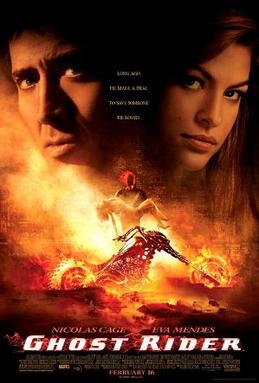
Behind the film
- Year
- 2007
- Director
- Mark Steven Johnson
- Writers
- Mark Steven Johnson
- Runtime
- 1h 50m
- Genres
- Action, Fantasy, Superhero, Horror
- Production
- Columbia Pictures, Crystal Sky Pictures, Relativity Media
- Country
- Australia, United States
- Cast
- Nicolas Cage, Eva Mendes, Wes Bentley, Sam Elliott, Donal Logue, Matt Long, Peter Fonda, Brett Cullen
About the film
Contains story spoilers.
Mark Steven Johnson’s Ghost Rider links Johnny Blaze’s stunt career to a childhood bargain. At seventeen, Johnny accepts Mephistopheles’ promise to cure his father’s cancer, only for his father to die in a stunt accident the next day. Years later, Johnny is famous, Roxanne has returned as a reporter, and Mephistopheles’ son Blackheart is searching for the Contract of San Venganza, which holds a thousand dark souls. Mephistopheles turns Johnny into his bounty hunter and promises freedom if he defeats Blackheart. Caretaker explains the Rider’s history and leads Johnny to the contract. In San Venganza, Johnny defeats Blackheart with the Penance Stare, but refuses Mephistopheles’ offer to remove the curse. He rides away choosing to direct its power against evil, accepting the burden rather than passing it to someone else.
Johnny’s two forms are joined by a career built on risk. In daylight, the stunt show depends on a performer’s ability to turn danger into a controlled spectacle; at night, the transformation makes that same body an instrument that no longer obeys ordinary limits. The film uses this contrast to shape its central image: a blazing skeleton on a motorcycle is at once a comic-book figure and a distorted version of the daredevil Johnny has spent years presenting to crowds. His public fame masks his private history with Mephistopheles. The crowd cheers a jump without knowing the bargain behind the man attempting it, while the supernatural form exposes a cost that entertainment had allowed him to keep hidden.
The bargain’s first consequence is emotional rather than contractual. Johnny accepts the deal to save his father, not to acquire wealth or power, and the cure makes the later death feel like a cruel accounting trick. His anger does not undo the terms; it becomes part of the resentment he carries into adulthood. The film’s supernatural system is starkly transactional: Mephistopheles offers relief, then claims the person who accepted it. Johnny’s final decision matters because it is the first meaningful refusal within that relationship. He cannot undo the past or make the curse disappear through willpower, but he can reject the demon’s framing that service must end with returning to a previous life. Responsibility becomes a choice about what to do with a compromised inheritance.
Roxanne’s work as a reporter offers an ordinary public language for an extraordinary event. She covers Johnny’s dangerous performances and investigates the violence associated with Blackheart, while Johnny struggles to disclose what is happening to him. Their reunion has an emotional history that neither can simply resume: she has built a career and a life apart from him, while he has kept his transformation secret. When Johnny reveals the truth, disbelief is a reasonable response within the film’s world. The relationship is not resolved by Roxanne becoming an effortless believer or by the curse producing instant intimacy. Her later participation is practical and brave, but Johnny remains responsible for facing the danger he invited into her life. The film gives her a point of view beyond the role of hostage, even as the action repeatedly puts her at risk.
Caretaker gives the curse a history, which changes Johnny's predicament from a solitary disaster into an inherited role. Advice in that setting has an ethical weight: someone who understands a burden can offer preparation instead of merely describing danger. The western associations also put the rider in a recognizable tradition of wandering figures whose freedom comes with estrangement. A mount, a weapon and an unsettled debt are enough to suggest a whole moral landscape. Johnny's modern motorcycle belongs to the same image while replacing the frontier's horse with a machine designed for speed and display. The connection makes the supernatural premise feel like a continuation of older outlaw stories. It raises the question of whether a person carrying a violent power can become more than the purpose for which it was originally bestowed.
The Rider’s abilities make moral judgment literal. The Penance Stare forces a target to experience the pain inflicted on others, turning an abstract idea of accountability into a supernatural attack. This is not a legal system and the film does not present it as one; it is a mythic power tied to the curse. Blackheart’s plan to use the contract transforms the thousand souls into a source of dominion, while Johnny’s refusal prevents the contest from ending as a simple exchange in which one demon replaces another. The fiery effects and altered silhouette emphasize how far the transformation removes him from ordinary human appearance, but the story keeps returning to choice: Johnny can be commanded, feared or celebrated, yet his last act defines what the role means to him.
The mythology's physical vocabulary helps keep its abstractions understandable. Fire suggests punishment but also energy; the skeletal face removes the reassuring expressions through which a human being usually communicates intent. A rider can move freely while remaining bound, which makes the motorcycle an especially apt image for Johnny's predicament. Those contradictions give the character more to carry than a collection of frightening effects. His appearance may identify him as monstrous before his choices become visible, and that gap turns intention into something he has to demonstrate. The important distinction is between possessing a dangerous ability and consenting to the uses others demand of it. The curse makes freedom imperfect, but imperfect freedom still leaves room for responsibility, even when restoration of the old life is impossible.