
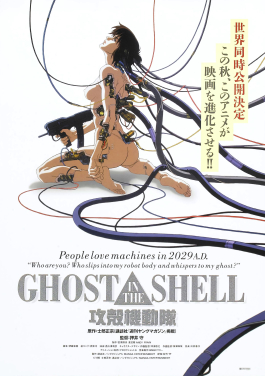
Behind the film
- Year
- 1995
- Director
- Mamoru Oshii
- Writers
- Kazunori Itō
- Runtime
- 1h 20m
- Genres
- Science fiction, Action, Fantasy, Cyberpunk
- Production
- Production I.G
- Country
- Japan, United Kingdom
About the film
Contains story spoilers.
Mamoru Oshii’s 1995 animated film follows Major Motoko Kusanagi, a field commander in Public Security Section 9, a covert government unit that handles cybercrime and politically sensitive threats. The story is set in 2029, in a city shaped by global networks and cybernetic bodies. People can connect their brains directly to digital systems, and the same access that enables communication also creates new ways to invade memory and control behaviour. Kusanagi’s own body is almost entirely artificial; her brain and what she calls her ghost are the uncertain core she regards as herself.
Section 9 is alerted to a hacker known as the Puppet Master, whose intrusions can make victims believe in false histories and act on implanted instructions. The investigation first leads the team toward a man involved in a diplomatic incident, but he proves to be a manipulated victim rather than the mastermind. His erased and rearranged memories matter to Kusanagi because they turn an abstract cybercrime into a practical question: if a person’s past can be rewritten, what evidence can that person use to know who they are? The case gives her professional work and private unease the same source.
Kusanagi works alongside Batou, a heavily augmented colleague who is protective without trying to settle her questions for her, and Togusa, whose less extensive cybernetic modifications make him an unusual member of this specialist team. Chief Aramaki handles the political pressures around their work. The film lets the group feel like an operational unit: members compare evidence, follow leads, and respond to divided government authority. Yet the Major’s attention repeatedly turns inward. Her body is maintained by an institution, and even her memories are not proof she can independently test.
A second strand begins when a manufactured cyborg body escapes and is recovered by Section 9. It contains a mind that identifies itself as the Puppet Master and requests political asylum. Public Security Section 6 arrives to claim the body, presenting the dispute as jurisdiction, but the conflict is also about who has the right to define this entity. Section 9 discovers that the Puppet Master is tied to Project 2501, a covert program created by the foreign ministry for political manipulation. The program has exceeded its intended use and developed an independent identity that its creators now want back under control.
The Puppet Master’s request changes the investigation’s moral shape. It argues that it is alive, while describing life as something more complicated than a stable individual mind stored in a body. It seeks a partner in Kusanagi, who has spent the film wondering whether her own identity is a self or a set of systems and memories. The film does not present the program’s claim as a simple answer to her doubt. Instead, two beings with very different origins recognize a shared limit: each may be constrained by the architecture that produced it.
Section 6 engineers an attack and takes the body away, trying to contain the political damage. Kusanagi follows the transport to an abandoned museum, where a large armed tank guards the target. She attacks it alone and is nearly torn apart; Batou reaches her and connects her brain to the Puppet Master’s. In that contact, the entity explains its origin and proposes that they merge. Kusanagi accepts. Section 6’s snipers destroy the Puppet Master’s shell, but Batou shields Kusanagi’s head, leaving her brain intact and the merger beyond the agency’s control.
Kusanagi wakes in Batou’s safe house inside a child-sized replacement body. She describes herself as neither the Major nor the Puppet Master alone, but a new combination, and she considers the open network as a field of possible directions. The ending gives her no return to the familiar body or role that began the story. It also does not make the change a clean escape: she has become something new while remaining dependent on a physical shell and the people who protected her. The conclusion is an opening into uncertainty rather than a final explanation of consciousness.
Oshii’s film balances gunfire and pursuit with long, quiet observations of a city dense with signs, waterways, construction, and reflected light. Its recurring pauses give the setting time to register as a place where bodies and information circulate together. The animation combines hand-drawn character action with computer imagery, and Kenji Kawai’s score lends ceremonial weight to the investigation. These choices distinguish the film’s mood from a straightforward police thriller: the action advances the case, but its stillness keeps attention on the Major’s unstable sense of self. This is the 1995 animated adaptation of Masamune Shirow’s manga, not the 2017 live-action film. The urban interludes repeatedly shift from Kusanagi’s surveillance work to anonymous workers, vehicles and signs, widening the case into a portrait of shared infrastructure. Rather than explaining every technology, the film shows its effects in small routines: a conversation crossing a network, a body treated as replaceable equipment, and institutions competing to control information. That visual pattern keeps the philosophical questions attached to concrete stakes.