
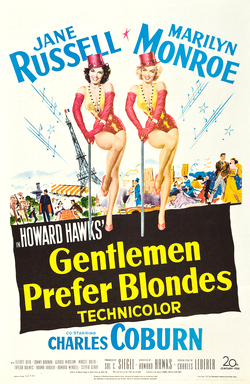
Behind the film
- Year
- 1953
- Director
- Howard Hawks
- Writers
- Charles Lederer
- Genres
- Romantic comedy, Musical, Comedy, Drama
- Production
- 20th Century Studios
- Country
- United States
- Cast
- Marilyn Monroe, Jane Russell, Charles Coburn, Elliott Reid, Tommy Noonan, Norma Varden, Marcel Dalio, Steven Geray
About the film
Contains story spoilers.
Gentlemen Prefer Blondes places two women's different romantic priorities inside a friendship that proves more dependable than the men assessing them. Lorelei wants wealth to accompany affection; Dorothy is more immediately interested in attraction. Their disagreement creates comedy without requiring either to stop caring about the other. That partnership gives the film a centre beyond the pursuit of husbands. Each woman understands something about her friend that an outsider's judgment tends to miss, and each can act when the other's position becomes precarious. The musical's glamorous world is therefore organised around practical solidarity as well as conspicuous desire.
Lorelei travels to France with Dorothy before marrying wealthy Gus. His suspicious father hires detective Malone, who falls for Dorothy while watching Lorelei. Her flirtation with diamond magnate Piggy produces compromising pictures and a disputed tiara. The women recover the film, but the detective's report cuts off their money in Paris. They perform to support themselves, and Dorothy impersonates Lorelei in court while Malone establishes that Piggy has the missing jewellery. Lorelei persuades Gus's father that wanting financial security need not exclude love. The film ends with both couples marrying. The women survive the interference through performance, ingenuity and their willingness to protect one another.
Marilyn Monroe's Lorelei makes an economic preference visible in a world that would often prefer not to name its own transactions. Other people can disapprove of her interest in money while continuing to judge women through appearance and desirability. The comedy gives her a way to expose that inconsistency. She is not claiming that a bank account is a complete substitute for a person. She recognises that material security has consequences, particularly when affection alone cannot guarantee what a woman's future will look like. Her directness can sound naïve while actually making a calculation others would rather keep hidden inside more respectable language.
Jane Russell's Dorothy brings another kind of directness. Her attraction is not governed by the same financial priorities, yet the contrast does not make her morally appointed to correct Lorelei. The film lets desire have different forms without turning the friendship into a competition for the right answer. Dorothy's loyalty becomes especially important when private attraction and professional surveillance occupy the same relationship. Wanting Malone does not require her to accept harm done to her friend. That gives romance a condition beyond winning the desired man: a relationship has to coexist with an existing commitment, rather than earning the right to erase it.
The detective plot makes observation a source of control. A picture can be collected to establish what somebody has done, but the act of collecting it is already guided by a client's suspicion. The women are responding to a story being prepared about them, not simply to an impartial record. Their attempts to manage the evidence therefore belong to a wider contest over interpretation. Who gets to say what a gesture means, and whose motives remain outside the frame? The comedy keeps those questions lively by making disguise and performance available to the people under scrutiny, instead of reserving all the ingenuity for the observer.
The musical numbers give performance a public dimension that the intrigue also uses privately. Lorelei and Dorothy know how to present themselves, and that ability can earn a living as well as attract attention. The familiar song title Diamonds Are a Girl's Best Friend expresses Lorelei's concern with durable security in a form built for an audience. It need not be treated as a complete declaration about every woman or every relationship. Within the film, it belongs to a particular character whose glamour and calculation can occupy the same moment. The number turns a social argument into an event, allowing the presentation to carry something the dialogue is also negotiating.
Howard Hawks directs a screenplay by Charles Lederer, adapted from material associated with Anita Loos and its stage-musical form. The film's movement between an ocean crossing, Parisian entertainment and a legal complication keeps shifting the setting in which the women have to be legible to others. Their professional skill remains useful across those changes. The court impersonation makes that continuity particularly comic: a familiar performance identity becomes a way to buy time within an institution that expects a stable name and person. The plot's disguises depend on the audience recognising the difference even when the people inside the scene have yet to establish it.
The double wedding gives the story a conventional destination, but the route there has repeatedly depended on the friendship rather than on a man arriving to solve everything. Lorelei and Dorothy work, improvise and argue for their interests within a world that watches them closely. Their differences remain compatible with cooperation, making the title's apparent preference less decisive than the relationship between the two central women. Gentlemen Prefer Blondes builds its glamour around that combination. Desire can be comic, money can be openly important, and neither condition prevents loyalty from becoming the most reliable source of action when admiration turns into suspicion and a promising trip begins to go wrong.