
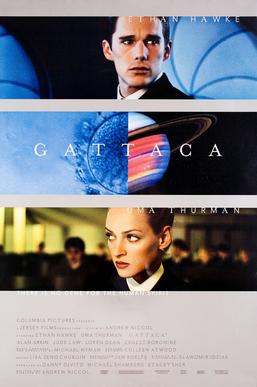
Behind the film
- Year
- 1997
- Director
- Andrew Niccol
- Writers
- Andrew Niccol
- Genres
- Science fiction, Drama, Dystopian, Biopunk
- Production
- Columbia Pictures
- Country
- United States
- Cast
- Ethan Hawke, Uma Thurman, Jude Law, Loren Dean, Gore Vidal, Xander Berkeley, Alan Arkin, Ernest Borgnine
About the film
Contains story spoilers.
Vincent grows up classified as genetically unsuitable for the future he wants. To join Gattaca’s space programme, he assumes the identity of Jerome, a genetically privileged former swimmer who now uses a wheelchair and supplies him with biological samples. Vincent earns a place on a mission to Titan and becomes close to Irene, but an administrator’s murder brings investigators into the facility. His own eyelash makes his unregistered identity a suspect. The actual murderer is mission director Josef. Vincent’s brother Anton discovers the deception, yet Vincent again outlasts him swimming and rescues him. At the final test, doctor Lamar knowingly lets Vincent pass. Vincent launches into space carrying Jerome’s hair; Jerome dies by suicide after preparing samples for Vincent’s future. The ascent ends alongside an irreversible loss.
Andrew Niccol’s future is disturbing because its prejudice can present itself as a form of sensible administration. The institution does not need to announce that it hates Vincent. It can claim that a measurement has simply indicated where he belongs. That gives discrimination an appearance of impersonality: the decision seems to come from data rather than from someone who might be questioned. The film’s argument depends on the distinction between knowing something about a body and knowing what a person will achieve. A probability becomes a verdict when a society uses it to close opportunities, then treats the consequences of exclusion as proof that its prediction was correct.
Vincent’s disguise also reverses the usual pleasures of an assumed identity. He cannot rely on a convincing suit, a new manner or a carefully rehearsed story. His own body continually produces the evidence that could undo him. That makes self-presentation a form of work rather than a single transformation, and gives the suspense an intimate scale. An ordinary trace of a person becomes threatening in a world organised to classify traces. Ethan Hawke’s Vincent therefore has to appear relaxed while maintaining a discipline that cannot relax. His confidence is an achievement performed under conditions in which the smallest evidence of himself can be treated as a failure.
Jerome exposes the other side of the promise. A privileged genetic identity may open doors without providing a reason to live comfortably with oneself. Jude Law gives the relationship a bitterness that prevents it from becoming a simple exchange between a fortunate donor and a deserving applicant. The two men each possess something the other lacks, but their needs cannot be measured in the same units as their arrangement. Vincent needs access to a system; Jerome needs an account of his value that can survive disappointment. Their friendship makes the scheme more than a clever fraud, while leaving an imbalance between the future one man can imagine and the future the other can bear.
Irene offers another perspective on what it means to live beneath an official estimate. Uma Thurman’s performance makes composure look like a practiced accommodation to limits, rather than proof that those limits have caused no pain. The possibility of intimacy is unsettling in a world where learning about another person can mean inspecting information before meeting the person himself. Trust must compete with verification. The romance consequently belongs to the film’s central problem, rather than sitting beside it as a reward for Vincent’s determination. To recognise another person requires deciding whether an authorised description will stand in for the less tidy work of attention.
The murder investigation gives that problem a familiar thriller shape. Suspicion is supposed to connect evidence with an action, yet the surrounding system encourages a shortcut between a disfavoured identity and presumed guilt. The audience knows how much effort Vincent has invested in belonging, making the investigators’ search an attack on more than a cover story. At the same time, the deception is real, so the film does not remove the tension by pretending that identity checks are entirely irrelevant. It asks what happens when an institution becomes so confident in its categories that those categories begin to determine what the institution is willing to notice.
The world’s orderly appearance is part of that confidence. Gattaca’s restrained spaces and formal presentation suggest a future that has made uncertainty unwelcome, placing human ambition inside an environment that seems already complete. Against that composure, the recurring water imagery offers movement without an easily visible measure. A body in the sea cannot be reduced to the same neat outline it holds in an institutional record. The contrast is dramatic rather than a claim about real genetics. Niccol uses a fictional system to examine how people behave when predictive information acquires the status of destiny, not to provide a medical account of heredity or astronaut selection.
The ending keeps the cost of escape beside its possibility. A success story could treat every sacrifice as a contribution toward the hero’s destination, but Jerome’s absence resists that tidy arrangement. Vincent’s achievement cannot make another person’s suffering useful merely because the two lives have become connected. Nor does the launch prove that the institution has changed for everyone left behind. The story permits one person to exceed the role assigned to him, while leaving the structure that assigned it largely intact. That combination gives the final movement its particular ache: liberation is real within the story, and the world in which it has been won remains capable of wasting human possibility.