
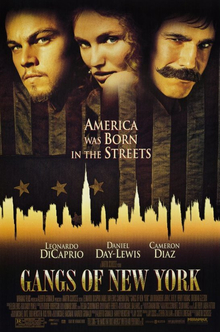
Behind the film
- Year
- 2002
- Director
- Martin Scorsese
- Writers
- Jay Cocks, Steven Zaillian, Kenneth Lonergan
- Genres
- Crime, Drama, Historical, Crime drama
- Production
- Intermedia, Miramax
- Country
- United States, Italy, Netherlands, Germany, United Kingdom
- Cast
- Leonardo DiCaprio, Daniel Day-Lewis, Cameron Diaz, Jim Broadbent, John C. Reilly, Henry Thomas, Brendan Gleeson, Liam Neeson
About the film
Contains story spoilers.
Gangs of New York begins in 1846 with a violent clash outside the Old Brewery, where Irish Catholic Dead Rabbits led by Priest Vallon fight the Anglo-Protestant Natives led by Bill Cutting. Bill kills Priest and declares the Dead Rabbits outlawed. Priest's young son Amsterdam sees the killing, hides the knife used in it and is taken to an orphanage. Sixteen years later he returns to the Five Points as the city is being reshaped by immigration and the Civil War. He finds his old friend Johnny Sirocco and learns that Bill still dominates the neighborhood, with other gangs paying tribute and local power intertwined with political machines.
Amsterdam keeps his identity secret and gets himself noticed by helping loot a burning building. Bill welcomes him into his circle and makes him a protégé, unaware that the young man intends to kill him. The film depicts Bill as both a racist gang leader and a showman, staging the annual anniversary of his victory over Priest as a public ritual that reinforces his claim to the neighborhood. Amsterdam becomes close to Jenny Everdeane, a pickpocket and grifter who has her own history with Bill, and encounters William Tweed, whose political organization can turn street loyalty into votes. The plot lets personal revenge, social exclusion and political patronage overlap rather than treating the gang war as a private feud alone.
Bill's trust in Amsterdam grows after an attempt on Bill's life. Amsterdam saves him, but later discovers that Monk McGinn, a former Dead Rabbit, organized the attack. Johnny's jealousy leads him to reveal Amsterdam's identity. Bill turns the next anniversary into a public humiliation: he stages a knife-throwing act around Jenny, and Amsterdam throws his father's knife at him. Bill deflects it, wounds Amsterdam, beats him and burns his cheek with a hot blade before sending him away. Jenny urges Amsterdam to leave for San Francisco, but he chooses to return to the Five Points and openly revive the Dead Rabbits. His personal revenge becomes a challenge to Bill's civic authority, not just a chance to settle a score.
Amsterdam gathers Irish gangs and forms an alliance with Tweed, who backs Monk for sheriff in exchange for Irish votes. Monk wins, but Bill kills him with his own club after being denied a duel. Amsterdam is furious and calls for a gang battle in Paradise Square. While they prepare, the city erupts in draft riots, while Union troops are deployed to control the rioters. The setting makes clear that the gang conflict is taking place within a larger crisis of race, immigration and political power. Amsterdam's confrontation with Bill cannot control the city around them, and the chaos alters the scale and outcome of their planned showdown.
During the riot, Bill's gang fights the Dead Rabbits amid bombardment and street fires. Amsterdam and Bill face one another in the wreckage; Amsterdam ultimately stabs Bill with the razor that belonged to his father. Bill dies as Amsterdam holds his hand, and the gang battle ends as soldiers restore order. Amsterdam and Jenny leave the Five Points after Amsterdam places a memorial to Bill beside Priest's grave. The film then carries the cemetery through time, showing New York's skyline changing while the graves become obscured. That final movement separates the neighborhood's shifting surface from the names of the dead, although the film's fictional characters and compressed events should not be mistaken for a literal history of the real Five Points or draft riots.
Martin Scorsese builds the Five Points as a crowded social stage where gangs, politicians, immigrants and police cross paths. The opening battle and the anniversary rituals make violence public and theatrical; Bill's costumes, knives and speeches turn intimidation into performance. Daniel Day-Lewis's Bill and Leonardo DiCaprio's Amsterdam give the rivalry different rhythms, one practiced and self-mythologizing, the other driven by an old wound that keeps changing meaning. The production's constructed streets give the film a dense, stylized city rather than a neutral historical reconstruction. It draws on a nineteenth-century setting and a book of the same title, but its characters and story are dramatized, and many details should be read as the film's invention.
Amsterdam's return also exposes what happened to his father's followers after the first defeat. Happy Jack, once a Dead Rabbit, now works as a corrupt policeman serving Bill's interests; McGloin has joined the same arrangement. Remaining alive in the district has not meant remaining loyal to Priest's cause. When Amsterdam announces himself, Happy Jack is sent to investigate, and their encounter ends with the policeman dead. Johnny's jealousy has already revealed Amsterdam's identity, but betraying his friend does not protect him from Bill. Bill retaliates against Amsterdam by leaving Johnny gravely wounded, forcing Amsterdam to confront what revenge has cost someone he grew up with. Monk then returns Priest's razor to him, making the inheritance a physical object again. These encounters complicate the idea of a unified neighborhood waiting for its old gang to return. Its members have survived by choosing different loyalties, and Amsterdam's campaign pulls each choice back into the open.