
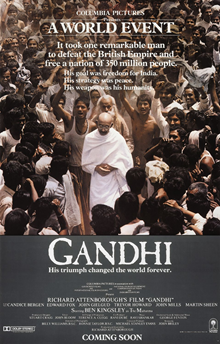
Behind the film
- Year
- 1982
- Director
- Richard Attenborough
- Writers
- John Briley
- Genres
- Biographical, Flashback, Drama, Historical drama
- Production
- Goldcrest Films, International Film Investors, Columbia Pictures
- Country
- United Kingdom, India
- Cast
- Ben Kingsley, Candice Bergen, Edward Fox, John Gielgud, Trevor Howard, John Mills, Martin Sheen, Ian Charleson
About the film
Contains story spoilers.
Richard Attenborough’s Gandhi opens at the end of its subject’s life: Nathuram Godse shoots Mohandas K. Gandhi during a prayer gathering, and the film moves from the killing to a vast funeral procession before returning decades to the past. The structure makes the outcome known from the outset, so the suspense lies in how a barrister becomes a political figure whose methods reshape a mass movement. Ben Kingsley plays Gandhi through successive stages of life, keeping the performance attentive to posture, speech and quiet humour rather than turning him into an untouchable monument.
In 1893, the young lawyer travels to South Africa and is thrown off a train despite holding a first-class ticket. The episode exposes how racial rules are enforced through ordinary institutions, not only by spectacular violence. Gandhi initially sees the insult as a personal wrong; he gradually connects it to the treatment of Indian migrants more broadly. He organises legal and public resistance, learns the limits of petitions, and endures imprisonment. The film presents satyagraha—resistance through truth and refusal to cooperate—as a practice developed under pressure, not a magical tactic that prevents opponents from using force.
After returning to India, Gandhi travels through the country before taking a central role in the independence struggle. His campaigns are shaped by the Indian National Congress and relationships with figures such as Jawaharlal Nehru and Vallabhbhai Patel, whose political responsibilities do not always align neatly with his moral demands. The film places the movement in streets, villages and crowded meetings, emphasising that leadership depends on persuading people with very different interests to act together. Gandhi’s plain clothing and ashram life become public symbols, yet the story also shows the hard work of organising, communicating and sustaining noncooperation.
The 1919 Amritsar massacre becomes a turning point in the film’s depiction of British rule. General Reginald Dyer orders troops to fire on an unarmed gathering trapped in Jallianwala Bagh, and the scene refuses to soften the brutality or its political consequence. Gandhi responds by urging noncooperation, but when violence erupts among Indian protesters, he calls off a campaign and accepts that his followers have not yet made nonviolence a shared discipline. That decision frustrates allies who want immediate liberation; it also demonstrates the tension in a strategy that asks a movement to restrain itself even when it has been attacked.
The Salt March gives the film a distinct visual and political rhythm. Gandhi and a group of followers walk for weeks toward the sea, turning a tax and monopoly over salt into a direct challenge that ordinary people can understand and join. The journey is not framed as a military advance: its force comes from visibility, the discipline of the marchers and the response of authorities. News coverage helps the campaign travel beyond the route itself. Later, at the Dharasana salt works, unarmed volunteers advance in waves and are beaten by police without retaliating, bringing the costs of the policy into sharp public view.
That resistance does not erase disagreement or private strain. The film follows Gandhi through arrests, negotiations and fasts, while his family’s needs sit beside the demands of public life. His wife Kasturba challenges him and shares the consequences of his choices; their relationship is neither merely supportive nor reducible to a political symbol. Gandhi’s insistence on self-discipline can inspire others, but it can also burden those closest to him. Kingsley’s stillness in these quieter exchanges gives the surrounding crowds and set pieces a human point of reference.
Independence arrives amid partition and escalating Hindu-Muslim violence, complicating any triumphant account of victory. The film shows Gandhi attempting to halt communal reprisals through travel, prayer and fasting, even as political leaders negotiate division and human displacement overwhelms any one person’s influence. He does not control the outcome simply because he has become a symbol. His final days return the story to the prayer meeting from the opening, linking the intimate violence of the assassination to the public life the film has spent three hours tracing.
Attenborough stages a historical epic through contrasts of scale: intimate conversations and prison cells give way to huge crowds, demonstrations and funeral processions. The design repeatedly places Gandhi’s slight frame against colonial architecture, military lines or open landscapes, while reporters show how local actions acquire international visibility. The film’s broad sweep simplifies a complicated political history and centres one leader, so its scenes are a dramatic shaping of events rather than a complete record. Its strongest thread is the collision between a method based on self-restraint and a world that answers protest with force. The photography and editing repeatedly shift from Gandhi’s composed face to the scale of the response around him: a courtroom, a silent line of marchers, or a crowd gathered to hear a speech. Newsreel-like images help bridge years without suggesting that change happened quickly. The recurring return to public ceremonies also shows how a private death becomes part of a nation’s contested memory.