
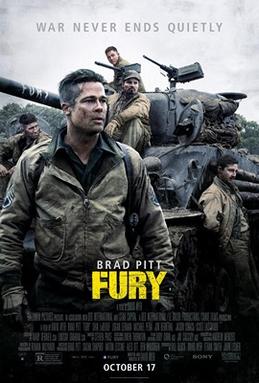
Behind the film
- Year
- 2014
- Director
- David Ayer
- Writers
- David Ayer
- Genres
- War, Action, Drama
- Production
- QED International, Columbia Pictures
- Country
- United States, People's Republic of China, United Kingdom
- Cast
- Brad Pitt, Shia LaBeouf, Logan Lerman, Michael Peña, Jon Bernthal, Jason Isaacs, Anamaria Marinca, Alicia von Rittberg
About the film
Contains story spoilers.
David Ayer’s Fury stays close to a single Sherman tank during the final weeks of the Second World War. Don “Wardaddy” Collier commands the vehicle and its experienced crew, whose routines are interrupted when Norman Ellison, a typist with little combat training, replaces a dead assistant driver. Norman’s hesitation under fire puts the crew at risk, and Don responds by forcing him to shoot a captured German soldier. The moment is brutal and defining: Norman’s transformation is not a clean passage into heroism but an imposed loss of innocence inside a group that measures survival through action.
The tank’s interior gives the film an unusually constrained social space. Five men work shoulder to shoulder around controls, ammunition, radios and narrow hatches; private feelings have to coexist with the machine’s practical demands. Boyd “Bible” Swan, Grady Travis and Trini Garcia each bring a different way of coping with violence, and their teasing or cruelty can turn quickly into discipline. The crew’s nicknames create a rough shared language, but Norman has not earned a place in it. His learning curve is inseparable from the fact that every mistake can affect the whole vehicle.
Fury does not present its crew as a unified moral example. Don is capable of care and coercion, Bible’s faith offers steadiness without removing the violence around him, and Grady’s bullying exposes how the men enforce their own hierarchy. Norman’s first instinct is to refuse killing, while the veterans treat hesitation as a danger to everyone. A later stop in a captured German town briefly lets him connect with Emma, one of two cousins hiding in an apartment. That possibility ends when artillery strikes the town and Emma is killed, showing how little control the crew has over the people it meets.
The battles are staged through the tank’s limited field of view as much as through open terrain. Crews must see, communicate and act with a delay, and an enemy position can remain hidden until it is already firing. Fury’s clash with a Tiger tank illustrates the asymmetry of armored combat: the Sherman crew needs coordination and tactical opportunity to survive against a more formidable opponent. When the tank loses radio contact and is immobilized by a mine at a crossroads, the men face a decision without dependable support. The landscape becomes a map of exposure rather than a neutral battlefield.
Norman's change occurs through repeated decisions under pressure, and becoming useful to the crew does not remove what he has been made to do. The apartment episode places those pressures beside civilians who have little power to refuse an occupying soldier. Don directs the encounter, while the later arrival of the drunken crew disrupts even the limited privacy he arranged. The scene cannot be understood simply as a rest from combat: command and coercion have entered a domestic space. Its food, music and ordinary furniture promise another kind of life, but the men's conduct carries their hierarchy into that promise. Emma's subsequent death ends the possibility of a continuing relationship before Norman can find out what it would mean away from occupation.
After the mine disables Fury, Norman scouts and sees a Waffen-SS battalion approaching. The crew could leave, but Don insists on holding the crossroads; Norman chooses to stay, and the others follow. They disguise the tank and prepare a last stand. The battle kills Grady, Gordo and Bible; Don is mortally wounded, and he sends Norman through the floor hatch to hide beneath the tank. A young German soldier finds Norman but does not reveal him. In the morning, American reinforcements arrive, and Norman covers Don’s body before being taken to safety.
The film’s ending turns survival into an uneasy inheritance. Norman is praised as a hero, but the image of him beneath the tank remains more important than the label: he has lived because an enemy soldier spared him, after watching his crew die in a position they chose to defend. Fury itself is left wrecked among the dead. The battle does not restore the crew or settle the larger war; it leaves one young man carrying the habits and losses of men whose world has narrowed to a single vehicle and a single assignment.
Production choices reinforce that narrowed perspective. The central vehicle’s weight and physical presence shape how the actors move around it. The camera alternates between close quarters, where metal walls restrict sight, and broad exterior views that make the tank appear exposed in open fields. This shift lets the viewer feel both the crew’s enclosed dependency and the danger they cannot fully see. Fury is a dramatized war story, not a record of one documented crew; its focus is the pressure of combat and the bonds, compromises and trauma that form inside that pressure. By keeping battlefield information partial, the film makes the audience share Norman's dependence on shouted instructions, periscope glimpses and the commander’s judgment. The tank is a weapon, shelter and workplace at once; damage to one function changes the others. That material interdependence gives the crew's emotional conflicts a concrete setting instead of treating them as separate from the labor of staying alive.