
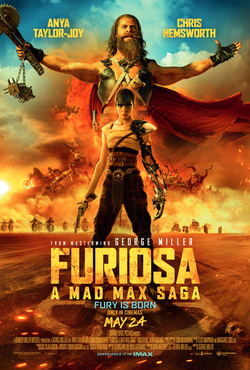
Behind the film
- Year
- 2024
- Director
- George Miller
- Writers
- George Miller, Nico Lathouris
- Runtime
- 2h 28m
- Genres
- Action, Post-apocalyptic, Adventure, Dystopian
- Production
- Kennedy Miller Mitchell, Village Roadshow Pictures
- Country
- Australia, United States
- Cast
- Anya Taylor-Joy, Chris Hemsworth, Tom Burke, Nathan Jones, Angus Sampson, Daniel Webber, Lachy Hulme, John Howard
About the film
Contains story spoilers.
Furiosa: A Mad Max Saga looks back to the life of the young woman Charlize Theron played in Mad Max: Fury Road. In this film, Alyla Browne plays Furiosa as a child and Anya Taylor-Joy takes over as she grows older. The story begins before the events of Fury Road and follows her through years of captivity, labour and conflict in the Wasteland. It is a prequel in the films’ chronology, although it was released later; the timeline in the larger Mad Max series has never been laid out as a strict historical record. The film’s focus is a specific journey through this harsh world, not a definitive account of how every earlier film fits together.
Furiosa is taken from the Green Place of Many Mothers, a hidden oasis whose inhabitants have preserved water, plants and a way of life outside the major warlords’ reach. Her abduction breaks that fragile refuge open to the wider Wasteland. Dementus leads the biker horde that carries her away, and his followers move between settlements built around controlling scarce goods. At the Citadel, Immortan Joe has turned water and food into instruments of rule. Furiosa grows up between these powers, learning that strength means more than surviving a fight: it means keeping a plan and a sense of self when other people believe they own her future.
Dementus and Joe govern differently, but each builds authority around spectacle, violence and possession. Dementus performs the part of a charismatic conqueror, and his riders follow him through raids and negotiations that can turn in an instant. Joe’s Citadel is more organised, with a hierarchy of War Boys, workers and women whose lives are controlled by the ruler. Their rivalry is about land, fuel and supply routes as much as pride. Furiosa becomes caught between them because she knows the Citadel’s routines and has the resourcefulness to survive outside them. The film makes the contrast visible in the vehicles and strongholds: a mobile biker horde against an established fortress that has turned scarcity into a system.
As Furiosa gets older, she hides her identity and adapts to the work demanded of her. A chance to leave the Citadel arises when she meets Praetorian Jack, a skilled driver responsible for the War Rig. Their relationship begins through discipline and shared danger rather than instant trust. Jack recognises that Furiosa can learn the routes and machinery, while she sees a possible path beyond the role Joe’s court has assigned her. She studies the vehicle and the Wasteland’s rhythms, building the knowledge that later makes her an effective Imperator. This period matters because her strength is not presented as something she simply possessed from childhood; she earns it through observation, practice and the hard lessons of a hostile world.
Furiosa and Jack plan to escape together, but a supply run into the Bullet Farm takes them into Dementus's ambush. He has seized the stronghold, turning a familiar route into a trap. Their flight ends with Jack killed and Furiosa chained by her injured left arm. She gets away at the cost of that arm and returns to the Citadel, where the warlords' conflict is moving toward open war. The loss gives the mechanical limb seen in Fury Road a brutal history. It also makes Jack's training inseparable from grief: the skills that keep Furiosa alive now belong to a future they will never share.
Furiosa’s revenge against Dementus is personal, but it does not restore the Green Place or bring back the people she has lost. She takes control of the ending of their conflict and returns to the Citadel, where the story meets the ground prepared for Fury Road. The closing movement links the two films through the figure of Furiosa rather than through Max, who is not the central character here. That connection explains some of the history behind her position as an Imperator while leaving her later alliance with Max to the 2015 film. Keeping the stories in their correct order matters: the prequel shows how she reached a point of hardened resolve, while Fury Road follows what she chooses to do with it.
George Miller and cinematographer Simon Duggan give this chapter a different sense of scale from Fury Road. The story spans years, and the action has room to register as a series of episodes within a life rather than one uninterrupted convoy run. The film shifts between distant terrain, crowded settlements and moving vehicles, giving the Wasteland a wider social map. Complex vehicle sequences combine physical action with digital imagery and carefully planned movement. Those tools support the exaggerated world while keeping the main physical problem clear: people and machines must cross a landscape where shelter, water and safe passage are never guaranteed.
By the time Furiosa reaches the point where Fury Road begins, the character’s silence and skill have a history behind them. She has learned how to hide her intentions, read the powerful people around her and act when the opening appears. Her mechanical competence is linked to years of survival and to the time she spent working with Jack, while her drive to escape comes from the childhood home she has never stopped trying to recover. The ending does not present the Wasteland as healed or claim that personal vengeance can repair it. Instead, the film closes on the formation of a figure who can challenge Joe’s order from within it, setting the conditions for the next story without retelling that story’s pursuit.