
Behind the film
- Year
- 1987
- Director
- Stanley Kubrick
- Writers
- Stanley Kubrick, Michael Herr, Gustav Hasford
- Runtime
- 1h 56m
- Genres
- War, Drama
- Production
- Warner Bros. Entertainment, Hawk Films, Natant
- Country
- United Kingdom, United States
- Cast
- Matthew Modine, Vincent D’Onofrio, R. Lee Ermey, Adam Baldwin, Arliss Howard, Dorian Harewood, Kevyn Major Howard, Ngoc Le
About the film
Contains story spoilers.
Full Metal Jacket begins by making its recruits resemble one another before asking us to recognise them as individuals. Hair falls away, beds form lines and Gunnery Sergeant Hartman supplies names that replace the men’s own. His voice dominates the barracks, defining competence and failure through humiliation as much as instruction. Stanley Kubrick gives those spaces an order that seems to contain every movement, so a recruit’s difficulty can immediately become a public event. The training promises to produce men capable of functioning together, but the film attends to what happens when that promise is enforced by turning vulnerability into something the group must punish.
Matthew Modine’s Joker uses humour to retain a degree of distance from the language surrounding him. Leonard Lawrence, renamed Pyle by Hartman, has less protection. Vincent D’Onofrio makes his confusion and effort visible in a body that repeatedly fails to meet the expected pace. Joker is assigned to help him, and those scenes give the barracks a temporary relationship that differs from the sergeant’s relentless performance. Hartman’s decision to punish everyone for Pyle’s mistakes changes that arrangement. The other recruits become agents of the discipline directed against him, making their need to escape collective punishment stronger than their sympathy for the person causing it.
Pyle improves as a marksman while his behaviour becomes increasingly disturbing. His attachment to the rifle gives competence a shape that the institution can praise even as the person holding it appears less able to remain within ordinary conversation. The final bathroom encounter exposes how little control the training has over the violence it has cultivated. Pyle kills Hartman and himself, leaving Joker as a witness rather than someone whose jokes or assistance can reverse what has happened. The room’s bright surfaces and rigid arrangement make the breakdown especially stark. The film moves beyond the camp without turning that sequence into a problem the military has successfully resolved.
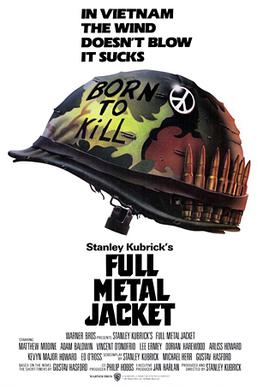
In Vietnam, Joker works for Stars and Stripes beside photographer Rafter Man, participating in a different kind of production. Events must become reports that fit expectations about the war, and the office’s instructions reveal a gap between what a correspondent might observe and what an institution wants him to write. Joker’s helmet and peace symbol carry contradictory messages that he tries to explain when challenged. His language still lets him appear reflective, but he remains part of the organisation conducting the fighting. The Tet Offensive brings the war close to the base and moves him toward the infantry, where observation can no longer depend on staying beyond the danger.
Rejoining Cowboy’s squad gives the second half a connection to the men seen in training without repeating the barracks’ controlled geometry. Ruined buildings and open streets offer uncertain protection, and the soldiers’ talk turns fear, hostility and experience into performances of their own. Animal Mother’s aggression supplies one response to the environment; Joker’s wit supplies another. Interviews with the men let each present a version of himself for the camera, briefly making combatants into people managing how they will be seen. Their confidence does not create a shared interpretation of the war. It creates a set of voices trying to remain convincing inside circumstances that can invalidate them without warning.
The movement through Huế gives those circumstances a cruel practical form. A sniper can hold a stretch of ground without being visible, using injured men to draw others into danger. Attempts to help become vulnerable to the same fire that caused the injuries, and leadership changes as the squad loses people. Kubrick lets distance matter: the men can see where a companion has fallen without possessing a safe route to reach him. The urban landscape frustrates the expectation that strength and preparation will translate directly into control. Acting decisively may be necessary, but hesitation can also be an acknowledgement of something the men cannot yet understand from their position.
Finding the sniper changes the scale of the threat again. She is a young woman rather than the impersonal source of fire the squad has been trying to locate. Rafter Man wounds her after Joker’s rifle fails, and the men must decide whether to leave her suffering or kill her. Joker ultimately shoots her, accepting an action his earlier position as commentator could keep at a verbal distance. The encounter does not erase her role in the squad’s losses, but it gives the decision a human presence that cannot be reduced to a distant target. His survival now includes something he has done, alongside everything he has seen happen to others.
The Marines’ march through the burning night is accompanied by a song associated with childhood entertainment, making the closing movement unsettling in a way a triumphant military theme would not be. Joker’s final thoughts concentrate on being alive and getting through his remaining service, leaving the larger meaning unresolved. The two halves of the film connect the ordered process of making soldiers to the disorder in which they must operate, without supplying a simple one-to-one explanation for every death. Its fictional characters inhabit the historical Vietnam War, while its precise images and competing voices make institutional confidence, personal identity and immediate survival difficult to separate. The man who could joke about those contradictions has reached a place where speaking about them offers little shelter.