
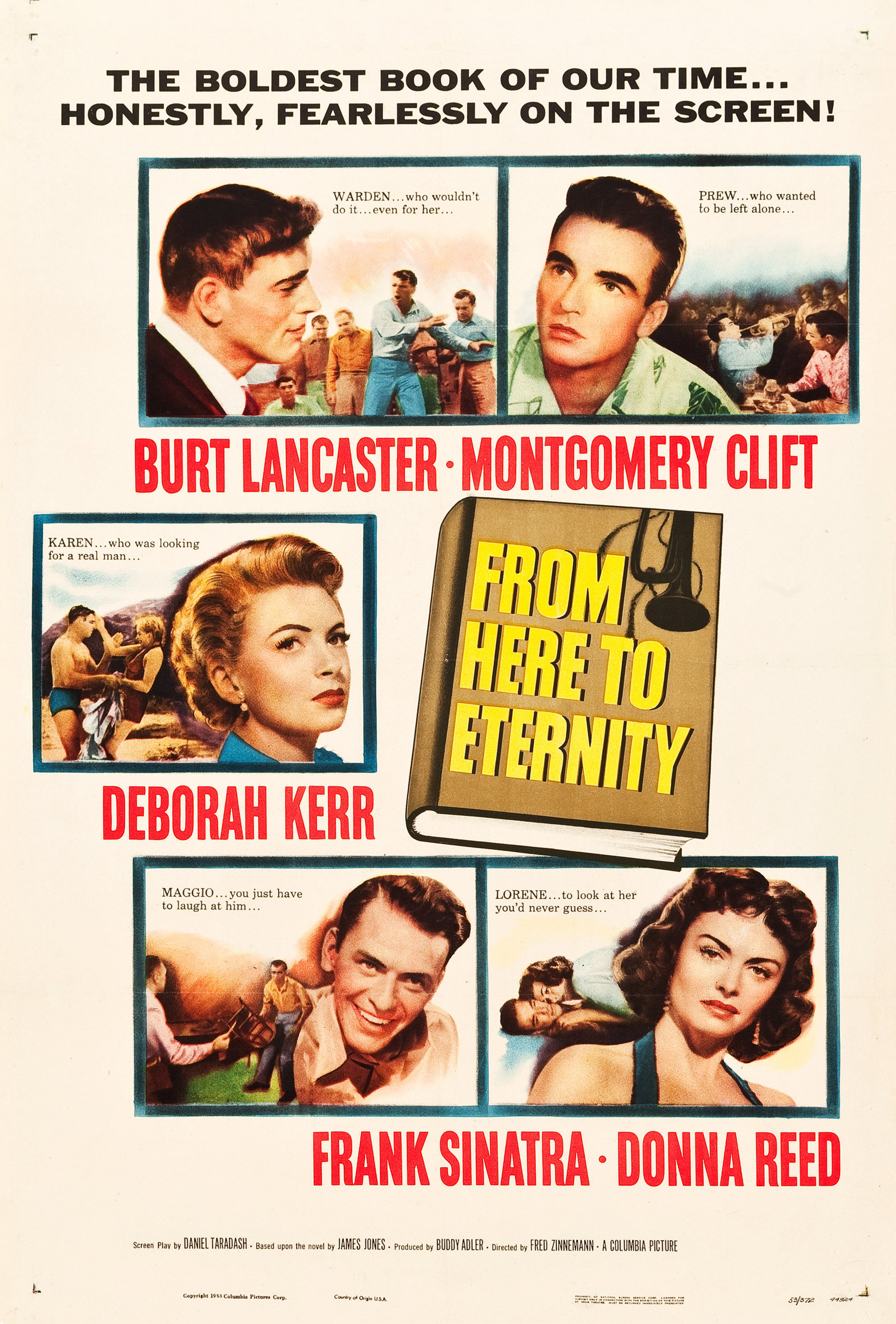
Behind the film
- Year
- 1953
- Director
- Fred Zinnemann
- Writers
- Daniel Taradash
- Genres
- Romance, War, Drama
- Production
- Columbia Pictures
- Country
- United States
- Cast
- Burt Lancaster, Montgomery Clift, Deborah Kerr, Frank Sinatra, Donna Reed, Ernest Borgnine, Philip Ober, Jack Warden
About the film
Contains story spoilers.
Set in Hawaii in 1941, the film follows men who live inside a strict military hierarchy while the world beyond their barracks is moving toward war. Robert E. Lee Prewitt arrives at Schofield Barracks as a bugler and skilled former boxer. Captain Holmes wants him on the company team, but Prewitt refuses because he once blinded a sparring partner. The refusal turns an ordinary posting into a campaign of pressure: Holmes expects obedience, while Prewitt regards his choice as the one boundary he can still defend.
First Sergeant Milton Warden is ordered to make Prewitt’s life difficult and tries to balance the captain’s demand against what he sees as unfair treatment. Prewitt’s closest support comes from Angelo Maggio, a quick-tempered friend who clashes with stockade sergeant James “Fatso” Judson. At the New Congress club, Prewitt meets Lorene, whose real name is Alma; she hopes to save enough money to return to the mainland and marry. The two are drawn together, but each has built a future that may not include the other.
The film gives Warden a second conflict away from command. He begins an affair with Karen Holmes, the captain’s wife, whose marriage has been damaged by her husband’s drinking and infidelity. Karen imagines that Warden might become an officer, allowing her to leave Holmes and build a life with him. Warden’s reluctance to pursue a commission exposes a mismatch between what she needs and what he is willing to promise. The affair is dangerous not only because of military rules, but because neither can turn a private arrangement into a stable future.
Maggio’s dispute with Judson becomes more serious when he walks away from guard duty and is sent to the stockade, where Judson abuses him. He escapes after a beating and dies with Prewitt beside him. Prewitt then confronts Judson in a knife fight and kills him, but is badly wounded. Warden covers for him while he recuperates with Lorene. At the same time, a regimental inquiry exposes Holmes’s misconduct; the captain resigns rather than face court-martial, and his replacement ends promotions through boxing. The company’s rules have changed, but Prewitt and Maggio have already paid for them.
The story’s final turn arrives with the Japanese attack on Pearl Harbor on December 7. Warden takes command as the base comes under attack. Prewitt, despite Lorene’s plea that he stay hidden, tries to return to his unit and is shot by military police when he refuses to halt. The film does not frame his death as a triumphant reconciliation: it is a cruel result of the discipline and choices that have shaped his life. Warden identifies him as a hardhead but a good soldier, a judgment that is both affectionate and insufficient.
Days later, Karen and Lorene find themselves aboard a ship leaving Hawaii. Lorene tells Karen that she will not return because her “fiancé,” whom she names as Prewitt, died in the attack and received a medal. Karen recognizes the name from Warden’s stories but lets the fiction stand. Their brief exchange closes the film on an uneasy contrast: the war has made a lie useful to one woman and left another with a truth she cannot share. The famous beachside kiss between Warden and Karen is part of the film’s visual memory, but the narrative is just as interested in what its characters conceal.
Fred Zinnemann’s adaptation concentrates a sprawling military world into a few intersecting relationships and recurring spaces: the parade ground, barracks, stockade, club, and shore. The sharp shift between public order and private life lets a captain’s authority feel present even when he is absent. Burt Lancaster’s Warden appears physically self-assured yet hesitant about the future; Montgomery Clift gives Prewitt a reserve that makes his refusal feel principled rather than performative. Frank Sinatra’s Maggio brings restless energy to the friendship, while Donna Reed and Deborah Kerr give Alma and Karen ambitions that extend beyond being love interests.
Prewitt’s ability as a bugler gives his grief a sound distinct from the boxing that Holmes wants to exploit. After Maggio’s death, the instrument allows him to express something that his guarded speech does not easily reveal. Clift’s stillness also differs from Lancaster’s expansive physical presence: Warden can negotiate and intervene within the company, while Prewitt repeatedly holds to a position even when it exposes him to further punishment. Ernest Borgnine makes Judson’s abuse seem deliberately personal beneath the authority of his job. The romantic scenes provide another register, particularly when Karen tells Warden what happened during her marriage and why a different future matters to her. Daniel Taradash’s screenplay, adapted from James Jones’s novel, brings those conversations into contact with duties the men are unwilling to abandon. Alma wants the security of life away from the club, whereas Prewitt understands remaining a soldier as part of who he is. The beach gives Karen and Warden physical intimacy without resolving the conditions for staying together. These moments make the ending more than a change from peace to war: each survivor carries an interrupted relationship whose difficulties existed before the attack.