
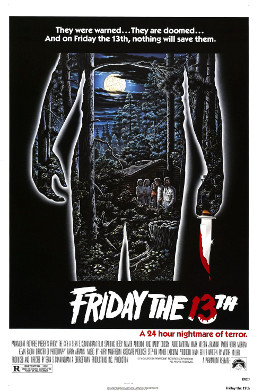
Behind the film
- Year
- 1980
- Director
- Sean S. Cunningham
- Writers
- Victor Miller
- Genres
- Slasher, Horror, Crime, Teen
- Production
- Georgetown Productions, Sean S. Cunningham Films
- Country
- United States
- Cast
- Adrienne King, Betsy Palmer, Kevin Bacon, Harry Crosby, Laurie Bartram, Robbi Morgan, Mark Nelson, Jeannine Taylor
About the film
Contains story spoilers.
Friday the 13th makes preparation for a pleasant summer into the setting for an unseen attack. Camp Crystal Lake is meant to become a place where other people can arrive and feel safe, but the people doing the preparatory work are increasingly unsafe themselves. That reversal gives the camp a useful horror geography. Familiar facilities and routine tasks do not disappear; they become parts of an environment whose apparent purpose no longer explains what is happening inside it. The film asks its characters to discover the change after the audience already knows that the promise of an ordinary camp has been broken.
Sean S. Cunningham directs the 1980 film, with Victor Miller credited for its screenplay. Adrienne King plays Alice and Betsy Palmer plays Mrs Voorhees, while Kevin Bacon appears among the young counsellors. This is the original film, and describing it accurately requires separating its particular mystery from the later franchise's best-known iconography. The events are not organised around an adult Jason in a hockey mask. Recognition of that later image can obscure what this first story is actually asking the audience to discover. Its immediate threat remains unidentified for much of the narrative, making the revelation part of its construction.
The camp's reopening follows earlier deaths and the drowning of a boy. As the counsellors disappear, Alice discovers that Mrs Voorhees has been killing them in revenge for her son Jason's death, which she blames on negligent supervision. Alice defeats her and retreats onto the lake. A startling apparent attack by the boy is followed by Alice waking in hospital, where police report finding no child. The ending leaves the final image unresolved rather than proving every later development of the franchise. Alice survives the immediate confrontation but does not receive a fully reassuring account of what she experienced.
The absence of the killer's identity directs attention towards spaces rather than explanations. A path, a cabin or a shared facility can become threatening because somebody might be nearby without being recognised. The camp is therefore more than a remote backdrop. It offers routes that separate people while still making them believe they are within an ordinary collective arrangement. Isolation can happen inside a group, especially when nobody yet knows that a missing person should be understood as a warning. The horror depends partly on the interval between absence and recognition, when familiar explanations remain available for something that has already become dangerous.
The older history gives that danger a motive without supplying a moral defence. Mrs Voorhees understands the new arrivals through a grievance they did not create. Her account collapses the difference between the people she blames for an earlier loss and the people currently occupying the camp. That is a central cruelty of the revenge premise. A place can carry a history, but new people entering it are not automatically responsible for everything that happened there. The film's revelation turns the supposed curse into an individual willingness to make that distinction disappear, directing violence at people who fit the avenger's chosen category.
The counsellors' ordinary activities become vulnerable to a familiar moralising interpretation, but the story need not be reduced to a rule that particular behaviour deserves punishment. Such a reading would adopt the killer's framework too readily. The more useful distinction is between a person's choices and another person's decision to use those choices as an excuse for harm. The slasher structure arranges danger around moments of separation and distraction. That arrangement creates suspense; it does not establish a just relationship between the victim's behaviour and what follows. Alice's survival is a narrative outcome, not proof that every other character earned their fate.
Alice's final confrontation changes the kind of uncertainty she must face. A hidden threat becomes a person, and immediate survival becomes possible through resisting that person. Yet identifying an attacker does not automatically restore a setting to safety in the survivor's imagination. The lake's last disturbance extends fear beyond the point at which the physical confrontation seemed complete. The film can therefore give an answer to its central murder mystery while withholding the emotional reassurance that an answer might ordinarily provide. Knowing who committed the attacks is not necessarily the same as feeling able to trust the world again.
The original Friday the 13th is best understood through that combination of mystery and physical vulnerability. Its camp supplies the routines that the violence disrupts, its revelation supplies a human motive, and its ending keeps the apparent resolution from becoming entirely comfortable. Later films take the mythology in other directions, but those developments should not be read backwards as a replacement for this story. Here, the unsettling movement is from a place readying itself to welcome people to a place whose past has been made lethally active, followed by a survivor who cannot quite put that past back where it belongs.