
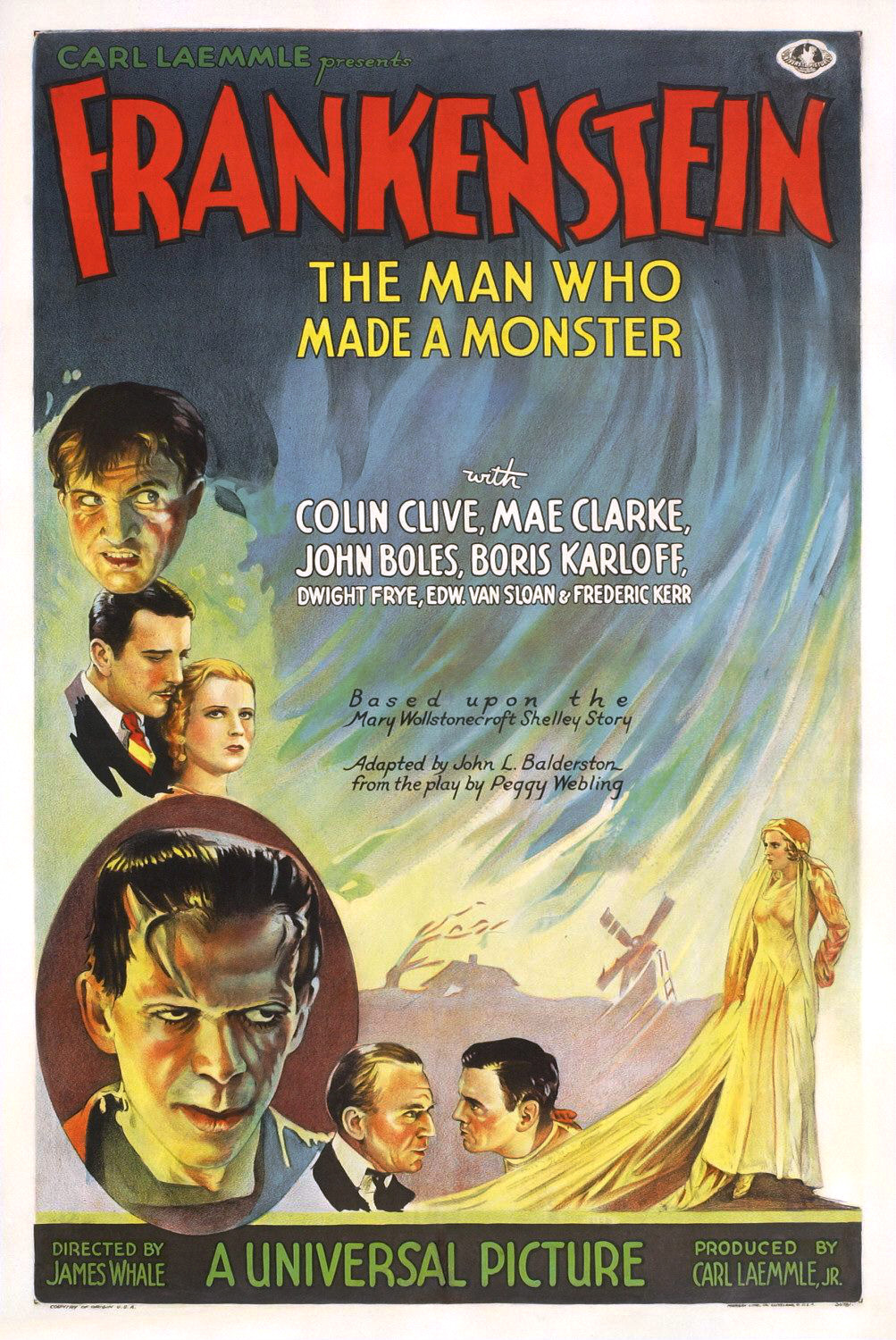
Behind the film
- Year
- 1931
- Director
- James Whale
- Writers
- Garrett Fort, Francis Edwards Faragoh
- Genres
- Horror, Science fiction, Monster
- Production
- Universal Pictures
- Country
- United States
- Cast
- Colin Clive, Mae Clarke, John Boles, Boris Karloff, Edward Van Sloan, Dwight Frye, Lionel Belmore, Frederick Kerr
About the film
Contains story spoilers.
Henry Frankenstein works in secret to assemble a body and animate it, assisted by Fritz. The creature awakens with a childlike vulnerability that Henry and Fritz fail to understand. After Fritz torments it, the creature kills him and escapes. It later encounters Maria, whose play with flowers ends in tragedy when the creature accidentally drowns her. Villagers turn against Henry, and a search party pursues the monster to a windmill. Henry is injured; the windmill burns with the creature inside, and the film closes with Henry alive at his wedding celebration. This is Universal’s 1931 Frankenstein, not its later sequel Bride of Frankenstein. This opening mismatch establishes the film’s central anxiety before the creature can be judged by the harm he later causes.
The film’s horror begins with a failure of recognition. Henry believes the experiment’s success can be measured by animation, while the audience sees a being unable to interpret the fear and violence surrounding it. The creature is frightening, but it is also repeatedly treated as an object before it can become a person in the eyes of others. This gap between scientific achievement and moral responsibility gives the story much of its lasting force. The question is not simply whether life can be created; it is what obligations begin once a creator has made something vulnerable and then recoils from it. The sets make scientific work look at once mechanical and sacramental, blurring invention with forbidden ceremony.
James Whale’s direction balances theatrical composition with movement that makes the laboratory feel unstable. Levers, electrical equipment and raised platforms turn scientific procedure into a staged ritual, while shadows and abrupt gestures keep the room from seeming controlled. The famous laboratory imagery is memorable because it presents invention as spectacle with visible danger. Yet the film does not linger over a rational explanation of the science. Its machinery functions as gothic iconography: a set of visual signals that let ambition feel transgressive before the consequences arrive. The film relies on visual tension instead of technical explanation, letting atmosphere carry the weight of impossible events.
Boris Karloff’s performance gives the creature a physical vocabulary built from hesitant movements, fixed attention and sudden force. The makeup makes him instantly recognizable as a monster, but the performance complicates that label by showing a being responding to immediate treatment rather than acting from a settled plan. Colin Clive’s Henry provides the opposite energy: nervous intensity turns scientific ambition into a personal obsession. Their contrast shapes the tragedy. Henry wants authorship over life without accepting the emotional labor of care; the creature’s gestures expose that responsibility even when no one in the story can articulate it. Karloff’s controlled stillness makes brief movement startling, a contrast that complicates the creature’s imposing appearance.
The film’s episode with Maria is central to its moral ambiguity. The creature approaches her without understanding the social meaning of its own strength, and their brief play ends in irreversible harm. The scene does not make the death harmless or erase the creature’s responsibility, but it makes intention and consequence diverge in a way that unsettles easy judgment. The villagers’ response then turns individual fear into collective violence. The chase becomes a story about how quickly a community settles on destruction when it cannot understand what it sees, even as the creature’s own actions give that fear real grounds. The scene asks audiences to hold sympathy and accountability together rather than selecting one simple response.
The mob and burning windmill deliver a forceful climax but leave the film’s moral questions unresolved. The creature is apparently destroyed, Henry survives, and the wedding feast restores a social order that has no place for the abandoned being. The closing toast can be read as relief, yet it also feels precarious because the audience has watched the cost of Henry’s experiment move beyond the laboratory. The film’s ending is not a formal judgment on the creator or a complete resolution of the legend. Its unsettling power lies in the return to celebration while responsibility remains unspoken. The final celebration restores social routine, but the absence of the creature makes that restoration ethically uneasy.
As a 1931 studio horror film, Frankenstein established images that became culturally durable, but its influence can obscure its specificity. It is a compact, expressionistic work about creation, fear and failed care, built through performance and design rather than an attempt to reproduce Mary Shelley’s novel scene for scene. Later adaptations and sequels developed different emphases; Bride of Frankenstein is a separate film. Keeping those works distinct helps viewers see how much the first film achieves through omission and suggestion. Its monster is memorable not only because of appearance, but because the story refuses to make creation itself a sufficient moral achievement. Its compact form leaves questions open, which is one reason the film continues to invite reinterpretation across generations.